2.10
Centripetal Force
Chapter contents: Chapter 2: Dynamics
Any force or combination of forces can cause a centripetal or radial acceleration. Just a few examples are the tension in the rope on a tether ball, the force of Earth’s gravity on the Moon, friction between roller skates and a rink floor, a banked roadway’s force on a car, and forces on the tube of a spinning centrifuge.
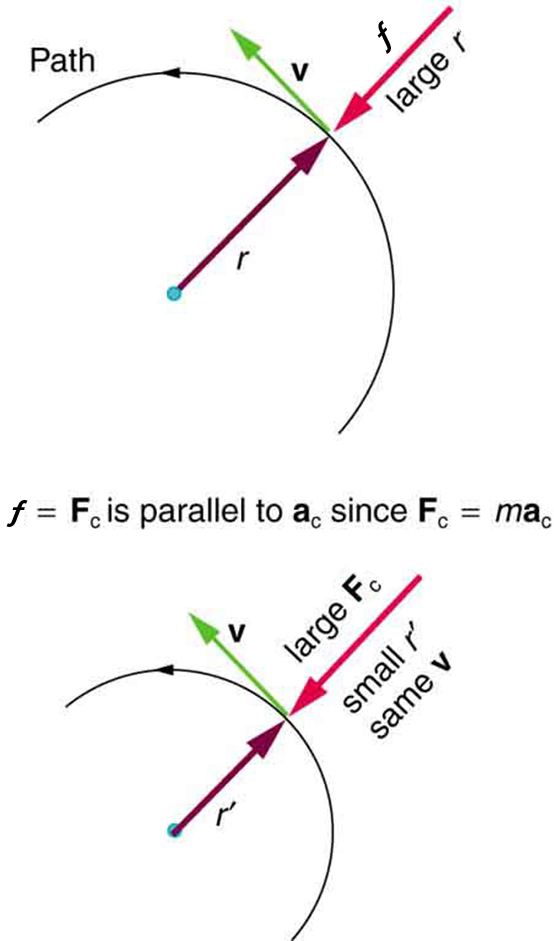
Any net force causing uniform circular motion is called a centripetal force. The direction of a centripetal force is toward the center of curvature, the same as the direction of centripetal acceleration. According to Newton’s second law of motion, net force is mass times acceleration: . For uniform circular motion, the acceleration is the centripetal acceleration— . Thus, the magnitude of centripetal force is
By using the expressions for centripetal acceleration from , we get an expression for the centripetal force in terms of mass, velocity, and radius of curvature:
Note that if you solve the first expression for , you get
(2.10.3)
This implies that for a given mass and velocity, a large centripetal force causes a small radius of curvature—that is, a tight curve.
Example 2.10.1
What Coefficient of Friction Do Car Tires Need on a Flat Curve?
(a) Calculate the centripetal force exerted on a 900 kg car that negotiates a 500 m radius curve at 25.0 m/s.
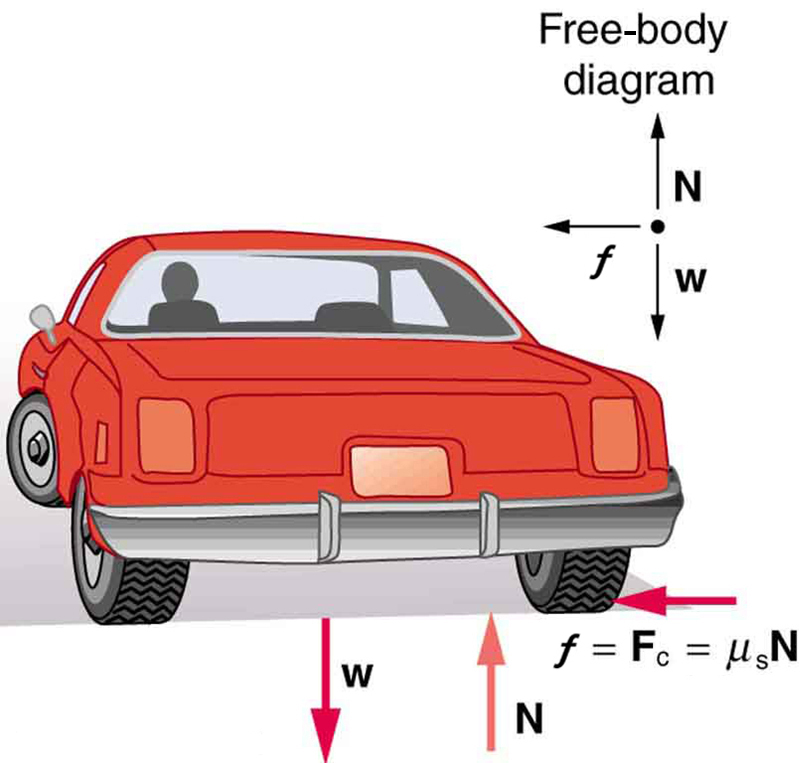
(b) Assuming an unbanked curve, find the minimum static coefficient of friction, between the tires and the road, static friction being the reason that keeps the car from slipping (see Figure 2.10.2).
Strategy and Solution for (a)
We know that
. Thus,
(2.10.4)
Strategy for (b)
Figure 2.10.2 shows the forces acting on the car on an unbanked (level ground) curve. Friction is to the left, keeping the car from slipping, and because it is the only horizontal force acting on the car, the friction is the centripetal force in this case. We know that the maximum static friction (at which the tires roll but do not slip) is , where is the static coefficient of friction and is the normal force. The normal force equals the car’s weight on level ground, so that
. Thus the centripetal force in this situation is
(2.10.5)
Now we have a relationship between centripetal force and the coefficient of friction. Using the expression for
(2.10.7)
We solve this for , noting that mass cancels, and obtain
(2.10.8)
Solution for (b)
Substituting the knowns,
(2.10.9)
(Because coefficients of friction are approximate, the answer is given to only two digits.)
Discussion
The coefficient of friction found in part (b) is much smaller than is typically found between tires and roads. The car will still negotiate the curve if the coefficient is greater than 0.13, because static friction is a responsive force, being able to assume a value less than but no more than . A higher coefficient would also allow the car to negotiate the curve at a higher speed, but if the coefficient of friction is less, the safe speed would be less than 25 m/s. Note that mass cancels, implying that in this example, it does not matter how heavily loaded the car is to negotiate the turn. Mass cancels because friction is assumed proportional to the normal force, which in turn is proportional to mass. If the surface of the road were banked, the normal force would be less as will be discussed below.
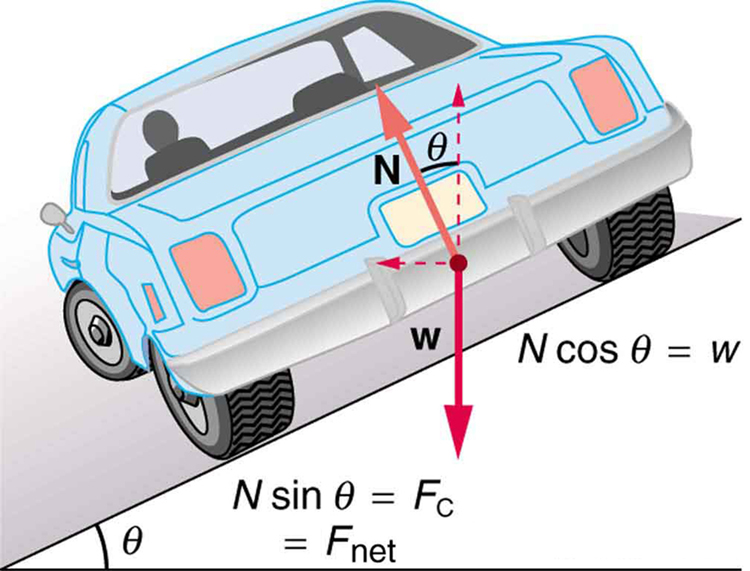
In the case of banked curves, where the slope of the road helps you negotiate the curve, some or all of the necessary centripetal force is provided by the normal force. See Figure 2.10.3. The greater the angle , the faster you can take the curve. Race tracks for bikes as well as cars, for example, often have steeply banked curves. In an “ideally banked curve,” the angle is such that you can negotiate the curve at a certain speed without the aid of friction between the tires and the road. Conceptually, for ideal banking, the net external force equals the horizontal centripetal force in the absence of friction. The components of the normal force in the horizontal and vertical directions must equal the centripetal force and the weight of the car, respectively.
Figure 2.10.3 shows a free body diagram for a car on a frictionless banked curve. If the angle is ideal for the speed and radius, then the net external force will equal the necessary centripetal force. The only two external forces acting on the car are its weight and the normal force of the road . (A frictionless surface can only exert a force perpendicular to the surface—that is, a normal force.) These two forces must add to give a net external force that is horizontal toward the center of curvature and has magnitude . We omit detailed calculations, which require trigonometry.
Section Summary
- Centripetal force is any force causing uniform circular motion. It is a “center-seeking” force that always points toward the center of rotation. It is perpendicular to linear velocity and has magnitude
(2.10.10)which can also be expressed as(2.10.11)
Conceptual Questions
Exercise 32
If you wish to reduce the stress (which is related to centripetal force) on high-speed tires, would you use large- or small-diameter tires? Explain.
Exercise 33
Define centripetal force. Can any type of force (for example, tension, gravitational force, friction, and so on) be a centripetal force? Can any combination of forces be a centripetal force?
Exercise 34
If centripetal force is directed toward the center, why do you feel that you are ‘thrown’ away from the center as a car goes around a curve? Explain.
Exercise 35
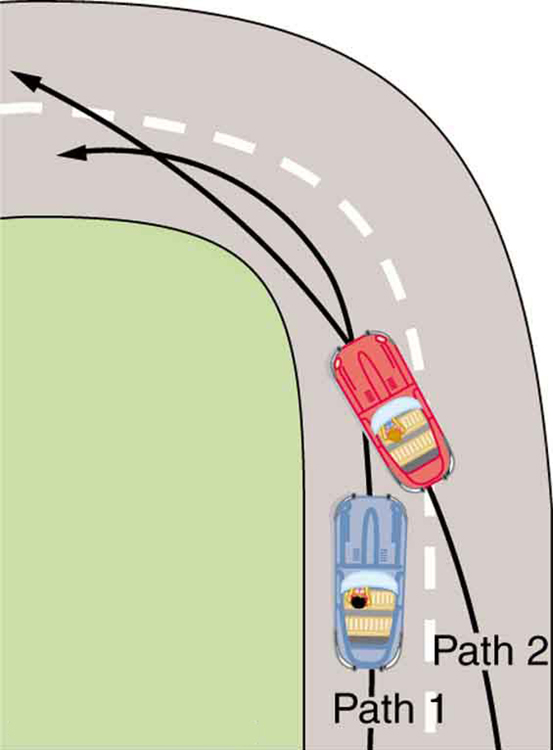
Race car drivers routinely cut corners as shown in Figure 2.E.1. Explain how this allows the curve to be taken at the greatest speed.
Exercise 36
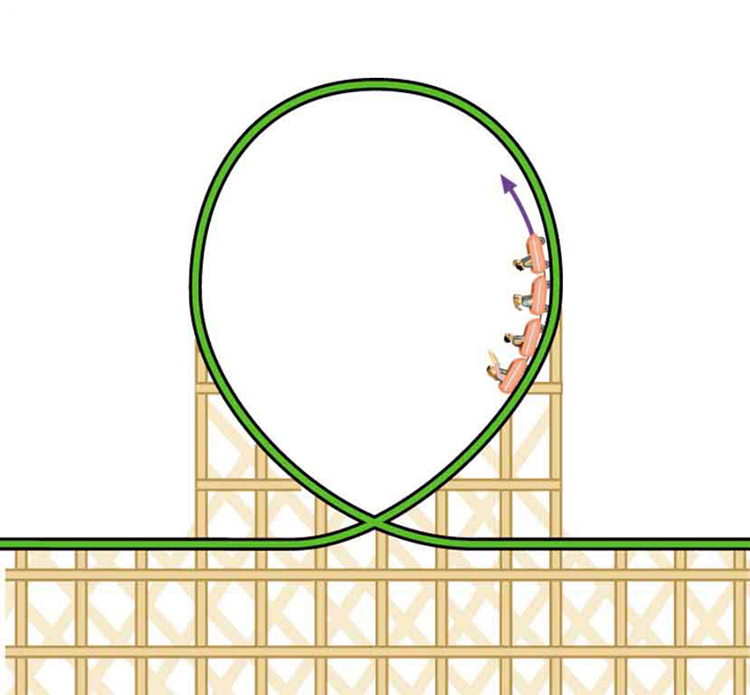
A number of amusement parks have rides that make vertical loops like the one shown in Figure 2.E.2. For safety, the cars are attached to the rails in such a way that they cannot fall off. If the car goes over the top at just the right speed, gravity alone will supply the centripetal force. What other force acts and what is its direction if:
(a) The car goes over the top at faster than this speed?
(b)The car goes over the top at slower than this speed?
Exercise 37
What is the direction of the force exerted by the car on the passenger as the car goes over the top of the amusement ride pictured in Figure 2.E.2 under the following circumstances:
(a) The car goes over the top at such a speed that the gravitational force is the only force acting?
(b) The car goes over the top faster than this speed?
(c) The car goes over the top slower than this speed?
Exercise 38
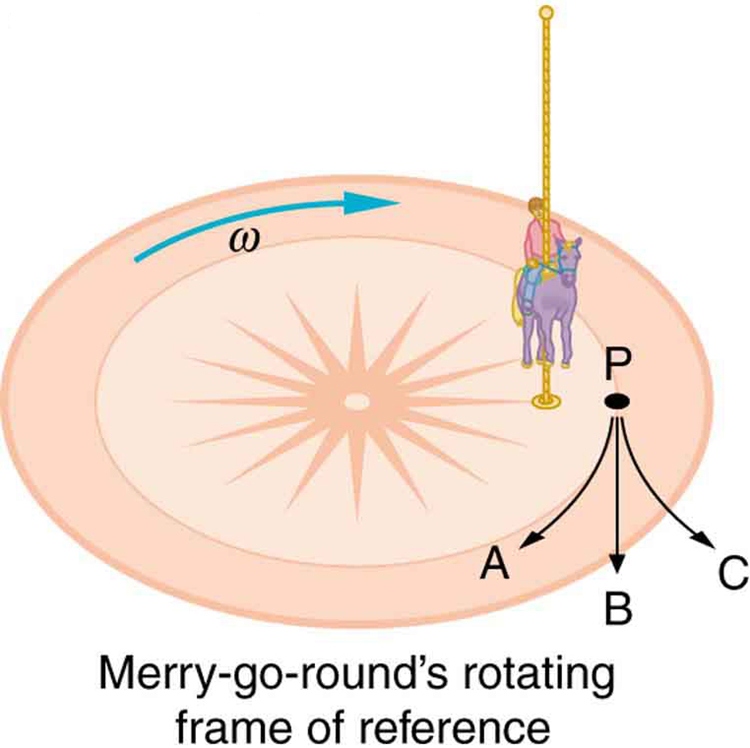
Suppose a child is riding on a merry-go-round at a distance about halfway between its center and edge. She has a lunch box resting on wax paper, so that there is very little friction between it and the merry-go-round. Which path shown in Figure 2.E.3 will the lunch box take when she lets go? The lunch box leaves a trail in the dust on the merry-go-round. Is that trail straight, curved to the left, or curved to the right? Explain your answer.
Exercise 39
Do you feel yourself thrown to either side when you negotiate a curve that is ideally banked for your car’s speed? What is the direction of the force exerted on you by the car seat?
Exercise 40
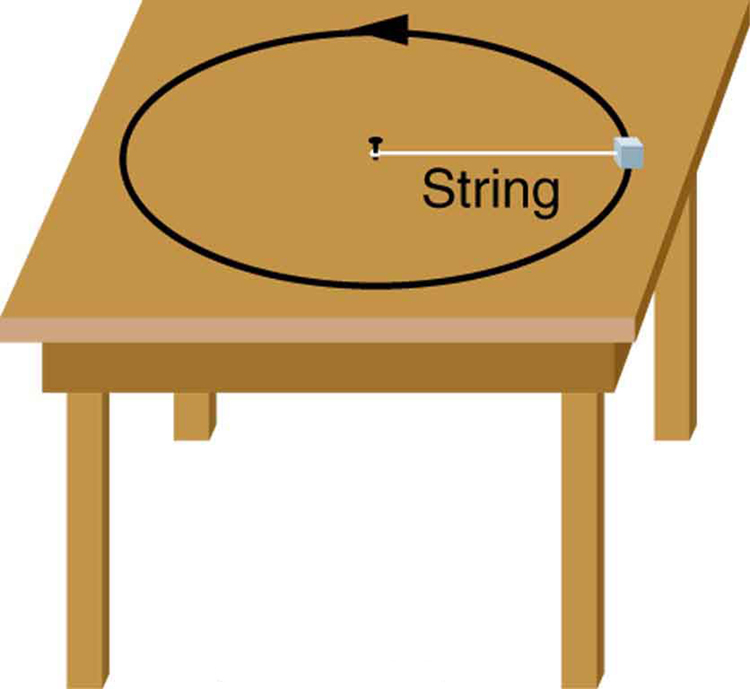
Suppose a mass is moving in a circular path on a frictionless table as shown in figure. In the Earth’s frame of reference, there is no centrifugal force pulling the mass away from the centre of rotation, yet there is a very real force stretching the string attaching the mass to the nail. Using concepts related to centripetal force and Newton’s third law, explain what force stretches the string, identifying its physical origin.
centripetal force
any net force causing uniform circular motion
ideal banking
the sloping of a curve in a road, where the angle of the slope allows the vehicle to negotiate the curve at a certain speed without the aid of friction between the tires and the road; the net external force on the vehicle equals the horizontal centripetal force in the absence of friction
banked curve
the curve in a road that is sloping in a manner that helps a vehicle negotiate the curve