9.10
Electric Power and Energy
Chapter contents: Chapter 9: Electricity
Power in Electric Circuits
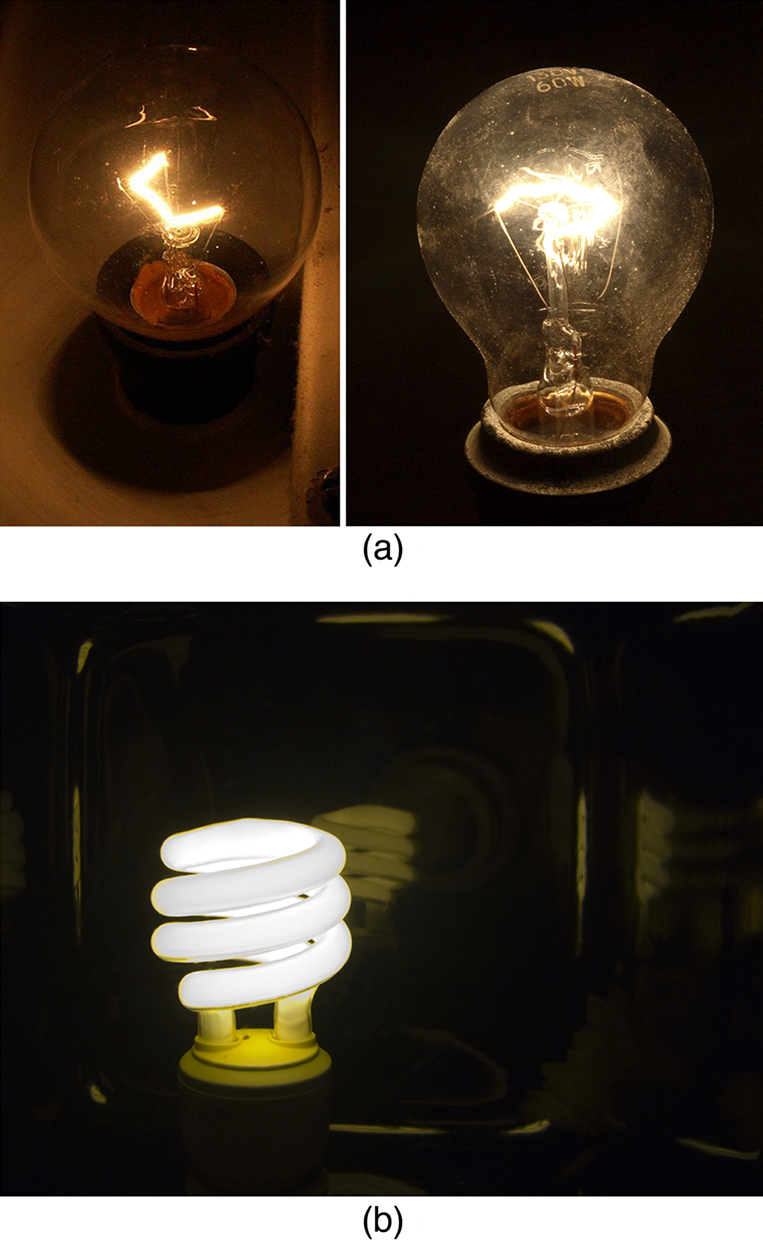
Power is associated by many people with electricity. Knowing that power is the rate of energy use or energy conversion, what is the expression for electric power? Power transmission lines might come to mind. We also think of lightbulbs in terms of their power ratings in watts. Let us compare a 25-W bulb with a 60-W bulb. (See Figure 9.10.1(a).) Since both operate on the same voltage, the 60-W bulb must draw more current to have a greater power rating. Thus the 60-W bulb’s resistance must be lower than that of a 25-W bulb. If we increase voltage, we also increase power. For example, when a 25-W bulb that is designed to operate on 120 V is connected to 240 V, it briefly glows very brightly and then burns out. Precisely how are voltage, current, and resistance related to electric power?
Electric energy depends on both the voltage involved and the charge moved. This is expressed most simply as , where is the charge moved and is the voltage (or more precisely, the potential difference the charge moves through). Power is the rate at which energy is moved, and so electric power is
(9.10.1)
Recognizing that current is (note that here), the expression for power becomes
(9.10.2)
Electric power ( ) is simply the product of current times voltage. Power has familiar units of watts. Since the SI unit for potential energy (PE) is the joule, power has units of joules per second, or watts. Thus, . For example, cars often have one or more auxiliary power outlets with which you can charge a cell phone or other electronic devices. These outlets may be rated at 20 A, so that the circuit can deliver a maximum power
. In some applications, electric power may be expressed as volt-amperes or even kilovolt-amperes (
).
To see the relationship of power to resistance, we combine Ohm’s law with . Substituting gives . Similarly, substituting gives . Three expressions for electric power are listed together here for convenience:
(9.10.5)
Note that the first equation is always valid, whereas the other two can be used only for resistors. In a simple circuit, with one voltage source and a single resistor, the power supplied by the voltage source and that dissipated by the resistor are identical. (In more complicated circuits, can be the power dissipated by a single device and not the total power in the circuit.)
Different insights can be gained from the three different expressions for electric power. For example, implies that the lower the resistance connected to a given voltage source, the greater the power delivered. Furthermore, since voltage is squared in , the effect of applying a higher voltage is perhaps greater than expected. Thus, when the voltage is doubled to a 25-W bulb, its power nearly quadruples to about 100 W, burning it out. If the bulb’s resistance remained constant, its power would be exactly 100 W, but at the higher temperature its resistance is higher, too.
Example 9.10.1
Calculating Power Dissipation and Current
Consider the example given in "Ohm’s Law: Resistance and Simple Circuits." Then find the power dissipated by the car headlight.
Strategy
For the headlight, we know voltage and current, so we can use to find the power.
Solution
Entering the known values of current and voltage for the hot headlight, we obtain
(9.10.6)
Discussion
The 30 W dissipated by the hot headlight is typical.
The Cost of Electricity
The more electric appliances you use and the longer they are left on, the higher your electric bill. This familiar fact is based on the relationship between energy and power. You pay for the energy used. Since , we see that
is the energy used by a device using power for a time interval . For example, the more lightbulbs burning, the greater used; the longer they are on, the greater is. The energy unit on electric bills is the kilowatt-hour (), consistent with the relationship . It is easy to estimate the cost of operating electric appliances if you have some idea of their power consumption rate in watts or kilowatts, the time they are on in hours, and the cost per kilowatt-hour for your electric utility. Kilowatt-hours, like all other specialized energy units such as food calories, can be converted to joules. You can prove to yourself that .
The electrical energy ( ) used can be reduced either by reducing the time of use or by reducing the power consumption of that appliance or fixture. This will not only reduce the cost, but it will also result in a reduced impact on the environment. Improvements to lighting are some of the fastest ways to reduce the electrical energy used in a home or business. About 20% of a home’s use of energy goes to lighting, while the number for commercial establishments is closer to 40%. Fluorescent lights are about four times more efficient than incandescent lights—this is true for both the long tubes and the compact fluorescent lights (CFL). (See Figure 9.10.1(b).) Thus, a 60-W incandescent bulb can be replaced by a 15-W CFL, which has the same brightness and color. CFLs have a bent tube inside a globe or a spiral-shaped tube, all connected to a standard screw-in base that fits standard incandescent light sockets. (Original problems with color, flicker, shape, and high initial investment for CFLs have been addressed in recent years.) The heat transfer from these CFLs is less, and they last up to 10 times longer. The significance of an investment in such bulbs is addressed in the next example. New white LED lights (which are clusters of small LED bulbs) are even more efficient (twice that of CFLs) and last 5 times longer than CFLs. However, their cost is still high.
Making Connections: Energy, Power, and Time
The relationship is one that you will find useful in many different contexts. The energy your body uses in exercise is related to the power level and duration of your activity, for example. The amount of heating by a power source is related to the power level and time it is applied. Even the radiation dose of an X-ray image is related to the power and time of exposure.
Example 9.10.2
Calculating the Cost Effectiveness of Compact Fluorescent Lights (CFL)
If the cost of electricity in your area is 12 cents per kWh, what is the total cost (capital plus operation) of using a 60-W incandescent bulb for 1000 hours (the lifetime of that bulb) if the bulb cost 25 cents? (b) If we replace this bulb with a compact fluorescent light that provides the same light output, but at one-quarter the wattage, and which costs $1.50 but lasts 10 times longer (10,000 hours), what will that total cost be?
Strategy
To find the operating cost, we first find the energy used in kilowatt-hours and then multiply by the cost per kilowatt-hour.
Solution for (a)
The energy used in kilowatt-hours is found by entering the power and time into the expression for energy:
(9.10.8)
In kilowatt-hours, this is
(9.10.9)
Now the electricity cost is
The total cost will be $7.20 for 1000 hours (about one-half year at 5 hours per day).
Solution for (b)
Since the CFL uses only 15 W and not 60 W, the electricity cost will be $7.20/4 = $1.80. The CFL will last 10 times longer than the incandescent, so that the investment cost will be 1/10 of the bulb cost for that time period of use, or 0.1($1.50) = $0.15. Therefore, the total cost will be $1.95 for 1000 hours.
Discussion
Therefore, it is much cheaper to use the CFLs, even though the initial investment is higher. The increased cost of labor that a business must include for replacing the incandescent bulbs more often has not been figured in here.
Making Connections: Take-Home Experiment—Electrical Energy Use Inventory
1) Make a list of the power ratings on a range of appliances in your home or room. Explain why something like a toaster has a higher rating than a digital clock. Estimate the energy consumed by these appliances in an average day (by estimating their time of use). Some appliances might only state the operating current. If the household voltage is 120 V, then use . 2) Check out the total wattage used in the rest rooms of your school’s floor or building. (You might need to assume the long fluorescent lights in use are rated at 32 W.) Suppose that the building was closed all weekend and that these lights were left on from 6 p.m. Friday until 8 a.m. Monday. What would this oversight cost? How about for an entire year of weekends?
Section Summary
- Electric power is the rate (in watts) that energy is supplied by a source or dissipated by a device.
- Three expressions for electrical power are
(9.10.11)(9.10.12)and(9.10.13)
- The energy used by a device with a power over a time is .
Conceptual Questions
Exercise 37
Why do incandescent lightbulbs grow dim late in their lives, particularly just before their filaments break?
Exercise 38
The power dissipated in a resistor is given by , which means power decreases if resistance increases. Yet this power is also given by , which means power increases if resistance increases. Explain why there is no contradiction here.
Problem Exercises
Exercise 118
What is the power of a
lightning bolt having a current of
?
Solution
Exercise 119
What power is supplied to the starter motor of a large truck that draws 250 A of current from a 24.0-V battery hookup?
Exercise 120
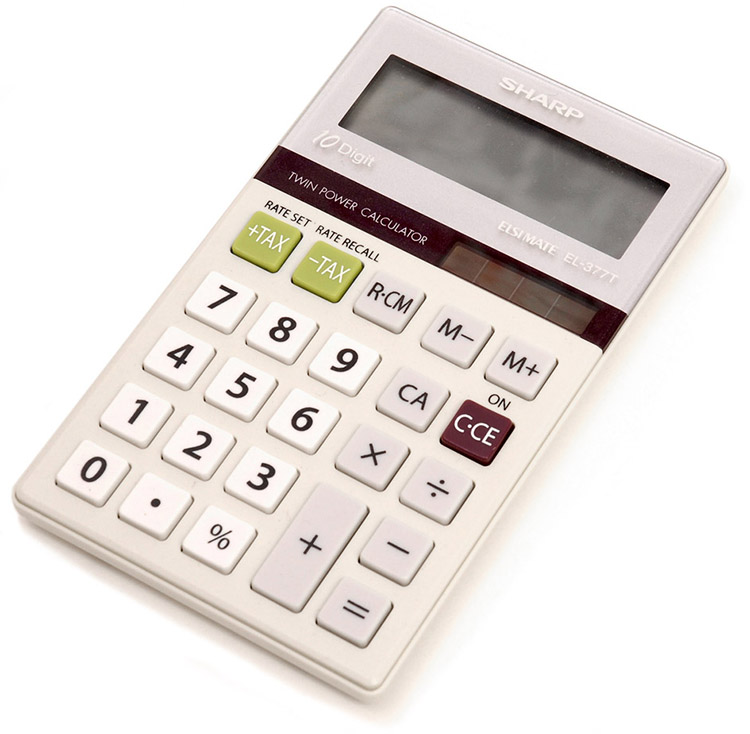
A charge of 4.00 C of charge passes through a pocket calculator’s solar cells in 4.00 h. What is the power output, given the calculator’s voltage output is 3.00 V? (See Figure 9.E.7.)
Exercise 121
How many watts does a flashlight that has
pass through it in 0.500 h use if its voltage is 3.00 V?
Exercise 122
Find the power dissipated in each of these extension cords: (a) an extension cord having a resistance and through which 5.00 A is flowing; (b) a cheaper cord utilizing thinner wire and with a resistance of
Solution
(a) 1.50 W
(b) 7.50 W
Exercise 123
Verify that the units of a volt-ampere are watts, as implied by the equation .
Exercise 124
Show that the units , as implied by the equation .
Solution
Exercise 125
Show that the units , as implied by the equation .
Exercise 126
Verify the energy unit equivalence that .
Solution
Exercise 127
Electrons in an X-ray tube are accelerated through
and directed toward a target to produce X-rays. Calculate the power of the electron beam in this tube if it has a current of 15.0 mA.
Exercise 128
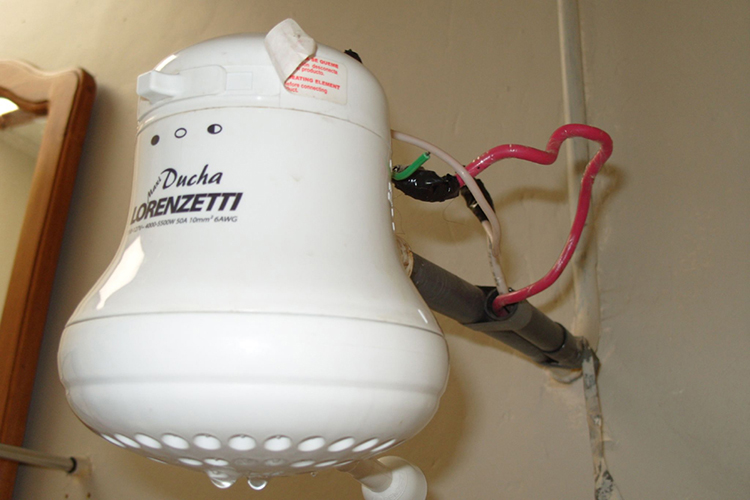
An electric water heater consumes 5.00 kW for 2.00 h per day. What is the cost of running it for one year if electricity costs ? See Figure 9.E.8.
Solution
$438/y
Exercise 129
With a 1200-W toaster, how much electrical energy is needed to make a slice of toast (cooking time = 1 minute)? At
,
how much does this cost?
Exercise 130
Some makes of older cars have 6.00-V electrical systems. (a) What is the hot resistance of a 30.0-W headlight in such a car? (b) What current flows through it?
Exercise 131
Alkaline batteries have the advantage of putting out constant voltage until very nearly the end of their life. How long will an alkaline battery rated at and 1.58 V keep a 1.00-W flashlight bulb burning?
Solution
1.58 h
Exercise 132
A cauterizer, used to stop bleeding in surgery, puts out 2.00 mA at 15.0 kV. (a) What is its power output? (b) What is the resistance of the path?
Exercise 133
The average television is said to be on 6 hours per day. Estimate the yearly cost of electricity to operate 100 million TVs, assuming their power consumption averages 150 W and the cost of electricity averages .
Solution
$3.94 billion/year
electric power
the rate at which electrical energy is supplied by a source or dissipated by a device; it is the product of current times voltage