14.10
Fission
Chapter contents: Chapter 14: Nuclear and Particle Physics
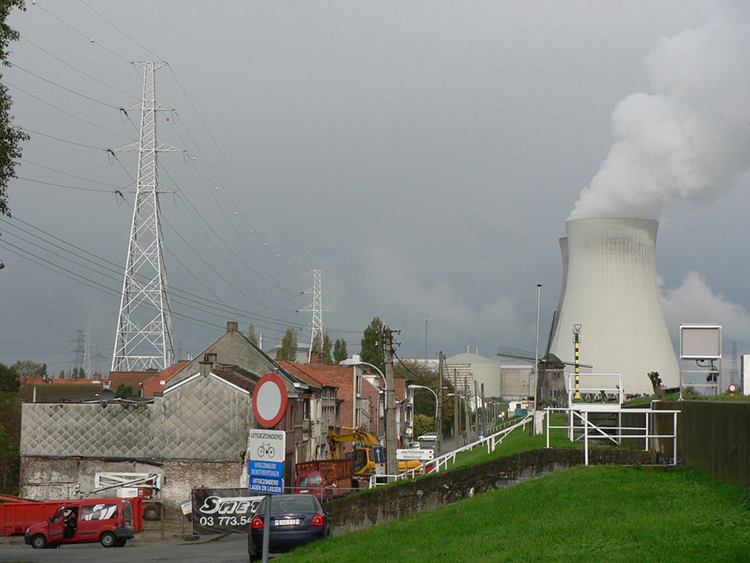
Nuclear fission is a reaction in which a nucleus is split (or fissured). Controlled fission is used to generate electricity, whereas commercial electricity generation from fusion remains a goal. In 2024, more than 400 nuclear fission reactors were in operation around the world, and nuclear power supplied about 9% of the world’s electricity (see Figure 14.10.1). Its share was much higher in some countries: nuclear power generated about 67% of France’s electricity and 61% of Slovakia’s electricity that year.
Fission is the opposite of fusion and releases energy only when heavy nuclei are split. As noted in “Fusion”, energy is released if the products of a nuclear reaction have a greater binding energy per nucleon () than the parent nuclei. Figure 14.10.2 shows that is greater for medium-mass nuclei than heavy nuclei, implying that when a heavy nucleus is split, the products have less mass per nucleon, so that mass is destroyed and energy is released in the reaction. The amount of energy per fission reaction can be large, even by nuclear standards. The graph in Figure 14.10.2 shows to be about 7.6 MeV/nucleon for the heaviest nuclei ( about 240), while is about 8.6 MeV/nucleon for nuclei having about 120. Thus, if a heavy nucleus splits in half, then about 1 MeV per nucleon, or approximately 240 MeV per fission, is released. This is about 10 times the energy per fusion reaction, and about 100 times the energy of the average , , or decay.
Example 14.10.1
Calculating Energy Released by Fission
Calculate the energy released in the following spontaneous fission reaction:
given the atomic masses to be ,
,
, and
.
Strategy
As always, the energy released is equal to the mass destroyed times , so we must find the difference in mass between the parent
and the fission products.
Solution
The products have a total mass of
.
The mass lost is the mass of
minus , or
,
so the energy released is
.
Discussion
A number of important things arise in this example. The 171-MeV energy released is large, but a little less than the earlier estimated 240 MeV. This is because this fission reaction produces neutrons and does not split the nucleus into two equal parts. Fission of a given nuclide, such as , does not always produce the same products. Fission is a statistical process in which an entire range of products are produced with various probabilities. Most fission produces neutrons, although the number varies with each fission. This is an extremely important aspect of fission, because neutrons can induce more fission, enabling self-sustaining chain reactions.
Spontaneous fission can occur, but this is usually not the most common decay mode for a given nuclide. For example,
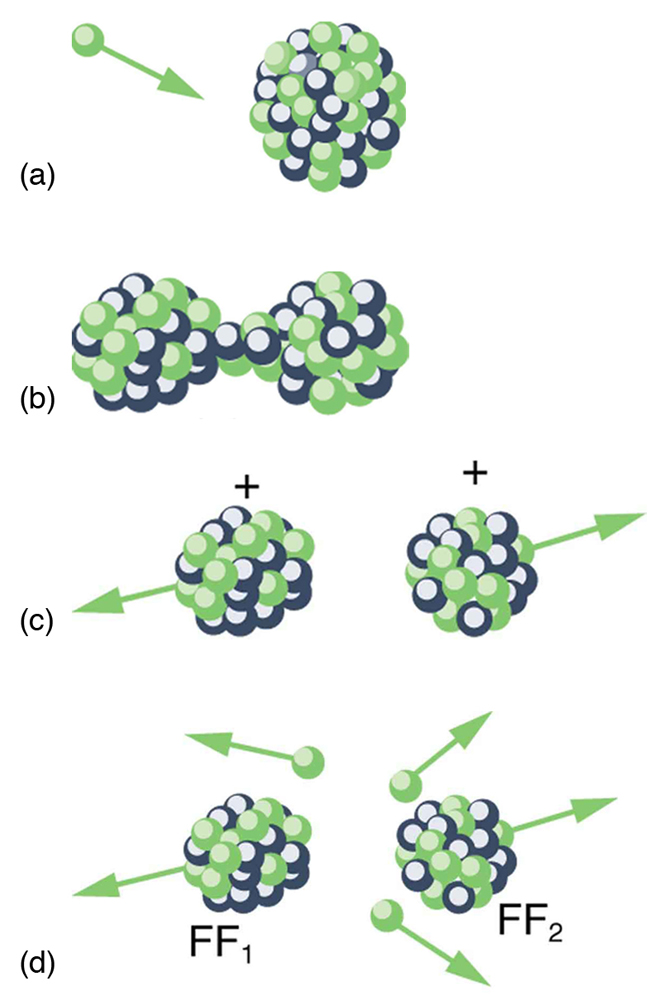
can spontaneously fission, but it decays mostly by emission. Neutron-induced fission is crucial as seen in Figure 14.10.2. Being chargeless, even low-energy neutrons can strike a nucleus and be absorbed once they feel the attractive nuclear force. Large nuclei are described by a liquid drop model with surface tension and oscillation modes, because the large number of nucleons act like atoms in a drop. The neutron is attracted and thus, deposits energy, causing the nucleus to deform as a liquid drop. If stretched enough, the nucleus narrows in the middle. The number of nucleons in contact and the strength of the nuclear force binding the nucleus together are reduced. Coulomb repulsion between the two ends then succeeds in fissioning the nucleus, which pops like a water drop into two large pieces and a few neutrons. Neutron-induced fission can be written as
,
(14.10.1)where and are the two daughter nuclei, called fission fragments, and is the number of neutrons produced. Most often, the masses of the fission fragments are not the same. Most of the released energy goes into the kinetic energy of the fission fragments, with the remainder going into the neutrons and excited states of the fragments. Since neutrons can induce fission, a self-sustaining chain reaction is possible, provided more than one neutron is produced on average — that is, if in . This can also be seen in Figure 14.10.3.
An example of a typical neutron-induced fission reaction is
.
(14.10.2)Note that in this equation, the total charge remains the same (is conserved): . Also, as far as whole numbers are concerned, the mass is constant: . This is not true when we consider the masses out to 6 or 7 significant places, as in the previous example.
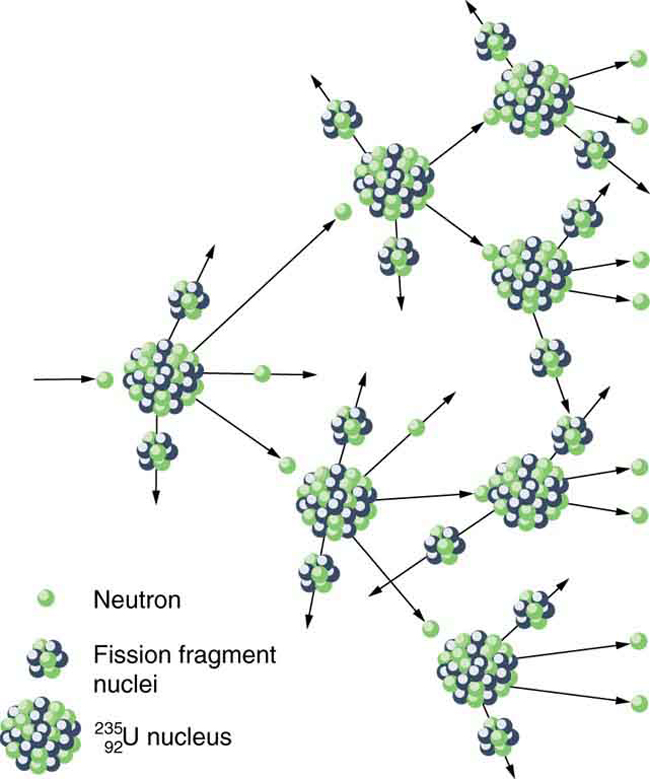
Not every neutron produced by fission induces fission. Some neutrons escape the fissionable material, while others interact with a nucleus without making it fission. We can enhance the number of fissions produced by neutrons by having a large amount of fissionable material. For a specified composition, shape, density, and surroundings, the minimum mass needed for a self-sustaining chain reaction is called the critical mass. Some nuclides, such as , produce more neutrons per fission than others, such as . Additionally, some nuclides are easier to make fission than others. In particular,
and
are easier to fission than the much more abundant . Both factors affect critical mass, which is smallest for .
The reason
and
are easier to fission than
is that the nuclear force is more attractive for an even number of neutrons in a nucleus than for an odd number. Consider that
has 143 neutrons, and
has 145 neutrons, whereas
has 146. When a neutron encounters a nucleus with an odd number of neutrons, the nuclear force is more attractive, because the additional neutron will make the number even. About 2-MeV more energy is deposited in the resulting nucleus than would be the case if the number of neutrons was already even. This extra energy produces greater deformation, making fission more likely. Thus,
and
are superior fission fuels. The isotope
is only 0.72% of natural uranium, while
is 99.27%, and
does not exist in nature. Australia has the largest deposits of uranium in the world, standing at 28% of the total. This is followed by Kazakhstan and Canada. The US has only 3% of global reserves.
Most fission reactors utilize , which is separated from
at some expense. This is called enrichment. The most common separation method is gaseous diffusion of uranium hexafluoride () through membranes. Since
has less mass than , its molecules have higher average velocity at the same temperature and diffuse faster. Another interesting characteristic of
is that it preferentially absorbs very slow moving neutrons (with energies a fraction of an eV), whereas fission reactions produce fast neutrons with energies in the order of an MeV. To make a self-sustained fission reactor with , it is thus necessary to slow down (“thermalize”) the neutrons. Water is very effective, since neutrons collide with protons in water molecules and lose energy. Figure 14.10.4 shows a schematic of a reactor design, called the pressurized water reactor.
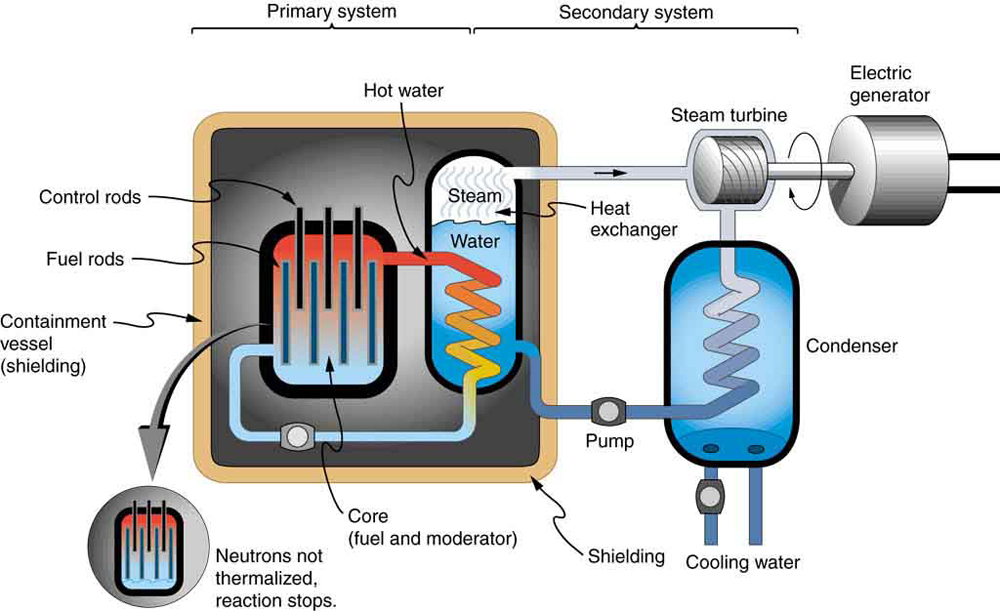
Control rods containing nuclides that very strongly absorb neutrons are used to adjust neutron flux. A chain reaction is critical when, on average, each fission leads to one further fission. Its average rate then remains steady; this condition is called criticality. It is subcritical when the rate decreases and supercritical when the rate increases. Supercriticality means that each generation produces more fissions in the next. Whether a sample sustains a chain reaction depends on neutron production, absorption, and escape. Critical mass therefore depends on composition, shape, density, and surroundings, including neutron moderators and reflectors. Control rods help prevent overheating, perhaps even a meltdown or explosive disassembly. The water that is used to thermalize neutrons, necessary to get them to induce fission in , and achieve criticality, provides a negative feedback for temperature increases. In case the reactor overheats and boils the water to steam or is breached, the absence of water kills the chain reaction. Considerable heat, however, can still be generated by the reactor’s radioactive fission products. Other safety features, thus, need to be incorporated in the event of a loss of coolant accident, including auxiliary cooling water and pumps.
Example 14.10.2
Calculating Energy from a Kilogram of Fissionable Fuel
Calculate the amount of energy produced by the fission of 1.00 kg of , given the average fission reaction of
produces 200 MeV.
Strategy
The total energy produced is the number of
atoms times the given energy per
fission. We should therefore find the number of
atoms in 1.00 kg.
Solution
The number of
atoms in 1.00 kg is Avogadro’s number times the number of moles. One mole of
has a mass of 235.04 g; thus, there are . The number of
atoms is therefore,
.
So the total energy released is
.
Discussion
This is another impressively large amount of energy, equivalent to about 14,000 barrels of crude oil or 600,000 gallons of gasoline. But, it is only one-fourth the energy produced by the fusion of a kilogram mixture of deuterium and tritium as seen in the previous section. Even though each fission reaction yields about ten times the energy of a fusion reaction, the energy per kilogram of fission fuel is less, because there are far fewer moles per kilogram of the heavy nuclides. Fission fuel is also much more scarce than fusion fuel, and less than 1% of uranium (the ) is readily usable.
Neutron capture can convert fertile material, such as uranium-238, into fissile material, such as plutonium-239. This production of new fissile material is called breeding. The following reaction sequence shows how uranium-238 can be converted into plutonium-239 in a reactor.
.
(14.10.3)Uranium-239 then decays:
.
(14.10.4)Neptunium-239 also decays:
.
(14.10.5)As in other decays, an electron and an electron antineutrino () are emitted.
Some plutonium-239 is produced when uranium-238 in reactor fuel captures neutrons. A breeder reactor is designed to produce more fissile material than it consumes.
Plutonium-239 has advantages over
as a reactor fuel — it produces more neutrons per fission on average, and it is easier for a thermal neutron to cause it to fission. It is also chemically different from uranium, so it is inherently easier to separate from uranium ore. This means
has a particularly small critical mass, an advantage for nuclear weapons.
Continue to this item in the chapter review.Continue to this item in the chapter review.Continue to this item in the chapter review.Continue to this item in the chapter review.Continue to this item in the chapter review.Continue to this item in the chapter review.Continue to this item in the chapter review.Continue to this item in the chapter review.Continue to this item in the chapter review.Continue to this item in the chapter review.Continue to this item in the chapter review.Continue to this item in the chapter review.Continue to this item in the chapter review.Continue to this item in the chapter review.Continue to this item in the chapter review.Continue to this item in the chapter review.Continue to this item in the chapter review.Continue to this item in the chapter review.Continue to this item in the chapter review.Continue to this item in the chapter review.Continue to this item in the chapter review.Continue to this item in the chapter review.Continue to this item in the chapter review.Continue to this item in the chapter review.Continue to this item in the chapter review.Continue to this item in the chapter review.Continue to this item in the chapter review.Continue to this item in the chapter review.Continue to this item in the chapter review.Continue to this item in the chapter review.Continue to this item in the chapter review.Continue to this item in the chapter review.Continue to this item in the chapter review.Continue to this item in the chapter review.Continue to this item in the chapter review.Continue to this item in the chapter review.Continue to this item in the chapter review.Continue to this item in the chapter review.