14.14
GUTs: The Unification of Forces
Chapter contents: Chapter 14: Nuclear and Particle Physics
Present quests to show that the four basic forces are different manifestations of a single unified force follow a long tradition. In the 19th century, the distinct electric and magnetic forces were shown to be intimately connected and are now collectively called the electromagnetic force. More recently, the weak nuclear force has been shown to be connected to the electromagnetic force in a manner suggesting that a theory may be constructed in which all four forces are unified. Certainly, there are similarities in how forces are transmitted by the exchange of carrier particles, and the carrier particles themselves (the gauge bosons in Table 14.13.1) are also similar in important ways. The analogy to the unification of electric and magnetic forces is quite good—the four forces are distinct under normal circumstances, but there are hints of connections even on the atomic scale, and there may be conditions under which the forces are intimately related and even indistinguishable. The search for a theory linking the strong and electroweak interactions, called a Grand Unified Theory (GUT), is explored in this section in the realm of particle physics.
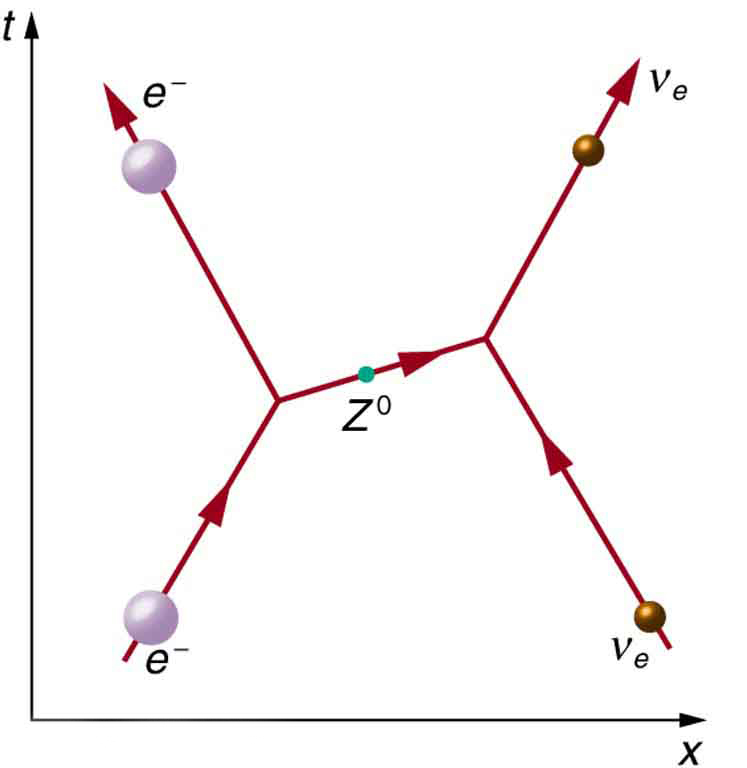
Figure 14.14.1 is a Feynman diagram showing how the weak nuclear force is transmitted by the carrier particle , similar to the diagrams in Figure 14.12.2 and Figure 14.12.3 for the electromagnetic and strong nuclear forces. In the 1960s, a gauge theory, called electroweak theory, was developed by Steven Weinberg, Sheldon Glashow, and Abdus Salam and proposed that the electromagnetic and weak forces are identical at sufficiently high energies. One of its predictions, in addition to describing both electromagnetic and weak force phenomena, was the existence of the , and carrier particles. Not only were three particles having spin 1 predicted, the mass of the and was predicted to be , and that of the was predicted to be . (Their masses had to be about 1000 times that of the pion, or about , since the range of the weak force is about 1000 times less than the strong force carried by virtual pions.) In 1983, these carrier particles were observed at CERN with the predicted characteristics, including masses having the predicted values as seen in Table 14.13.1. This was another triumph of particle theory and experimental effort, resulting in the 1984 Nobel Prize to the experiment’s group leaders Carlo Rubbia and Simon van der Meer. Theorists Weinberg, Glashow, and Salam had already been honored with the 1979 Nobel Prize for other aspects of electroweak theory.
Although the weak nuclear force is very short ranged (, as indicated in Table 14.12.1), its effects on atomic levels can be measured given the extreme precision of modern techniques. Since electrons spend some time in the nucleus, their energies are affected, and spectra can even indicate new aspects of the weak force, such as the possibility of other carrier particles. So systems many orders of magnitude larger than the range of the weak force supply evidence of electroweak unification in addition to evidence found at the particle scale.
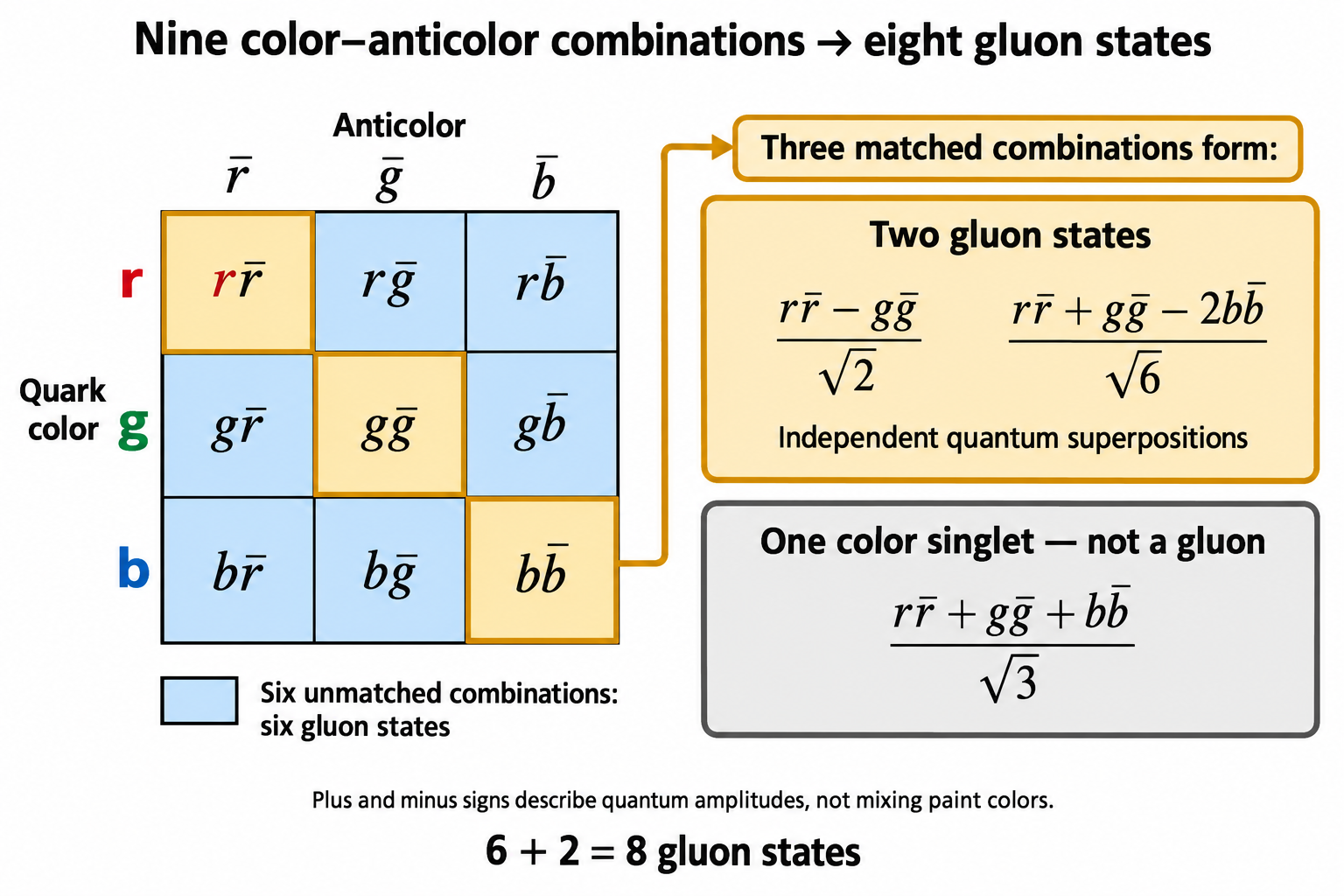
Gluons () are the experimentally established carriers of the strong interaction between quarks. Quantum chromodynamics (QCD) describes eight types of gluons, all massless and with spin 1. Gluons carry color charge and can interact with one another. Like quarks, they are confined within color-neutral combinations and are not observed as isolated particles. Their existence is established through experiments, including collisions that produce three jets of particles, corresponding to a quark, an antiquark, and a gluon.
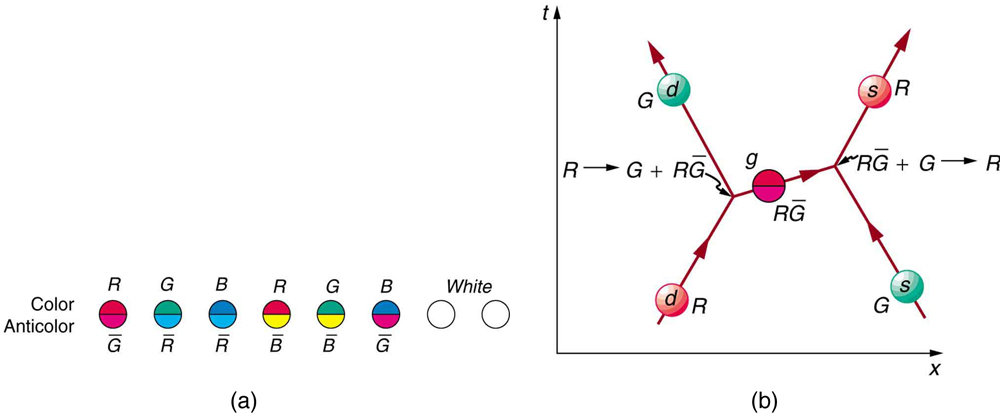
Gluon exchange can change a quark’s color without changing its flavor. In Figure 14.14.2(b), a red down quark emits a red–antigreen gluon and becomes green. A green strange quark absorbs that gluon and becomes red. The quarks remain a down quark and a strange quark throughout the interaction.
(a)
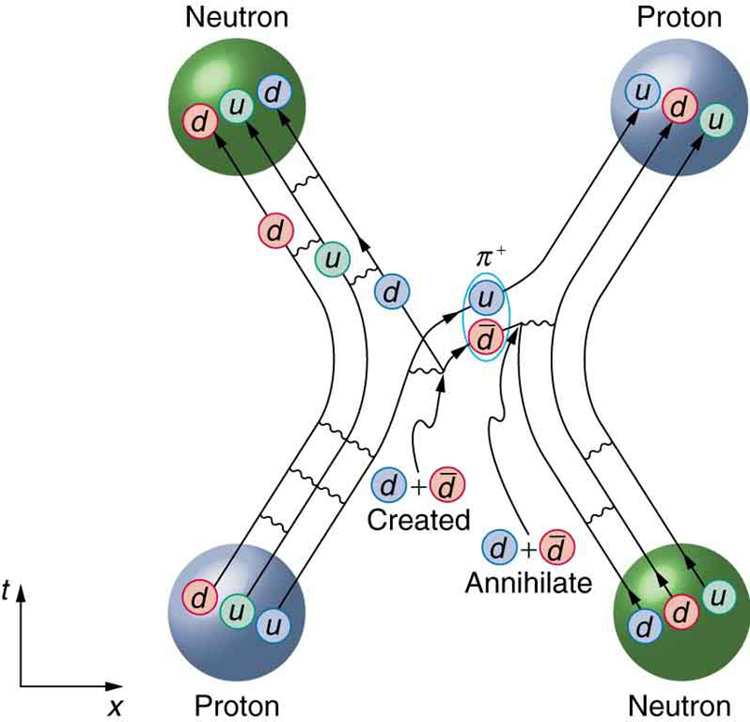
The strong force is complicated, since observable particles that feel the strong force (hadrons) contain multiple quarks. Figure 14.14.3 shows the quark and gluon details of pion exchange between a proton and a neutron as illustrated earlier in Figure 14.12.3. The quarks within the proton and neutron move along together exchanging gluons, until the proton and neutron get close together. As the quark leaves the proton, a gluon creates a pair of virtual particles, a quark and a antiquark. The quark stays behind and the proton turns into a neutron, while the and move together as a . The annihilates a quark in the neutron, the joins the neutron, and the neutron becomes a proton. A pion is exchanged and a force is transmitted.
Quantum chromodynamics (QCD) describes the strong interaction between quarks and gluons. Together with electroweak theory, it forms the Standard Model of particle physics. This framework describes quarks and leptons, the particles that carry the strong, weak, and electromagnetic interactions, and the Higgs boson. Its predictions have passed many precise experimental tests. However, it does not include gravity or explain dark matter, so it remains an incomplete description of nature.
Making Connections: Unification of Forces
Electroweak theory and quantum chromodynamics are established parts of the Standard Model. Grand unified theories and superstring theories explore further unification that has not yet been experimentally established. Grand unified theories connect the strong and electroweak interactions at much higher energies; superstring theories pursue a broader framework that can also include gravity. Specific energy and length scales depend on the model.
How can forces be unified? They are definitely distinct under most circumstances, for example, being carried by different particles and having greatly different strengths. But experiments show that at extremely small distances, the strengths of the forces begin to become more similar. In fact, electroweak theory’s prediction of the ,
, and carrier particles was based on the strengths of the two forces being identical at extremely small distances as seen in Figure 14.14.4. As discussed in case of the creation of virtual particles for extremely short times, the small distances or short ranges correspond to the large masses of the carrier particles and the correspondingly large energies needed to create them. Thus, the energy scale on the horizontal axis of Figure 14.14.4 corresponds to smaller and smaller distances, with 100 GeV corresponding to approximately, for example. At that distance, the strengths of the EM and weak forces are the same. To test physics at that distance, energies of about 100 GeV must be put into the system, and that is sufficient to create and release the , , and carrier particles. At energies much greater than their rest energies, the masses of the carrier particles can be neglected in some calculations. This does not mean that the particles become massless. Electroweak theory predicts a particle associated with the Higgs field, called the Higgs boson, but does not predict its mass. In 2012, the ATLAS and CMS experiments at CERN’s Large Hadron Collider discovered this particle, with a mass of approximately . The discovery supports the Higgs mechanism, through which the W and Z bosons acquire mass while the photon remains massless.
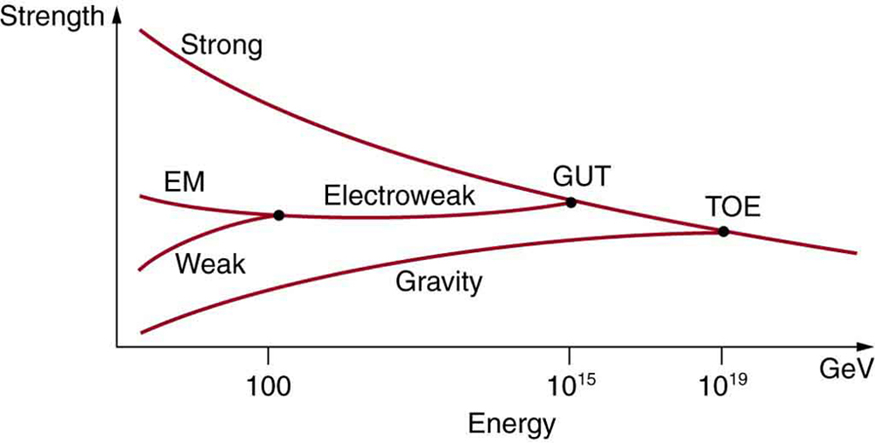
Grand unified theories propose a common framework for the strong and electroweak interactions at energies far beyond those reached by current accelerators. Their characteristic energy and length scales depend on the model. Superstring theory pursues a broader framework in which fundamental particles correspond to different vibrational states of strings and which incorporates supersymmetry. Such frameworks can also include gravity.
Some grand unified theories predict interactions that can change baryon number and allow proton decay. The predicted lifetime and decay modes depend on the model. One proposed decay mode is
, (proposed proton decay)
(14.14.1)which violates conservation of baryon number and electron family number. Experiments search for such decays using large quantities of matter and have found no convincing evidence of proton decay. These searches place lower limits on the lifetime for particular decay modes and constrain proposed theories.
From looking increasingly inward at smaller details for direct evidence of electroweak theory and GUTs, we turn around and look to the universe for evidence of the unification of forces. In the 1920s, the expansion of the universe was discovered. Thinking backward in time, the universe must once have been very small, dense, and extremely hot. At a tiny fraction of a second after the fabled Big Bang, proposed unification processes might have left their fingerprint on the existing universe. The search for these fingerprints connects the physics of the smallest particles with the origin and evolution of the universe.