Nuclear decay has provided an amazing window into the realm of the very small. Nuclear decay gave the first indication of the connection between mass and energy, and it revealed the existence of two of the four basic forces in nature. In this section, we explore the major modes of nuclear decay; and, like those who first explored them, we will discover evidence of previously unknown particles and conservation laws.
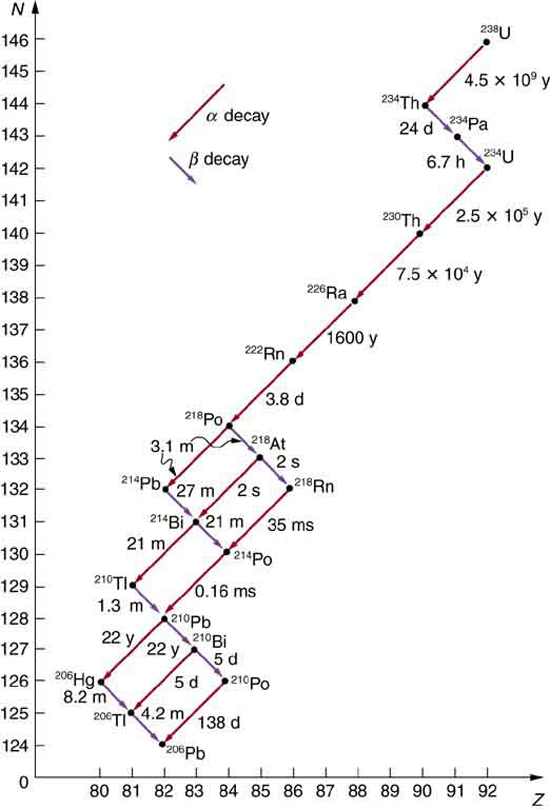
Some nuclides are stable, apparently living forever. Unstable nuclides decay (that is, they are radioactive), eventually producing a stable nuclide after many decays. We call the original nuclide the parent and its decay products the daughters. Some radioactive nuclides decay in a single step to a stable nucleus. For example, is unstable and decays directly to , which is stable. Others, such as , decay to another unstable nuclide, resulting in a decay series in which each subsequent nuclide decays until a stable nuclide is finally produced. The decay series that starts from is of particular interest, since it produces the radioactive isotopes and , which the Curies first discovered (see Figure 14.5.1). Radon gas is also produced ( in the series), an increasingly recognized naturally occurring hazard. Since radon is a noble gas, it emanates from materials, such as soil, containing even trace amounts of and can be inhaled. The decay of radon and its daughters produces internal damage. The decay series ends with , a stable isotope of lead.
Figure 14.5.1. The decay series produced by , the most common uranium isotope. Nuclides are graphed in the same manner as in the chart of nuclides. The type of decay for each member of the series is shown, as well as the half-lives. Note that some nuclides decay by more than one mode. You can see why radium and polonium are found in uranium ore. A stable isotope of lead is the end product of the series.
Note that the daughters of decay shown in Figure 14.5.1 always have two fewer protons and two fewer neutrons than the parent. This seems reasonable, since we know that decay is the emission of a nucleus, which has two protons and two neutrons. The daughters of decay have one less neutron and one more proton than their parent. Beta decay is a little more subtle, as we shall see. No decays are shown in the figure, because they do not produce a daughter that differs from the parent.
Alpha Decay
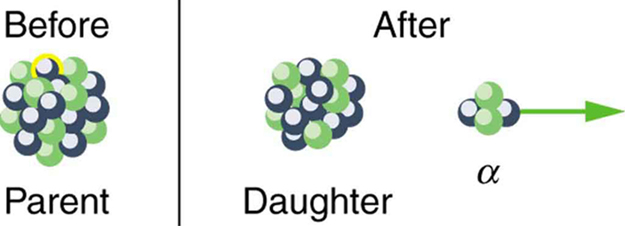
In alpha decay, a nucleus simply breaks away from the parent nucleus, leaving a daughter with two fewer protons and two fewer neutrons than the parent (see Figure 14.5.2). One example of decay is shown in Figure 14.5.1 for . Another nuclide that undergoes decay is . The decay equations for these two nuclides are
(14.5.1)
and
.
(14.5.2)
Figure 14.5.2. Alpha decay is the separation of a nucleus from the parent. The daughter nucleus has two fewer protons and two fewer neutrons than the parent. Alpha decay occurs spontaneously only if the daughter and nucleus have less total mass than the parent.
If you examine the periodic table of the elements, you will find that Th has , two fewer than U, which has . Similarly, in the second decay equation, we see that U has two fewer protons than Pu, which has . The general rule for decay is best written in the format . If a certain nuclide is known to decay (generally this information must be looked up in a table of isotopes, such as in Appendix B), its decay equation is
( decay)
(14.5.3)
where Y is the nuclide that has two fewer protons than X, such as Th having two fewer than U. So if you were told that decays and were asked to write the complete decay equation, you would first look up which element has two fewer protons (an atomic number two lower) and find that this is uranium. Then since four nucleons have broken away from the original 239, its atomic mass would be 235.
It is instructive to examine conservation laws related to decay. You can see from the equation that total charge is conserved. Linear and angular momentum are conserved, too. Although conserved angular momentum is not of great consequence in this type of decay, conservation of linear momentum has interesting consequences. If the nucleus is at rest when it decays, its momentum is zero. In that case, the fragments must fly in opposite directions with equal-magnitude momenta so that total momentum remains zero. This results in the particle carrying away most of the energy, as a bullet from a heavy rifle carries away most of the energy of the powder burned to shoot it. Total mass–energy is also conserved: the energy produced in the decay comes from conversion of a fraction of the original mass. The general relationship is
.
(14.5.4)
Here, is the nuclear reaction energy (the reaction can be nuclear decay or any other reaction), and is the difference in mass between initial and final products. When the final products have less total mass, is positive, and the reaction releases energy (is exothermic). When the products have greater total mass, the reaction is endothermic ( is negative) and must be induced with an energy input. For decay to be spontaneous, the decay products must have smaller mass than the parent.
Example 14.5.1
Alpha Decay Energy Found from Nuclear Masses
Find the energy emitted in the decay of .
Strategy
Nuclear reaction energy, such as released in α decay, can be found using the equation . We must first find , the difference in mass between the parent nucleus and the products of the decay. This is easily done using masses given in Appendix A.
Solution
The decay equation was given earlier for ; it is
.
Thus the pertinent masses are those of ,, and the particle or , all of which are listed in Appendix A. The initial mass was . The final mass is the sum .
Thus,
.
Now we can find by entering into the equation:
.
We know , and so
.
Discussion
The energy released in this decay is in the range, about times as great as typical chemical reaction energies, consistent with many previous discussions. Most of this energy becomes kinetic energy of the particle (or nucleus), which moves away at high speed. The energy carried away by the recoil of the nucleus is much smaller in order to conserve momentum. The nucleus can be left in an excited state to later emit photons ( rays). This decay is spontaneous and releases energy, because the products have less mass than the parent nucleus. The question of why the products have less mass will be discussed in “Binding Energy”. Note that the masses given in Appendix A are atomic masses of neutral atoms, including their electrons. The mass of the electrons is the same before and after decay, and so their masses subtract out when finding . In this case, there are 94 electrons before and after the decay.
Beta Decay
There are actually three types of beta decay. The first discovered was “ordinary” beta decay and is called decay or electron emission. The symbol represents an electron emitted in nuclear beta decay. Cobalt-60 is a nuclide that decays in the following manner:
.
(14.5.5)
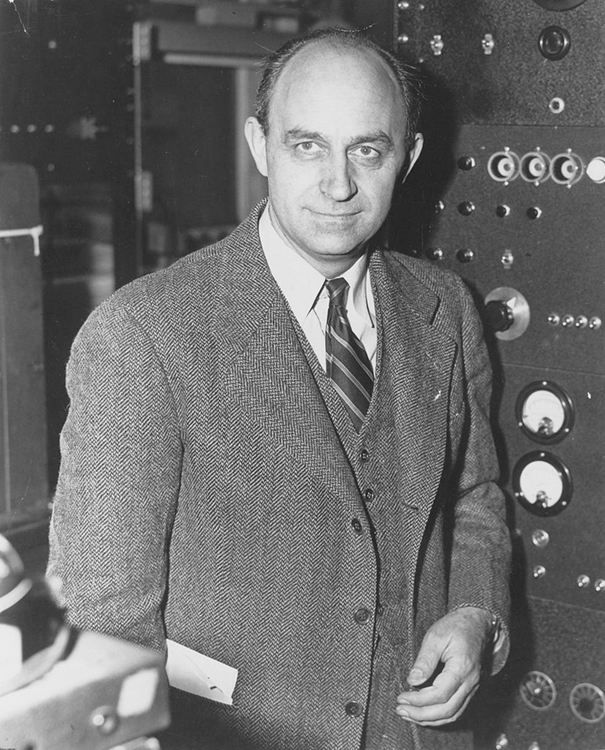
The neutrino is a particle emitted in beta decay that was unanticipated and is of fundamental importance. The neutrino was not even proposed in theory until more than 20 years after beta decay was known to involve electron emissions. Neutrinos are so difficult to detect that their first unambiguous detection was not achieved until 1956. Neutrinos are nearly massless, have no charge, and do not interact with nucleons via the strong nuclear force. Because they have no electric charge, they do not interact through the electromagnetic force in the way charged particles do. They do interact via the relatively weak and very short range weak nuclear force. Consequently, neutrinos escape almost any detector and penetrate almost any shielding. However, neutrinos do carry energy, angular momentum (they are fermions with half-integral spin), and linear momentum away from a beta decay. When accurate measurements of beta decay were made, it became apparent that energy, angular momentum, and linear momentum were not accounted for by the daughter nucleus and electron alone. Either a previously unsuspected particle was carrying them away, or three conservation laws were being violated. Wolfgang Pauli made a formal proposal for the existence of neutrinos in 1930. The Italian-born American physicist Enrico Fermi (1901–1954) gave neutrinos their name, meaning little neutral ones, when he developed a sophisticated theory of beta decay (see Figure 14.5.3). Part of Fermi’s theory was the identification of the weak nuclear force as being distinct from the strong nuclear force and in fact responsible for beta decay. Chinese-born physicist Chien-Shiung Wu, who had developed a number of processes critical to the Manhattan Project and related research, set out to investigate Fermi’s theory and some experiments whose failures had cast the theory in doubt. She first identified a number of flaws in her contemporaries’ methods and materials, and then designed an experimental method that would avoid the same errors. Wu verified Fermi’s theory and went on to establish the core principles of beta decay, which would become critical to further work in nuclear physics.
Figure 14.5.3. (a) Enrico Fermi made significant contributions both as an experimentalist and a theorist. His many contributions to theoretical physics included the identification of the weak nuclear force. The fermi (fm) is named after him, as are an entire class of subatomic particles (fermions), an element (Fermium), and a major research laboratory (Fermilab). (credit: United States Department of Energy, Office of Public Affairs). (b) Chien-Shiung Wu undertook the experimentation to verify Fermi’s theory of beta decay. She became the world’s expert on the subject, and contributed to work that led to a Nobel Prize, even though she was denied the award. (credit: Smithsonian Institute)
The neutrino also reveals a new conservation law. There are various families of particles, one of which is the electron family. We propose that the number of members of the electron family is constant in any process or any closed system. In our example of beta decay, there are no members of the electron family present before the decay, but after, there is an electron and an electron antineutrino. So electrons are given an electron family number of . The neutral particle emitted in decay is an electron antineutrino, given the symbol , where is the Greek letter nu, and the subscript e means this neutrino is related to the electron. The bar indicates this is a particle of antimatter. (A particle and its antiparticle have the same mass and spin. If they are electrically charged, their charges have equal magnitudes and opposite signs. Neutral particles can also have antiparticles: the electron neutrino and electron antineutrino are both electrically neutral, but have opposite electron family numbers. Antimatter is almost entirely absent on Earth, but it is found in nuclear decay and other nuclear and particle reactions as well as in outer space.) The electron antineutrino , being antimatter, has an electron family number of . The total is zero, before and after the decay. The new conservation law, obeyed in all circumstances, states that the total electron family number is constant. An electron cannot be created without also creating an antimatter family member. This law is analogous to the conservation of charge in a situation where total charge is originally zero, and equal amounts of positive and negative charge must be created in a reaction to keep the total zero.
If a nuclide is known to decay, then its decay equation is
( decay),
(14.5.6)
where Y is the nuclide having one more proton than X (see Figure 14.5.4). So if you know that a certain nuclide decays, you can find the daughter nucleus by first looking up
for the parent and then determining which element has atomic number
. In the example of the
decay of
given earlier, we see that for Co and
is Ni. It is as if one of the neutrons in the parent nucleus decays into a proton, electron, and neutrino. In fact, neutrons outside of nuclei do just that—they live only an average of a few minutes and
decay in the following manner:
.
(14.5.7)
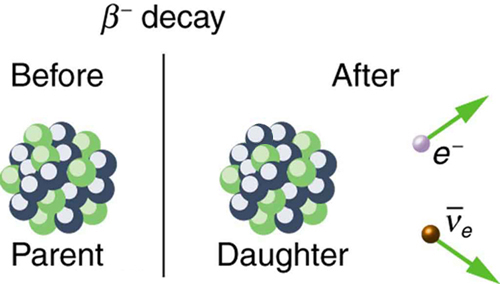
Figure 14.5.4. In decay, the parent nucleus emits an electron and an antineutrino. The daughter nucleus has one more proton and one less neutron than its parent. Neutrinos interact so weakly that they are almost never directly observed, but they play a fundamental role in particle physics.
We see that charge is conserved in decay, since the total charge is before and after the decay. For example, in decay, total charge is 27 before decay, since cobalt has
. After decay, the daughter nucleus is Ni, which has
, and there is an electron, so that the total charge is also or 27. Angular momentum is conserved, but not obviously (you have to examine the spins and angular momenta of the final products in detail to verify this). Linear momentum is also conserved, again imparting most of the decay energy to the electron and the antineutrino, since they are of low and zero mass, respectively. Another new conservation law is obeyed here and elsewhere in nature. The total number of nucleons is conserved. In
decay, for example, there are 60 nucleons before and after the decay. Note that total
is also conserved in
decay. Also note that the total number of protons changes, as does the total number of neutrons, so that total
and total are not conserved in decay, as they are in decay. Energy released in decay can be calculated given the masses of the parent and products.
Example 14.5.2
Decay Energy from Masses
Find the energy emitted in the decay of .
Strategy and Concept
As in the preceding example, we must first find , the difference in mass between the parent nucleus and the products of the decay, using masses given in Appendix A. Then the emitted energy is calculated as before, using . The initial mass is just that of the parent nucleus, and the final mass is that of the daughter nucleus and the electron created in the decay. The neutrino is massless, or nearly so. However, since the masses given in Appendix A are for neutral atoms, the daughter nucleus has one more electron than the parent, and so the extra electron mass that corresponds to the is included in the atomic mass of Ni. Thus,
.
Solution
The decay equation for is
.
As noticed,
.
Entering the masses found in Appendix A gives
.
Thus,
.
Using , we obtain
.
Discussion and Implications
Perhaps the most difficult thing about this example is convincing yourself that the mass is included in the atomic mass of . Beyond that are other implications. Again the decay energy is in the MeV range. This energy is shared by all of the products of the decay. In many decays, the daughter nucleus is left in an excited state and emits photons ( rays). Most of the remaining energy goes to the electron and neutrino, since the recoil kinetic energy of the daughter nucleus is small. One final note: the electron emitted in decay is created in the nucleus at the time of decay.
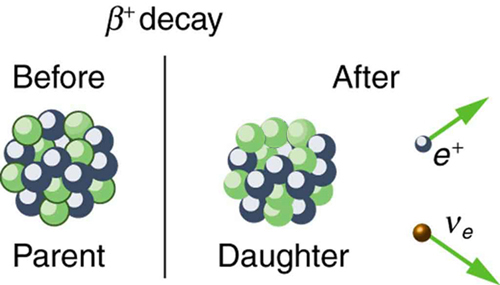
The second type of beta decay is less common than the first. It is decay. Certain nuclides decay by the emission of a positive electron. This is antielectron or positron decay (see Figure 14.5.5).
Figure 14.5.5. decay is the emission of a positron that eventually finds an electron to annihilate, characteristically producing ’s in opposite directions.
The antielectron is often represented by the symbol , but in beta decay it is written as to indicate the antielectron was emitted in a nuclear decay. Antielectrons are the antimatter counterpart to electrons, being nearly identical, having the same mass, spin, and so on, but having a positive charge and an electron family number of . When a positron encounters an electron, there is a mutual annihilation in which all the mass of the antielectron-electron pair is converted into pure photon energy. (The reaction, , conserves electron family number as well as all other conserved quantities.) If a nuclide is known to decay, then its decay equation is
( decay),
(14.5.8)
where Y is the nuclide having one less proton than X (to conserve charge) and is the symbol for the electron’s neutrino, which has an electron family number of . Since an antimatter member of the electron family (the ) is created in the decay, a matter member of the family (here the ) must also be created. Given, for example, that
decays, you can write its full decay equation by first finding that for , so that the daughter nuclide will have
, the atomic number for neon. Thus the decay equation for is
.
(14.5.9)
In decay, it is as if one of the protons in the parent nucleus decays into a neutron, a positron, and a neutrino. Protons do not do this outside of the nucleus, and so the decay is due to the complexities of the nuclear force. Note again that the total number of nucleons is constant in this and any other reaction. To find the energy emitted in decay, you must again count the number of electrons in the neutral atoms, since atomic masses are used. The daughter has one less electron than the parent, and one electron mass is created in the decay. Thus, in decay,
,
(14.5.10)
since we use the masses of neutral atoms.
Electron capture is the third type of beta decay. Here, a nucleus captures an inner-shell electron and undergoes a nuclear reaction that has the same effect as decay. Electron capture is sometimes denoted by the letters EC. We know that electrons cannot reside in the nucleus, but this is a nuclear reaction that consumes the electron and occurs spontaneously only when the products have less mass than the parent plus the electron. If a nuclide is known to undergo electron capture, then its electron capture equation is
(electron capture, or EC).
(14.5.11)
Any nuclide that can decay can also undergo electron capture (and often does both). The same conservation laws are obeyed for EC as for decay. It is good practice to confirm these for yourself.
All forms of beta decay occur because the parent nuclide is unstable and lies outside the region of stability in the chart of nuclides. Those nuclides that have relatively more neutrons than those in the region of stability will decay to produce a daughter with fewer neutrons, producing a daughter nearer the region of stability. Similarly, those nuclides having relatively more protons than those in the region of stability will decay or undergo electron capture to produce a daughter with fewer protons, nearer the region of stability.
Gamma Decay
Gamma decay is the simplest form of nuclear decay—it is the emission of energetic photons by nuclei left in an excited state by some earlier process. Protons and neutrons in an excited nucleus are in higher orbitals, and they fall to lower levels by photon emission (analogous to electrons in excited atoms). Nuclear excited states have lifetimes typically of only about s, an indication of the great strength of the forces pulling the nucleons to lower states. The decay equation is simply
( decay)
(14.5.12)
where the asterisk indicates the nucleus is in an excited state. There may be one or more ’s emitted, depending on how the nuclide de-excites. In radioactive decay, emission is common and is preceded by or decay. For example, when decays, it most often leaves the daughter nucleus in an excited state, written . Then the nickel nucleus quickly decays by the emission of two penetrating ’s:
.
(14.5.13)
These are called cobalt rays, although they come from nickel—they are used for cancer therapy, for example. It is again constructive to verify the conservation laws for gamma decay. Finally, since decay does not change the nuclide to another species, it is not prominently featured in charts of decay series, such as that in Figure 14.5.1.
There are other types of nuclear decay, but they occur less commonly than ,, and decay. Spontaneous fission is the most important of the other forms of nuclear decay because of its applications in nuclear power and weapons. It is covered in the next chapter.