1.8
Projectile Motion
Chapter contents: Chapter 1: Kinematics
Projectile motion is the motion of an object thrown or projected into the air, subject to only the acceleration of gravity. The object is called a projectile, and its path is called its trajectory. The motion of falling objects is a simple one-dimensional type of projectile motion in which there is no horizontal movement. In this section, we consider two-dimensional projectile motion, such as that of a football or other object for which air resistance is negligible.
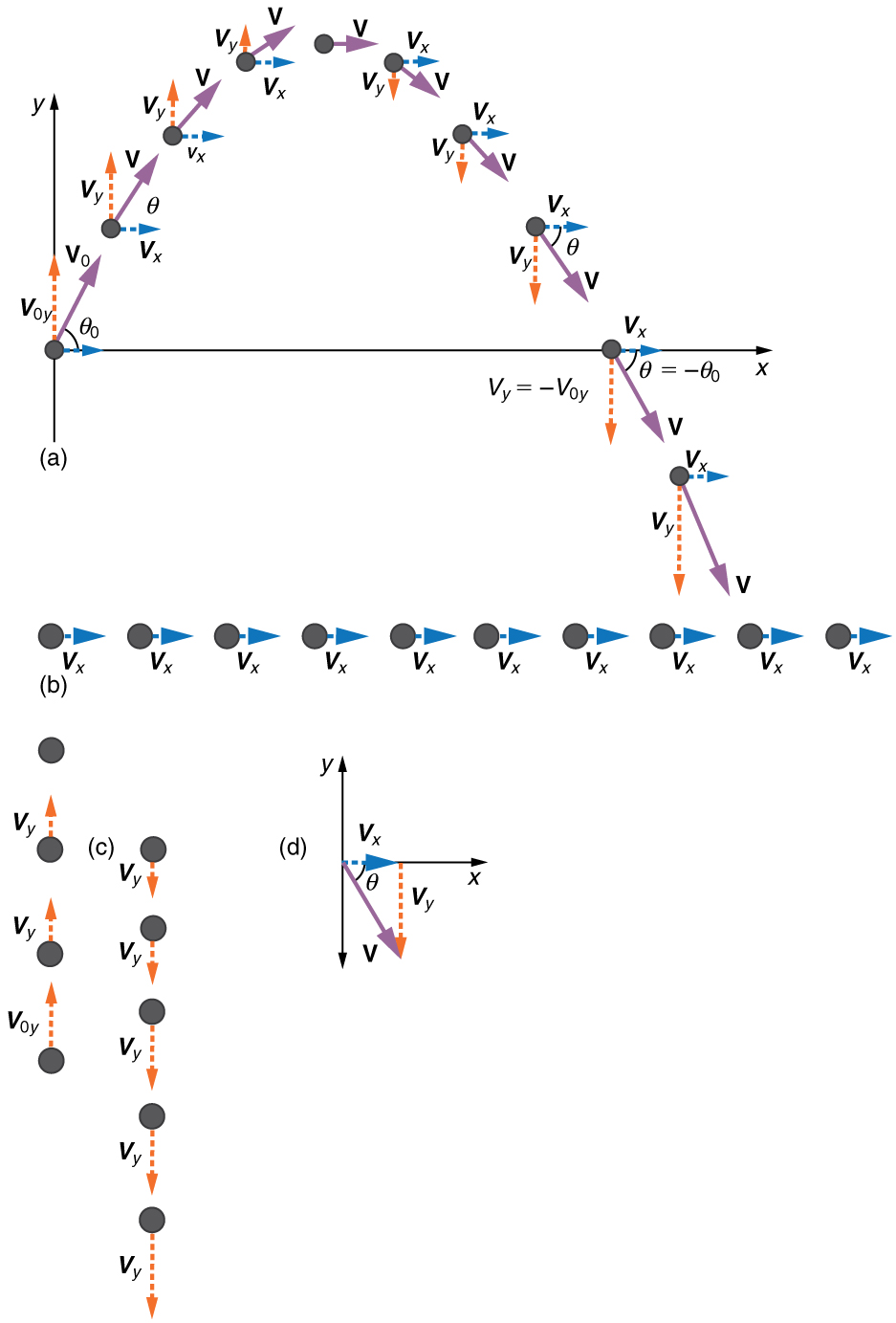
The most important fact to know here is that motions along perpendicular axes are independent and thus can be considered separately. In particular, it is often convenient to consider vertical and horizontal motions separately, or independently. The key to analyzing two-dimensional projectile motion is to break it into two motions, one along the horizontal axis and the other along the vertical. And we will assume all forces except gravity are negligible (that is, we ignore forces due to air resistance, wind, friction, etc.). The vertical component of acceleration is, then, , where we take upward direction as the positive direction. And because there is no force in the horizontal direction, . Figure 1.8.1 illustrates this approach to analyzing projectile motion.
One of the conceptual aspects of projectile motion we can discuss without a detailed analysis is the range. On level ground, we define range to be the horizontal distance traveled by a projectile. The range of projectiles describes everyday phenomena such as how far a football can be thrown or kicked. Also, investigating the range of projectiles can shed light on other interesting phenomena, such as the orbits of satellites around the Earth. Let us consider projectile range further.
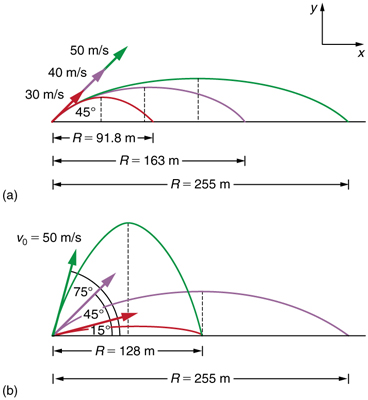
How does the initial velocity of a projectile affect its range? It is intuitive to guess that, the greater the initial speed , the greater the range, as shown in Figure 1.8.2(a). The initial angle also has a dramatic effect on the range, as illustrated in Figure 1.8.2(b). For a fixed initial speed, such as might be produced by a cannon, the maximum range is obtained with . Interestingly, for every initial angle except , there are two angles that give the same range. The range also depends on the value of the acceleration of gravity . The lunar astronaut Alan Shepherd was able to drive a golf ball a great distance on the Moon because gravity is weaker there. The range of a projectile on level ground for which air resistance is negligible is given by
(1.8.1)
where is the initial speed and is the initial angle relative to the horizontal. This formula (which can be derived using algebra and trigonometry) fits the major features of projectile range as described.
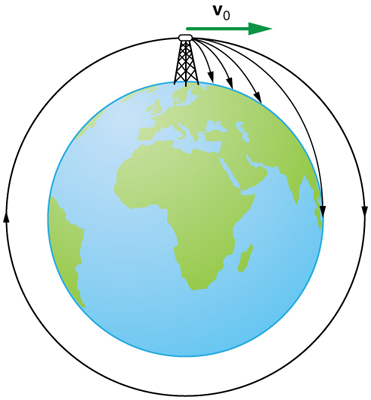
When we speak of the range of a projectile on level ground, we assume that is very small compared with the circumference of the Earth. If, however, the range is large, the Earth curves away below the projectile and acceleration of gravity changes direction along the path. The range is larger than predicted by the range equation given above because the projectile has farther to fall than it would on level ground. (See Figure 1.8.3.) If the initial speed is great enough, the projectile goes into orbit. This possibility was recognized centuries before it could be accomplished. When an object is in orbit, the Earth curves away from underneath the object at the same rate as it falls. The object thus falls continuously but never hits the surface.
Summary
- Projectile motion is the motion of an object through the air that is subject only to the acceleration of gravity.
- The most important fact regarding projectile motion is that motions along vertical direction and the horizontal direction are independent.
- The maximum horizontal distance traveled by a projectile is called the range. The range of a projectile on level ground launched at an angle above the horizontal with initial speed is given by
(1.8.2)
Conceptual Questions
Exercise 28
Answer the following questions for projectile motion on level ground assuming negligible air resistance (the initial angle being neither nor ): (a) Is the velocity ever zero? (b) When is the velocity a minimum? A maximum? (c) Can the velocity ever be the same as the initial velocity at a time other than at ? (d) Can the speed ever be the same as the initial speed at a time other than at ?
Exercise 29
Answer the following questions for projectile motion on level ground assuming negligible air resistance (the initial angle being neither nor ): (a) Is the acceleration ever zero? (b) Is the acceleration ever in the same direction as a component of velocity? (c) Is the acceleration ever opposite in direction to a component of velocity?
Exercise 30
For a fixed initial speed, the range of a projectile is determined by the angle at which it is fired. For all but the maximum, there are two angles that give the same range. Considering factors that might affect the ability of an archer to hit a target, such as wind, explain why the smaller angle (closer to the horizontal) is preferable. When would it be necessary for the archer to use the larger angle? Why does the punter in a football game use the higher trajectory?
Exercise 31
During a lecture demonstration, a professor places two coins on the edge of a table. She then flicks one of the coins horizontally off the table, simultaneously nudging the other over the edge. Describe the subsequent motion of the two coins, in particular discussing whether they hit the floor at the same time.
air resistance
a frictional force that slows the motion of objects as they travel through the air; when solving basic physics problems, air resistance is assumed to be zero
motion
displacement of an object as a function of time
projectile
an object that travels through the air and experiences only acceleration due to gravity
projectile motion
the motion of an object that is subject only to the acceleration of gravity
range
the maximum horizontal distance that a projectile travels
trajectory
the path of a projectile through the air