5.3
Simple Harmonic Motion: A Special Periodic Motion
Chapter contents: Chapter 5: Oscillations and Waves
Amplitude: the maximum magnitude of an oscillating quantity’s departure from its equilibrium value.
The oscillations of a system in which the net force can be described by Hooke’s law are of special importance, because they are very common. They are also the simplest oscillatory systems. Simple Harmonic Motion (SHM) is the name given to oscillatory motion for a system where the net force can be described by Hooke’s law, and such a system is called a simple harmonic oscillator. If the net force can be described by Hooke’s law and there is no damping (by friction or other non-conservative forces), then a simple harmonic oscillator will oscillate with equal displacement on either side of the equilibrium position, as shown for an object on a spring in Figure 5.3.1. The maximum displacement from equilibrium is called the amplitude . The units for amplitude and displacement are the same, but depend on the type of oscillation. For the object on the spring, the units of amplitude and displacement are meters; whereas for sound oscillations, they have units of pressure (and other types of oscillations have yet other units). Because amplitude is the maximum displacement, it is related to the energy in the oscillation.
Take-Home Experiment: SHM and the Marble
Find a bowl or basin that is shaped like a hemisphere on the inside. Place a marble inside the bowl and tilt the bowl periodically so the marble rolls from the bottom of the bowl to equally high points on the sides of the bowl. Get a feel for the force required to maintain this periodic motion. What is the restoring force and what role does the force you apply play in the simple harmonic motion (SHM) of the marble?
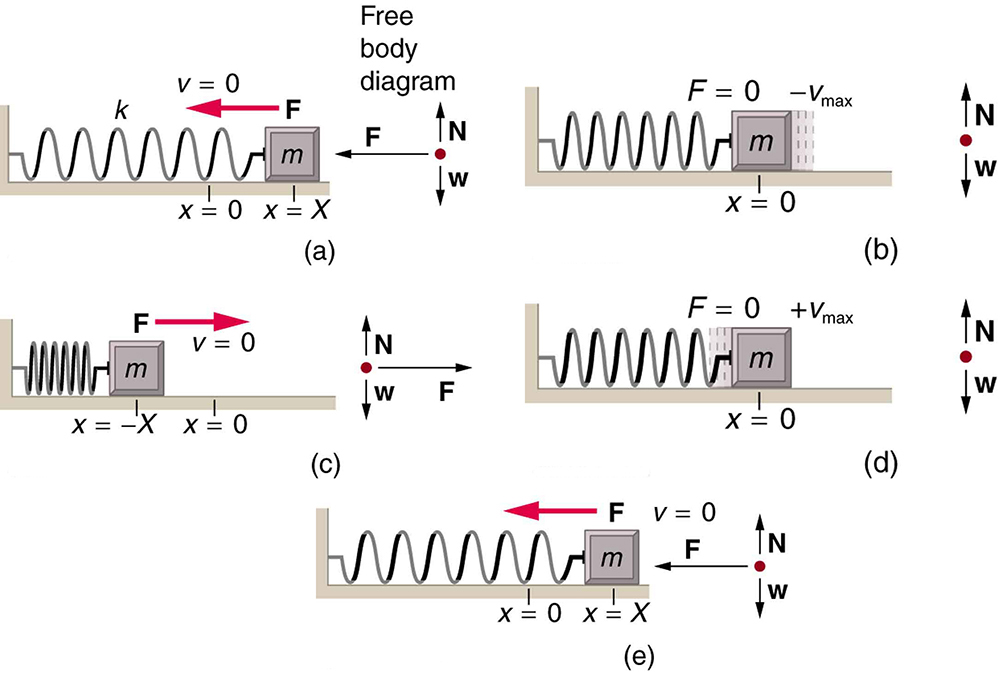
What is so significant about simple harmonic motion? One special thing is that the period and frequency of a simple harmonic oscillator are independent of amplitude. The string of a guitar, for example, will oscillate with the same frequency whether plucked gently or hard. Because the period is constant, a simple harmonic oscillator can be used as a clock.
Two important factors do affect the period of a simple harmonic oscillator. The period is related to how stiff the system is. A very stiff object has a large spring constant , which causes the system to have a smaller period. For example, you can adjust a diving board’s stiffness—the stiffer it is, the faster it vibrates, and the shorter its period. Period also depends on the mass of the oscillating system. The more massive the system is, the longer the period. For example, a heavy person on a diving board bounces up and down more slowly than a light one.
In fact, the mass and the spring constant are the only factors that affect the period and frequency of simple harmonic motion of a mass on a spring.
Period of Simple Harmonic Oscillator
The period of a simple harmonic oscillator is given by
and, because , the frequency of a simple harmonic oscillator is
.
(5.3.2)Note that neither nor has any dependence on amplitude.
Take-Home Experiment: Mass and Ruler Oscillations
Find two identical wooden or plastic rulers. Tape one end of each ruler firmly to the edge of a table so that the length of each ruler that protrudes from the table is the same. On the free end of one ruler tape a heavy object such as a few large coins. Pluck the ends of the rulers at the same time and observe which one undergoes more cycles in a time period, and measure the period of oscillation of each of the rulers.
Example 5.3.1
Calculate the Frequency and Period of Oscillations: Bad Shock Absorbers in a Car
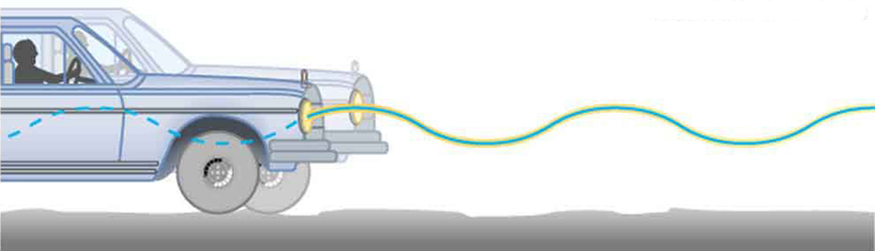
If the shock absorbers in a car go bad, then the car will oscillate at the least provocation, such as when going over bumps in the road and after stopping (See Figure 5.3.2). Calculate the frequency and period of these oscillations for such a car if the car’s mass (including its load) is 900 kg and the spring constant () of the suspension system is .
Strategy
The frequency of the car’s oscillations will be that of a simple harmonic oscillator as given in the equation . The mass and the spring constant are both given.
Solution
- Enter the known values of k and m:
.
- Calculate the frequency:
.
- You could use to calculate the period, but it is simpler to use the relationship and substitute the value just found for :
.
Discussion
The values of and both seem about right for a bouncing car. You can observe these oscillations if you push down hard on the end of a car and let go.
The Link between Simple Harmonic Motion and Waves
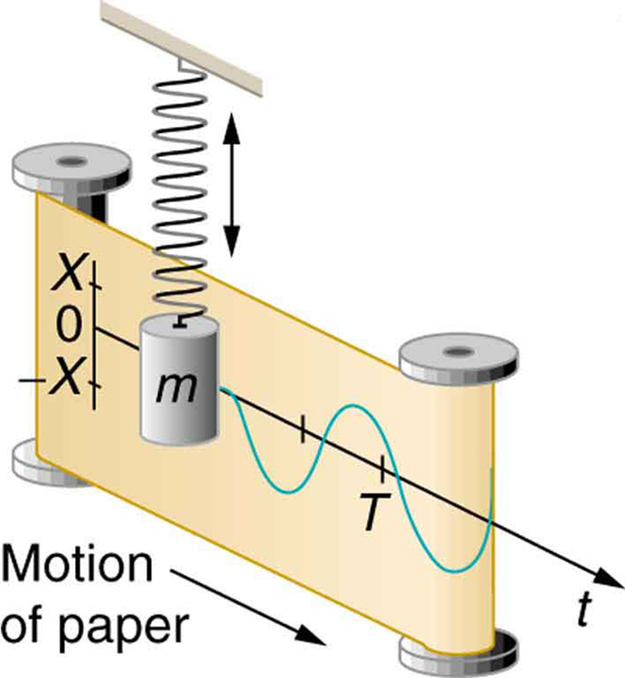
If a time-exposure photograph of the bouncing car were taken as it drove by, the headlight would make a wavelike streak, as shown in Figure 5.3.2. Similarly, Figure 5.3.3 shows an object bouncing on a spring as it leaves a wavelike “trace” of its position on a moving strip of paper. Both waves are sine functions. All simple harmonic motion is intimately related to sine and cosine waves.
The displacement , the velocity , and the acceleration of simple harmonic motion sketches out sinusoidal functions as a function of time. That is, if you sketch out and , with in seconds, for example, what you graph will appear similar to the actual graphs of , , and . You just need to scale them horizontally and vertically, so that they have correct period and amplitude, respectively.
Figure 5.3.4 shows the simple harmonic motion of an object on a spring and presents graphs of , , and versus time.
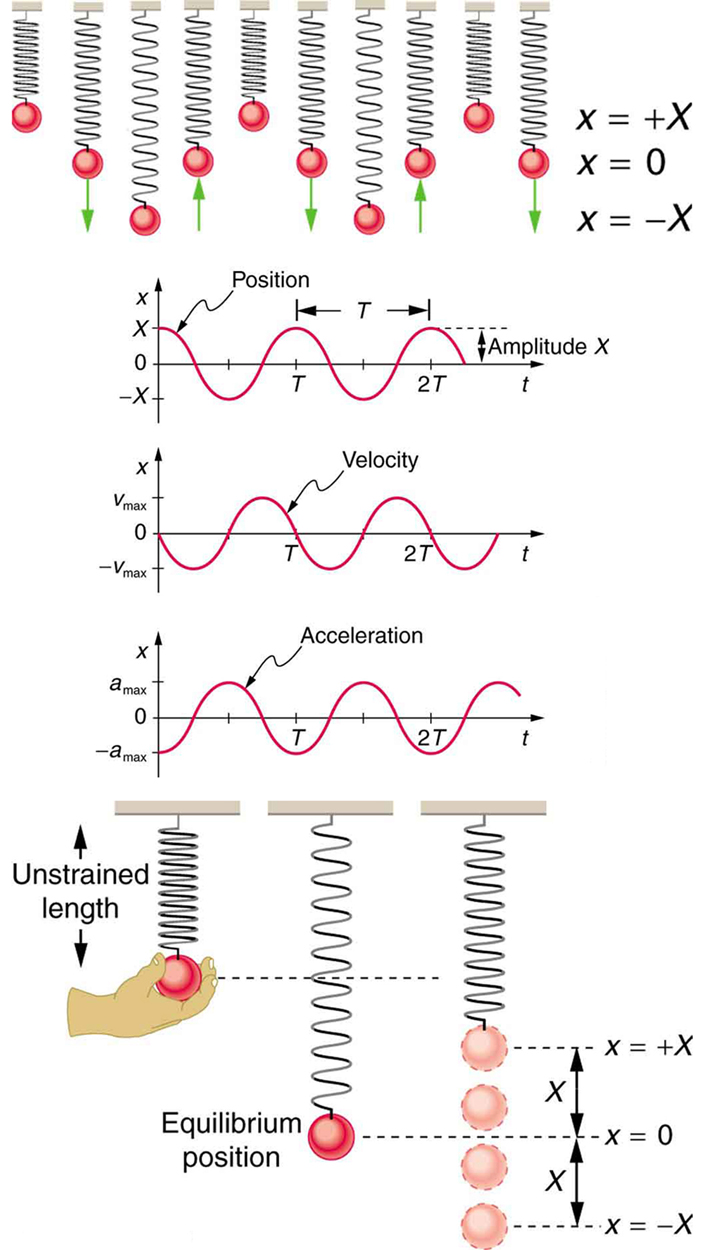
The most important point here is that these relationships are valid for all simple harmonic motion. They are very useful in visualizing waves associated with simple harmonic motion, including visualizing how waves add with one another.
Exercise
Check Your Understanding
Suppose you pluck a banjo string. You hear a single note that starts out loud and slowly quiets over time. Describe what happens to the sound waves in terms of period, frequency and amplitude as the sound decreases in volume.
Solution
Frequency and period remain essentially unchanged. Only amplitude decreases as volume decreases.
Exercise
Check Your Understanding
A babysitter is pushing a child on a swing. At the point where the swing reaches , where would the corresponding point on a wave of this motion be located?
Solution
is the maximum deformation, which corresponds to the amplitude of the wave. The point on the wave would either be at the very top or the very bottom of the curve.