2.7
Spring Force: Hooke’s Law
Chapter contents: Chapter 2: Dynamics
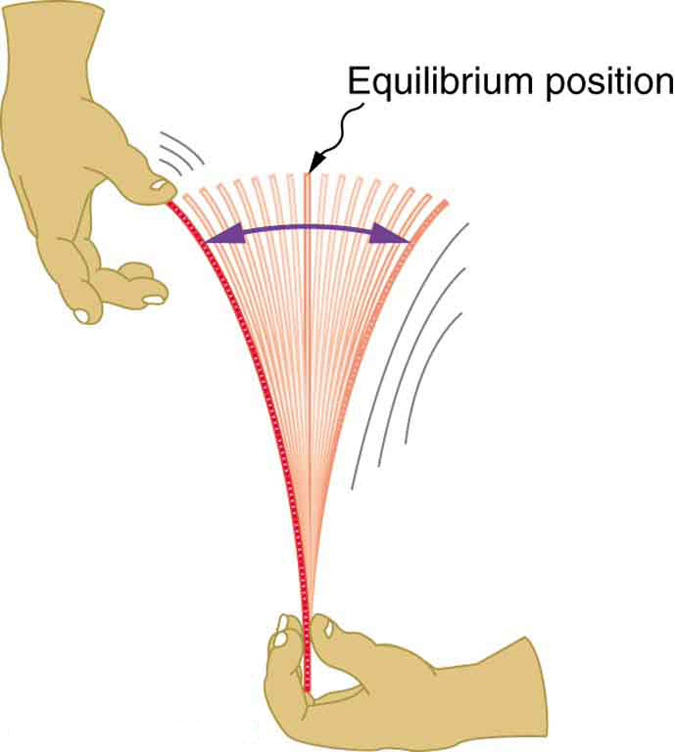
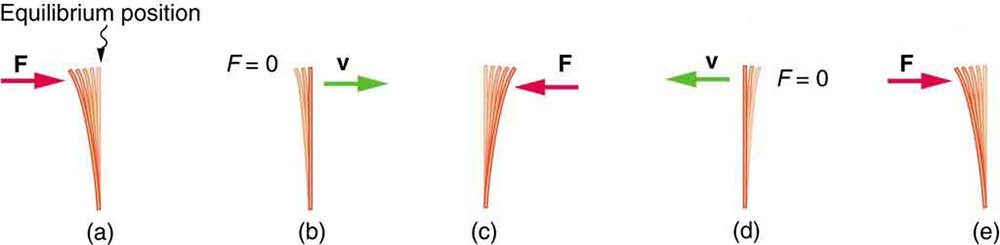
Newton’s first law implies that an object oscillating back and forth is experiencing forces. Without force, the object would move in a straight line at a constant speed rather than oscillate. Consider, for example, plucking a plastic ruler to the left as shown in Figure 2.7.1. The deformation of the ruler creates a force in the opposite direction, known as a restoring force. Once released, the restoring force causes the ruler to move back toward its stable equilibrium position, where the net force on it is zero. However, by the time the ruler gets there, it gains momentum and continues to move to the right, producing the opposite deformation. It is then forced to the left, back through equilibrium, and the process is repeated until dissipative forces dampen the motion. These forces remove mechanical energy from the system, gradually reducing the motion until the ruler comes to rest.
The simplest oscillations occur when the restoring force is directly proportional to displacement. This is called Hooke’s law force, or spring force:
Here, is the restoring force, is the displacement from equilibrium or deformation, and is a constant related to the difficulty in deforming the system. The minus sign indicates the restoring force is in the direction opposite to the displacement.
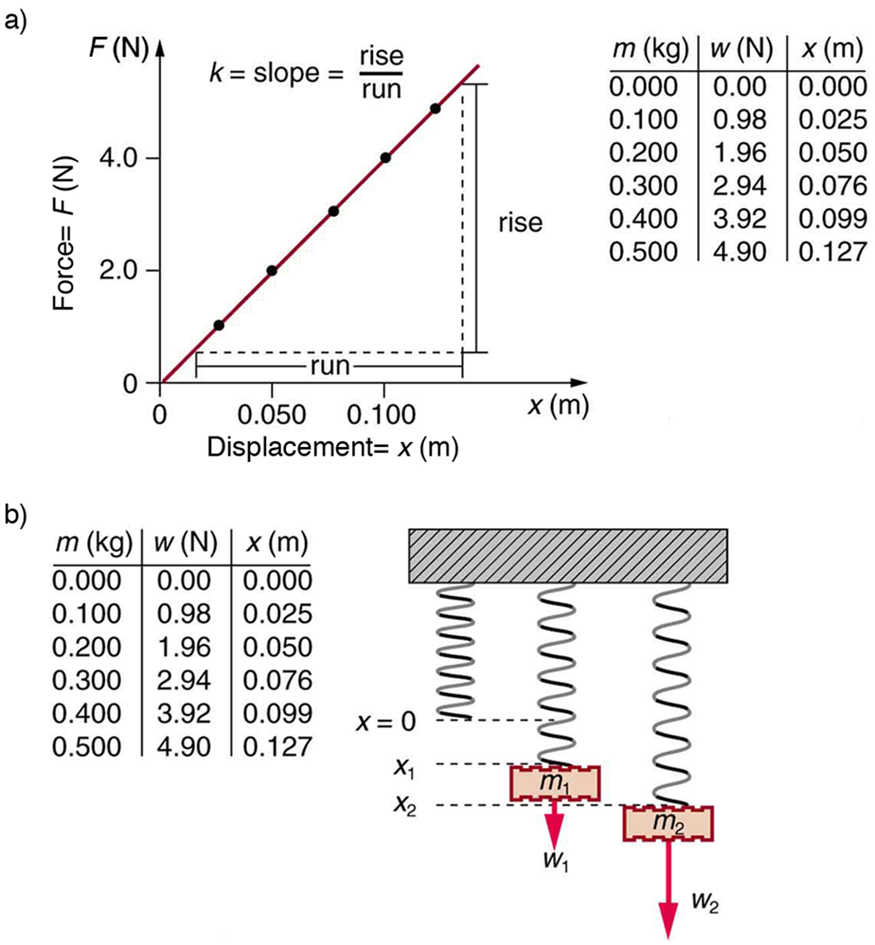
The spring constant is related to the rigidity (or stiffness) of a system—the larger the spring constant, the greater the restoring force, and the stiffer the system. The units of are newtons per meter (N/m). Figure 2.7.3 shows a graph of the absolute value of the restoring force versus the displacement for a system that can be described by Hooke’s law—a simple spring in this case. The slope of the graph equals the spring constant in newtons per meter.
Example 2.7.1
How Stiff Are Car Springs?

What is the spring constant for the suspension system of a car that settles 1.20 cm when an 80.0-kg person gets in?
Strategy
Consider the car to be in its equilibrium position before the person gets in. The car then settles down 1.20 cm, which means it is displaced to a position . At that point, the springs supply a restoring force equal to the person’s weight . We take this force to be in Hooke’s law. Knowing and , we can then solve the spring constant .
Solution
- Solve Hooke’s law, , for :
(2.7.2)Substitute known values and solve :(2.7.3)
Discussion
Note that and have opposite signs because they are in opposite directions—the restoring force is up, and the displacement is down. Also, note that the car would oscillate up and down when the person got in if it were not for damping (due to frictional forces) provided by shock absorbers. Bouncing cars are a sure sign of bad shock absorbers.
Section Summary
- An oscillation is a back and forth motion of an object between two points of deformation.
- An oscillation may create a wave, which is a disturbance that propagates from where it was created.
- The simplest type of oscillations and waves are related to systems that can be described by Hooke’s law:
(2.7.4)where is the restoring force, is the displacement from equilibrium or deformation, and is the spring constant of the system.
Conceptual Questions
Exercise 23
Describe a system which undergoes an oscillation under a Hooke's law force.
Exercise 24
Imagine an object under a hypothetical force behaving opposite to Hooke's law force. That is, instead of restoring force (, with the negative sign indicating that the force acts in the opposite direction of displacement), the force reinforces an initial displacement: . What would happen to this object if it is placed at the equilibrium () and then very slightly disturbed?
deformation
displacement from equilibrium
spring constant
a constant related to the rigidity of a system: the larger the spring constant, the more rigid the system; the spring constant is represented by k
restoring force
force acting in opposition to the force caused by a deformation