3.6
Spring Potential Energy
Chapter contents: Chapter 3: Work and Energy
Hooke's Law, , describes force exerted by a spring being deformed. Here, is the restoring force, is the displacement from equilibrium or deformation, and is a constant related to the difficulty in deforming the system. The minus sign indicates the restoring force is in the direction opposite to the displacement.
In order to produce a deformation, work must be done. That is, a force must be exerted through a distance, whether you pluck a guitar string or compress a car spring. If the only result is deformation, and no work goes into thermal, sound, or kinetic energy, then all the work is initially stored in the deformed object as some form of potential energy. The potential energy stored in a spring is . Here, we generalize the idea to elastic potential energy for a deformation of any system that can be described by Hooke’s law. Hence,
where is the elastic potential energy stored in any deformed system that obeys Hooke’s law and has a displacement from equilibrium and a force constant .
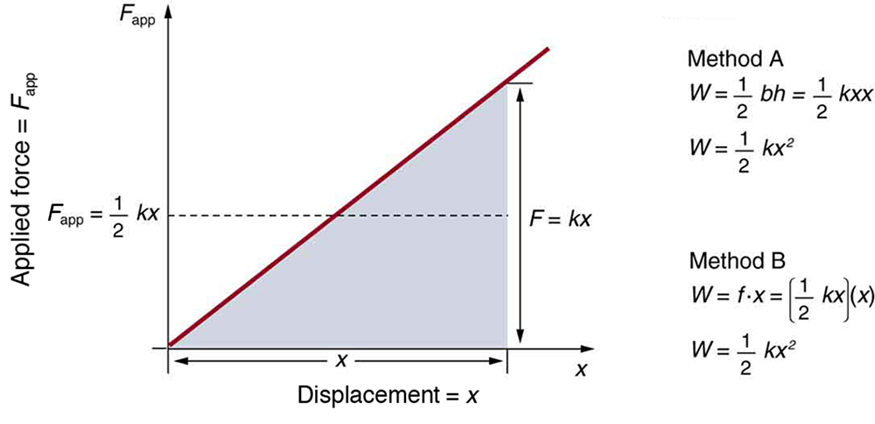
It is possible to find the work done in deforming a system in order to find the energy stored. This work is performed by an applied force . The applied force is exactly opposite to the restoring force (action-reaction), and so . Figure 3.6.1 shows a graph of the applied force versus deformation for a system that can be described by Hooke’s law. Work done on the system is force multiplied by distance, which equals the area under the curve or (Method A in the figure). Another way to determine the work is to note that the force increases linearly from 0 to , so that the average force is , the distance moved is , and thus (Method B in the figure).
Example 3.6.1
Calculating Stored Energy: A Tranquilizer Gun Spring
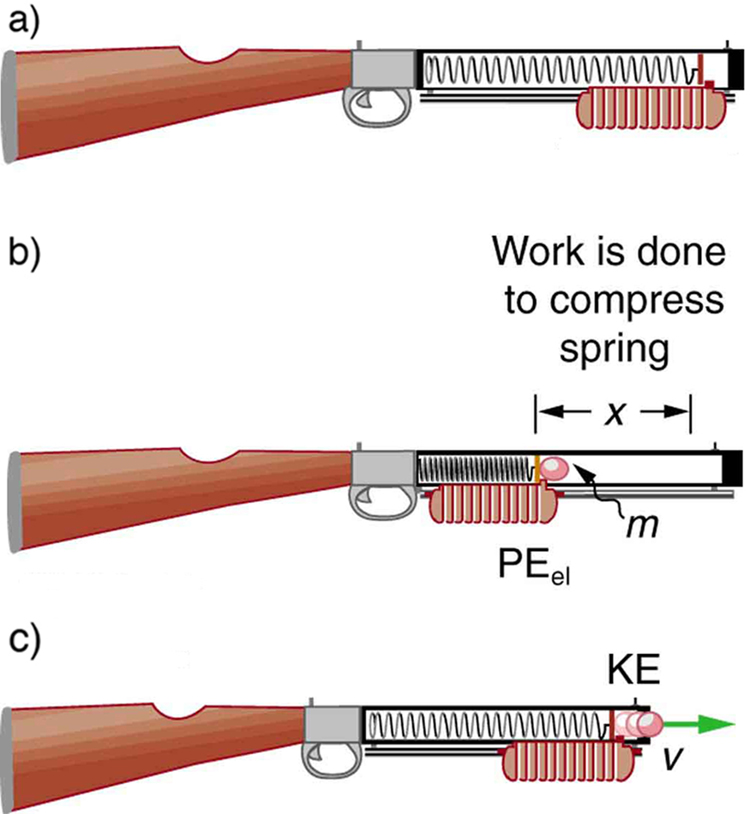
We can use a toy gun’s spring mechanism to ask and answer two simple questions: (a) How much energy is stored in the spring of a tranquilizer gun that has a force constant of 50.0 N/m and is compressed 0.150 m? (b) If you neglect friction and the mass of the spring, at what speed will a 2.00-g projectile be ejected from the gun?
Strategy for a
(a): The energy stored in the spring can be found directly from elastic potential energy equation, because and are given.
Solution for a
Entering the given values for and yields
Strategy for b
Because there is no friction, the potential energy is converted entirely into kinetic energy. The expression for kinetic energy can be solved for the projectile’s speed.
Solution for b
- Identify known quantities:
(3.6.3)
- Solve for :
(3.6.4)
- Convert units:
Discussion
(a) and (b): This projectile speed is impressive for a tranquilizer gun (more than 80 km/h). The numbers in this problem seem reasonable. The force needed to compress the spring is small enough for an adult to manage, and the energy imparted to the dart is small enough to limit the damage it might do. Yet, the speed of the dart is great enough for it to travel an acceptable distance.
Exercise
Check your Understanding
Envision holding the end of a ruler with one hand and deforming it with the other. When you let go, you can see the oscillations of the ruler. In what way could you modify this simple experiment to increase the rigidity of the system?
Solution
Answer
You could hold the ruler at its midpoint so that the part of the ruler that oscillates is half as long as in the original experiment.
Exercise
Check your Understanding
If you apply a deforming force on an object and let it come to equilibrium, what happened to the work you did on the system?
Solution
Answer
It was stored in the object as potential energy.
Section Summary
- Hooke’s law describes force exerted by a spring being deformed,
(3.6.5)where is the restoring force, is the displacement from equilibrium or deformation, and is the force constant of the system.
- Elastic potential energy stored in the deformation of a system that can be described by Hooke’s law is given by
(3.6.6)
Conceptual Questions
Exercise 17
Describe a system in which elastic potential energy is stored.
deformation
displacement from equilibrium
elastic potential energy
potential energy stored as a result of deformation of an elastic object, such as the stretching of a spring