11.5
The Electromagnetic Spectrum: Application Notes
Chapter contents: Chapter 11: Light
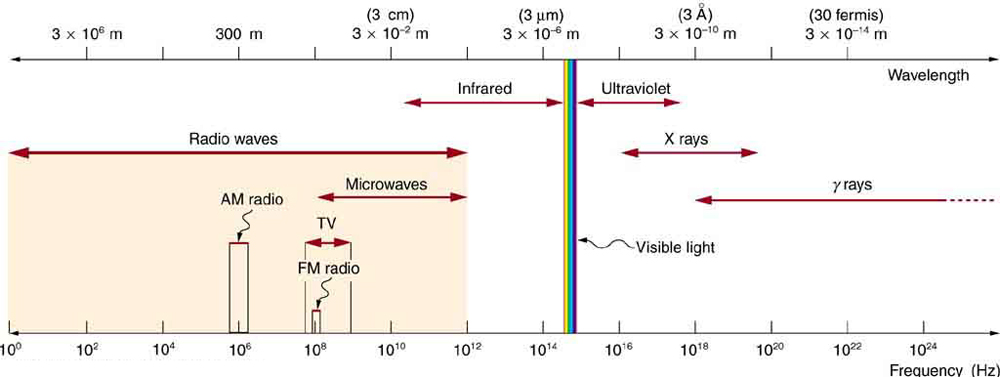
In this module, we look at the properties of different types of electromagnetic waves. Again, Figure 11.5.1 shows the electromagnetic spectrum. The characteristics of the various types of electromagnetic waves you will read about below are related to their frequencies and wavelengths.
Radio and TV Waves
Radio waves are electromagnetic waves in the lowest-frequency region of the spectrum, including microwaves. A familiar use of radio waves is carrying audio information in radio broadcasts. The name is applied to electromagnetic waves of similar frequencies regardless of source. Radio waves from outer space, for example, do not come from alien radio stations. They are created by many astronomical phenomena, and their study has revealed much about nature on the largest scales.
There are many uses for radio waves, and so the category is divided into many subcategories, including microwaves and those electromagnetic waves used for AM and FM radio, cellular telephones, and TV.
The lowest commonly encountered radio frequencies are produced by high-voltage AC power transmission lines at frequencies of 50 or 60 Hz. (See Figure 11.5.2.) These extremely long wavelength electromagnetic waves (about 6000 km!) are one means of energy loss in long-distance power transmission.

There was a concern regarding potential health hazards associated with exposure to these electromagnetic fields (-fields). Some people suspect that living near such transmission lines may cause a variety of illnesses, including cancer. Studies have not established that exposure to these fields from power lines causes cancer.
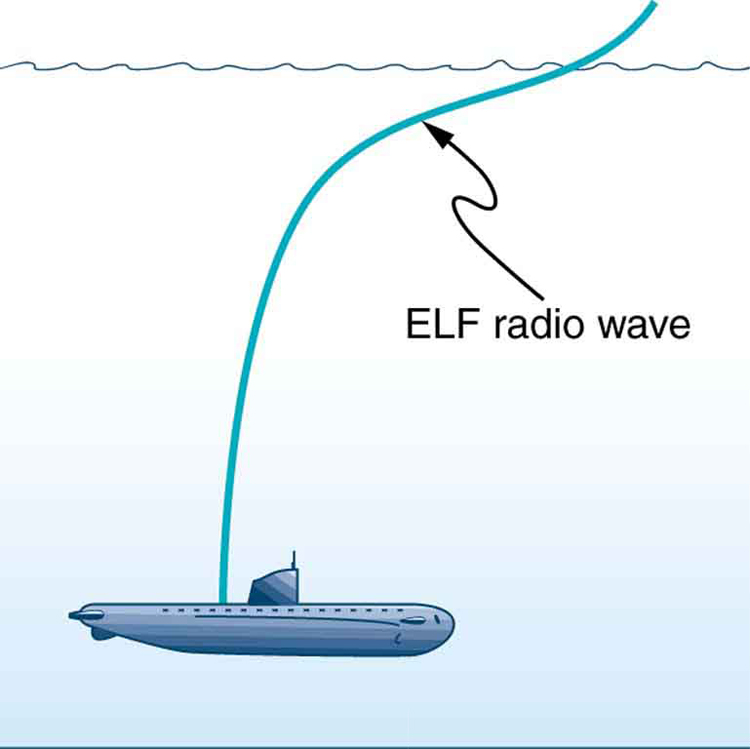
Extremely low frequency (ELF) radio waves have been used to communicate with submerged submarines; the US Navy used a frequency of about 76 Hz. The ability of radio waves to penetrate salt water is related to their wavelength—the longer the wavelength, the farther they penetrate. Since salt water is a good conductor, radio waves are strongly absorbed by it, and very long wavelengths are needed to reach a submarine under the surface. (See Figure 11.5.3.)
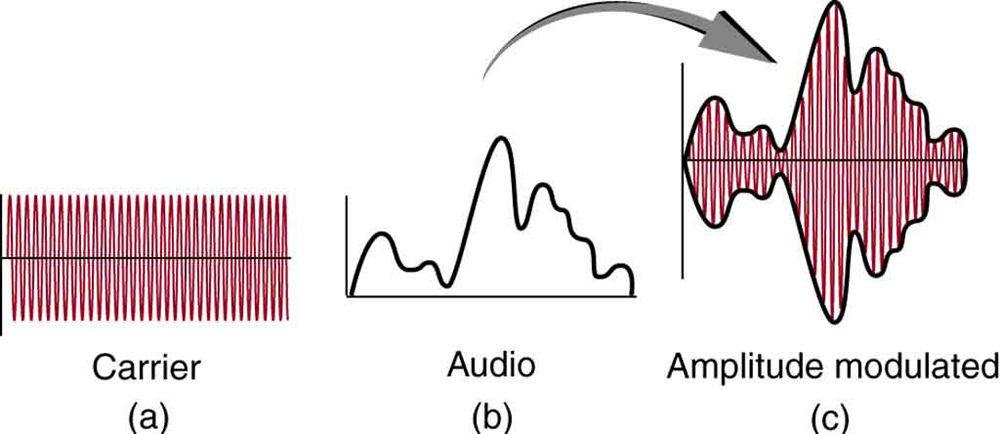
AM radio waves are used to carry commercial radio signals, with carrier frequencies from 540 to 1700 kHz in the United States. The abbreviation AM stands for amplitude modulation, which is the method for placing information on these waves. (See Figure 11.5.4.) A carrier wave having the basic frequency of the radio station, say 1530 kHz, is varied or modulated in amplitude by an audio signal. The carrier frequency remains fixed while its amplitude varies.
A radio receiver tuned to have the same resonant frequency as the carrier wave can pick up the signal, while rejecting the many other frequencies impinging on its antenna. The receiver’s circuitry is designed to respond to variations in amplitude of the carrier wave to replicate the original audio signal. That audio signal is amplified to drive a speaker or perhaps to be recorded.
FM Radio Waves
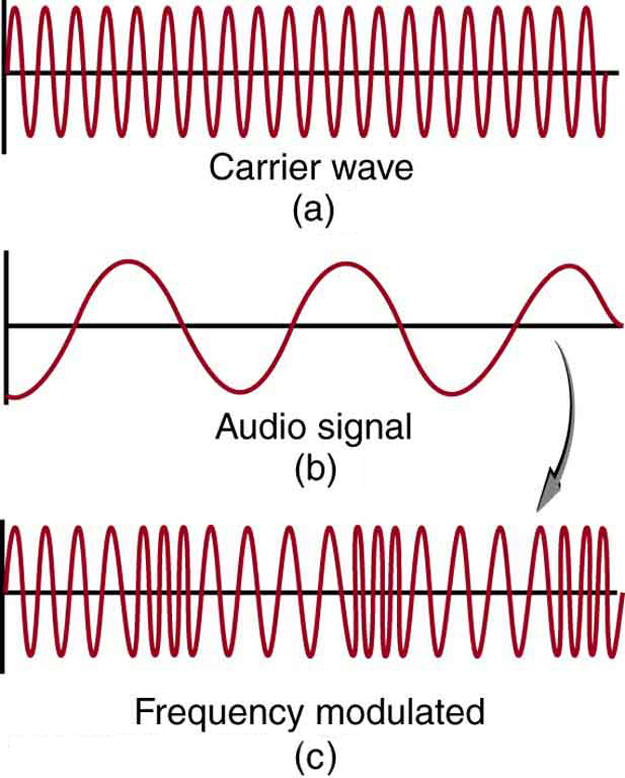
FM radio waves are also used for commercial radio transmission, but in a different frequency range: 88 to 108 MHz in the United States. FM stands for frequency modulation, another method of carrying information. (See Figure 11.5.5.) Here a carrier wave having the basic frequency of the radio station, perhaps 105.1 MHz, is modulated in frequency by the audio signal, producing a wave of constant amplitude but varying frequency.
Modulating a carrier with an audio signal produces additional frequency components, called sidebands, above and below the carrier frequency. The width of the frequency band needed to carry a signal is its bandwidth. For FM, transmitting higher audio frequencies or using a greater frequency deviation requires more bandwidth. Stations must be sufficiently separated in frequency for a receiver to select one station’s signal. In the United States, FM broadcast channels are spaced 200 kHz apart, with 100% modulation corresponding to a frequency deviation of 75 kHz above or below the carrier frequency. An FM receiver selects the desired channel and responds to variations in frequency, reproducing the audio information.
FM radio is inherently less subject to noise from stray radio sources than AM radio. The reason is that amplitudes of waves add. So an AM receiver would interpret noise added onto the amplitude of its carrier wave as part of the information. An FM receiver can be made to reject amplitudes other than that of the basic carrier wave and only look for variations in frequency. It is thus easier to reject noise from FM, since noise produces a variation in amplitude.
Television is also broadcast on electromagnetic waves. Since the waves must carry a great deal of visual as well as audio information, each channel requires greater bandwidth than an audio-only radio broadcast. In the United States, TV channels use frequencies from 54 to 72 MHz, 76 to 88 MHz, and 174 to 216 MHz. (The FM radio band lies between the lower and upper groups.) These TV channels are called VHF (for very high frequency). Other channels called UHF (for ultra high frequency) utilize an even higher frequency range of 470 to 608 MHz.
In older analog television broadcasts, the video signal used AM and the audio used FM. Digital television encodes both picture and sound as digital data. The frequency bands listed above are used for over-the-air broadcasts received by an antenna.
Example 11.5.1
Calculating Wavelengths of Radio Waves
Calculate the wavelengths of a 1530-kHz AM radio signal, a 105.1-MHz FM radio signal, and a 1.90-GHz cell phone signal.
Strategy
The relationship between wavelength and frequency is , where is the speed of light (the speed of light is only very slightly smaller in air than it is in a vacuum). We can rearrange this equation to find the wavelength for all three frequencies.
Solution
Rearranging gives
.
(a) For the AM radio signal, then,
.
(b) For the FM radio signal,
.
(c) And for the cell phone,
.
Discussion
These wavelengths are consistent with the spectrum in Figure 11.5.1. The wavelengths are also related to other properties of these electromagnetic waves, as we shall see.
The wavelengths found in the preceding example are representative of AM, FM, and cell phones, and account for some of the differences in how they are broadcast and how well they travel. The most efficient length for a linear antenna, such as discussed in “Production of Electromagnetic Waves”, is , half the wavelength of the electromagnetic wave. Thus a very large antenna is needed to efficiently broadcast typical AM radio with its carrier wavelengths on the order of hundreds of meters.
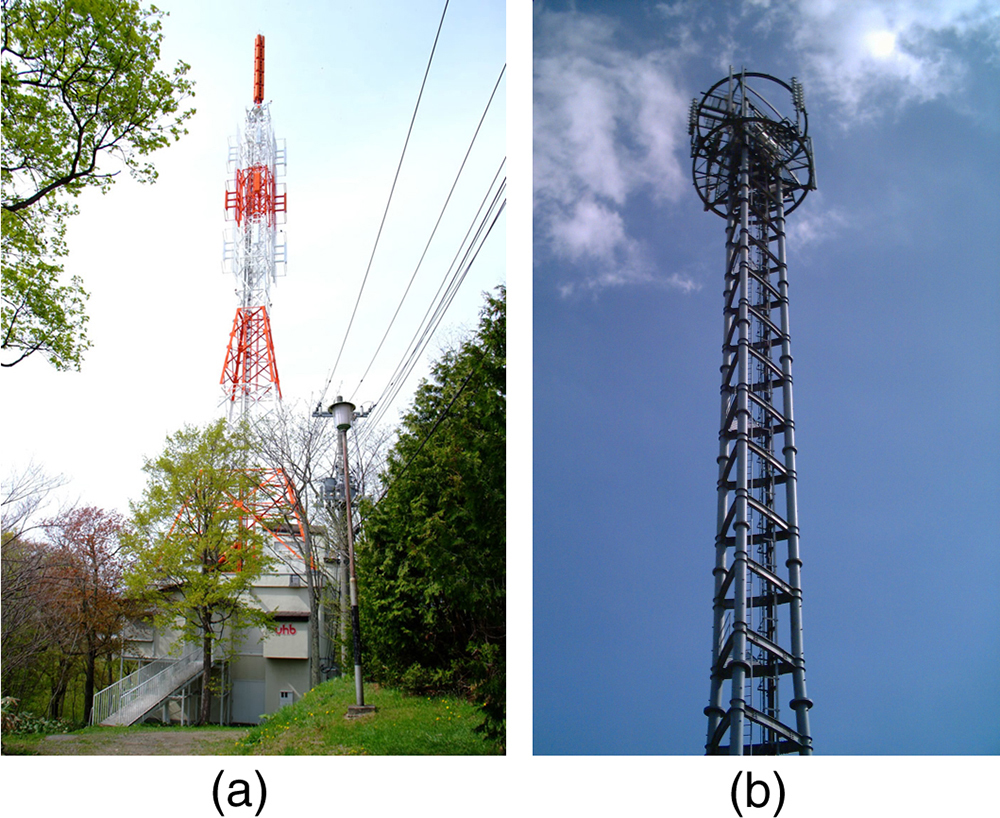
One benefit to these long AM wavelengths is that they can go over and around rather large obstacles (like buildings and hills), just as ocean waves can go around large rocks. FM and TV are best received when there is a line of sight between the broadcast antenna and receiver, and they are often sent from very tall structures. FM, TV, and mobile phone antennas themselves are much smaller than those used for AM, but they are elevated to achieve an unobstructed line of sight. (See Figure 11.5.6.)
Radio Wave Interference
Astronomers and astrophysicists collect signals from outer space using electromagnetic waves. A common problem for astrophysicists is the “pollution” from electromagnetic radiation pervading our surroundings from communication systems in general. Even everyday gadgets like our car keys having the facility to lock car doors remotely and being able to turn TVs on and off using remotes involve radio-wave frequencies. In order to prevent interference between all these electromagnetic signals, strict regulations are drawn up for different organizations to utilize different radio frequency bands.
One reason why we are sometimes asked to switch off our mobile phones on airplanes and in hospitals is that important communications or medical equipment can be affected by radio signals from these devices. MRI scanners, for example, are shielded to prevent outside radio signals from interfering with the signals used to form images.
Radio waves used in magnetic resonance imaging (MRI) have frequencies on the order of 100 MHz, although this varies significantly depending on the strength of the magnetic field used and the type of nucleus being scanned. MRI is an important medical imaging and research tool, producing highly detailed two- and three-dimensional images. Radio-frequency pulses excite nuclei, usually hydrogen nuclei (protons), and the resulting radio signals depend on the density of these nuclei and their surroundings.
The wavelength of 100-MHz radio waves in vacuum is 3 m, yet MRI can image details smaller than a millimeter. By varying the magnetic field strength with position, the scanner makes the resonant frequency depend on location, allowing signals from different locations to be distinguished. This permits imaging of details much smaller than the radio wavelength.
Microwaves
Microwaves are the highest-frequency electromagnetic waves that can be produced by currents in macroscopic circuits and devices. Microwave frequencies range from about to the highest practical resonance at nearly . Since they have high frequencies, their wavelengths are short compared with those of other radio waves—hence the name “microwave”.
Microwaves can also be produced by atoms and molecules. They are, for example, a component of electromagnetic radiation generated by thermal agitation. The thermal motion of atoms and molecules in any object at a temperature above absolute zero causes them to emit and absorb radiation.
Microwave bands offer wide bandwidths, allowing large amounts of information to be transmitted per unit time. Most satellite-transmitted information is carried on microwaves, as are land-based long-distance transmissions. A clear line of sight between transmitter and receiver is needed because of the short wavelengths involved.
Radar is a common application of microwaves that was first developed in World War II. By detecting and timing microwave echoes, radar systems can determine the distance to objects as diverse as clouds and aircraft. A Doppler shift in the radar echo can be used to determine the speed of a car or the intensity of a rainstorm. Sophisticated radar systems are used to map the Earth and other planets, with a resolution limited by wavelength. (See Figure 11.5.7.) The shorter the wavelength of any probe, the smaller the detail it is possible to observe.

Heating with Microwaves
How does the ubiquitous microwave oven produce microwaves electronically, and why does food absorb them preferentially? Microwaves at a frequency of 2.45 GHz are produced by accelerating electrons. The microwaves are then used to induce an alternating electric field in the oven.
Water and some other constituents of food have a slightly negative charge at one end and a slightly positive charge at one end (called polar molecules). The range of microwave frequencies is specially selected so that the polar molecules, in trying to keep orienting themselves with the electric field, absorb these energies and increase their temperatures—called dielectric heating.
The energy thereby absorbed results in thermal agitation heating food and not the plate, which does not contain water. Hot spots in the food are related to constructive and destructive interference patterns. Rotating antennas and food turntables help spread out the hot spots.
Another use of microwaves for heating is within the human body. Microwaves will penetrate more than shorter wavelengths into tissue and so can accomplish “deep heating” (called microwave diathermy). This is used for treating muscular pains, spasms, tendonitis, and rheumatoid arthritis.
Making Connections: Take-Home Experiment—Microwave Ovens
- Look at the door of a microwave oven. Describe the structure of the door. Why is there a metal grid on the door? How does the size of the holes in the grid compare with the wavelengths of microwaves used in microwave ovens? What is this wavelength?
- Place a glass of water (about 250 ml) in the microwave and heat it for 30 seconds. Measure the temperature gain (the ). Assuming that the power output of the oven is 1000 W, calculate the efficiency of the heat-transfer process.
- Remove the rotating turntable or moving plate and place a cup of water in several places along a line parallel with the opening. Heat for 30 seconds and measure the for each position. Do you see cases of destructive interference?
Microwaves generated by atoms and molecules far away in time and space can be received and detected by electronic circuits. Deep space acts like a blackbody with a 2.7 K temperature, radiating most of its energy in the microwave frequency range. In 1964, Penzias and Wilson detected this radiation and eventually recognized that it was the radiation of the Big Bang’s cooled remnants.
Infrared Radiation
The microwave and infrared regions of the electromagnetic spectrum overlap (see Figure 11.5.1). Infrared radiation is generally produced by thermal motion and the vibration and rotation of atoms and molecules. Electronic transitions in atoms and molecules can also produce infrared radiation.
The range of infrared frequencies extends up to the lower limit of visible light, just below red. In fact, infrared means “below red”. Frequencies at its upper limit are too high to be produced by accelerating electrons in circuits, but small systems, such as atoms and molecules, can vibrate fast enough to produce these waves.
Water molecules rotate and vibrate particularly well at infrared frequencies, emitting and absorbing them so efficiently that the emissivity for skin is in the infrared. Night-vision scopes can detect the infrared emitted by various warm objects, including humans, and convert it to visible light.
We can examine radiant heat transfer from a house by using a camera capable of detecting infrared radiation. Reconnaissance satellites can detect buildings, vehicles, and even individual humans by their infrared emissions, whose power radiation is proportional to the fourth power of the absolute temperature. More mundanely, we use infrared lamps, some of which are called quartz heaters, to preferentially warm us because we absorb infrared better than our surroundings.
The Sun radiates approximately like a blackbody—an ideal absorber and emitter of radiation—with a surface temperature of about 6000 K. A perfect blackbody has an emissivity of ; emissivity measures how effectively a surface emits thermal radiation compared with a blackbody at the same temperature. We discuss this model further in Blackbody Radiation. About half of the solar energy arriving at the Earth is in the infrared region, with most of the rest in the visible part of the spectrum, and a relatively small amount in the ultraviolet. On average, about half of the solar energy arriving at the top of the atmosphere is absorbed by Earth’s surface.
The relatively constant temperature of the Earth is a result of the energy balance between the incoming solar radiation and the energy radiated from the Earth. Most of the infrared radiation emitted from the Earth is absorbed by and in the atmosphere and then radiated back to Earth or into outer space. This radiation back to Earth is known as the greenhouse effect, and it maintains the surface temperature of the Earth about higher than it would be if there is no absorption. The increased concentration of and other greenhouse gases in the atmosphere, resulting from increases in fossil fuel burning, has increased global average temperatures.
Visible Light
Visible light is the narrow segment of the electromagnetic spectrum to which the normal human eye responds. Visible light is produced by vibrations and rotations of atoms and molecules, as well as by electronic transitions within atoms and molecules. The receivers or detectors of light largely utilize electronic transitions. We say the atoms and molecules are excited when they absorb and relax when they emit through electronic transitions.
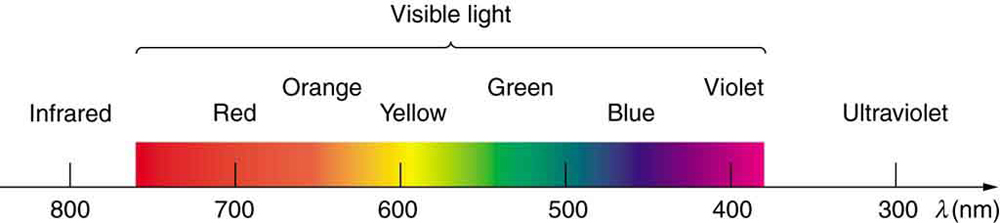
Figure 11.5.8 shows this part of the spectrum, together with the colors associated with particular pure wavelengths. We usually refer to visible light as having wavelengths of between 400 nm and 750 nm. (The retina of the eye actually responds to the lowest ultraviolet frequencies, but these do not normally reach the retina because they are absorbed by the cornea and lens of the eye.)
Within the visible spectrum, red light has the lowest frequencies and longest wavelengths, while violet has the highest frequencies and shortest wavelengths. Sunlight contains a broad mixture of visible wavelengths that together appear white. When sunlight passes through Earth’s atmosphere, shorter wavelengths are scattered more strongly, which can make the Sun appear yellow, orange, or red, especially near the horizon.
Living things—plants and animals—have evolved to utilize and respond to parts of the electromagnetic spectrum they are embedded in. Visible light is the most predominant and we enjoy the beauty of nature through visible light. Plants are more selective. Photosynthesis makes use of parts of the visible spectrum to make sugars.
Optics is the study of the behavior of visible light and other forms of electromagnetic waves. Optics falls into two distinct categories. When electromagnetic radiation, such as visible light, interacts with objects that are large compared with its wavelength, its motion can be represented by straight lines like rays. Ray optics is the study of such situations and includes lenses and mirrors.
When electromagnetic radiation interacts with objects about the same size as the wavelength or smaller, its wave nature becomes apparent. For example, observable detail is limited by the wavelength, and so visible light can never detect individual atoms, because they are so much smaller than its wavelength. Physical or wave optics is the study of such situations and includes all wave characteristics.
Take-Home Experiment: Colors That Match
When you light a match you see largely orange light; when you light a gas stove you see blue light. Why are the colors different? What other colors are present in these?
Ultraviolet Radiation
Ultraviolet means “above violet”. The electromagnetic frequencies of ultraviolet radiation (UV) extend upward from violet, the highest-frequency visible light. Ultraviolet is also produced by atomic and molecular motions and electronic transitions. The wavelengths of ultraviolet extend from 400 nm down to about 10 nm at its highest frequencies, which overlap with the lowest X-ray frequencies. It was recognized as early as 1801 by Johann Ritter that the solar spectrum had an invisible component beyond the violet range.
Solar UV radiation is broadly subdivided into three regions: UVA (315–400 nm), UVB (280–315 nm), and UVC (100–280 nm), ranked from long to shorter wavelengths (from smaller to larger energies). Most UVB and all UVC is absorbed by ozone () molecules in the upper atmosphere. Consequently, most of the solar UV radiation reaching the Earth’s surface is UVA.
Human Exposure to UV Radiation
It is largely exposure to UVB that causes skin cancer. It is estimated that as many as 20% of adults will develop skin cancer over the course of their lifetime. Treatment is often successful if the cancer is caught early. Despite very little UVB reaching the Earth’s surface, there are substantial increases in skin-cancer rates in countries such as Australia, indicating how important it is that UVB and UVC continue to be absorbed by the upper atmosphere.
UV radiation can damage collagen fibers, resulting in an acceleration of the aging process of skin and the formation of wrinkles. Large UV exposures can cause sunburn, and repeated exposure increases the risk of skin cancer. Some studies indicate a link between overexposure to the Sun when young and melanoma later in life. UVB radiation can damage DNA molecules, leading to mutations and the possible formation of cancerous cells. The tanning response is a defense mechanism in which the body produces the pigment melanin to absorb some of the UV radiation reaching the skin.
Repeated exposure to UVB may also lead to the formation of cataracts in the eyes—a cause of blindness among people living in the equatorial belt where medical treatment is limited. Cataracts, clouding in the eye’s lens and a loss of vision, are age related; 60% of those between the ages of 65 and 74 will develop cataracts. However, treatment is easy and successful, as one replaces the lens of the eye with a plastic lens. Prevention is important. Eye protection from UV is more effective with plastic sunglasses than those made of glass. A major acute effect of extreme UV exposure is the suppression of the immune system, both locally and throughout the body.
Flash photography is generally not allowed of precious artworks and colored prints because the UV radiation from the flash can cause photo-degradation in the artworks. Often artworks will have an extra-thick layer of glass in front of them, which is especially designed to absorb UV radiation.
UV Light and the Ozone Layer
If all of the Sun’s ultraviolet radiation reached the Earth’s surface, there would be extremely grave effects on the biosphere from the severe cell damage it causes. However, the layer of ozone () in our upper atmosphere (10 to 50 km above the Earth) protects life by absorbing most of the dangerous UV radiation.
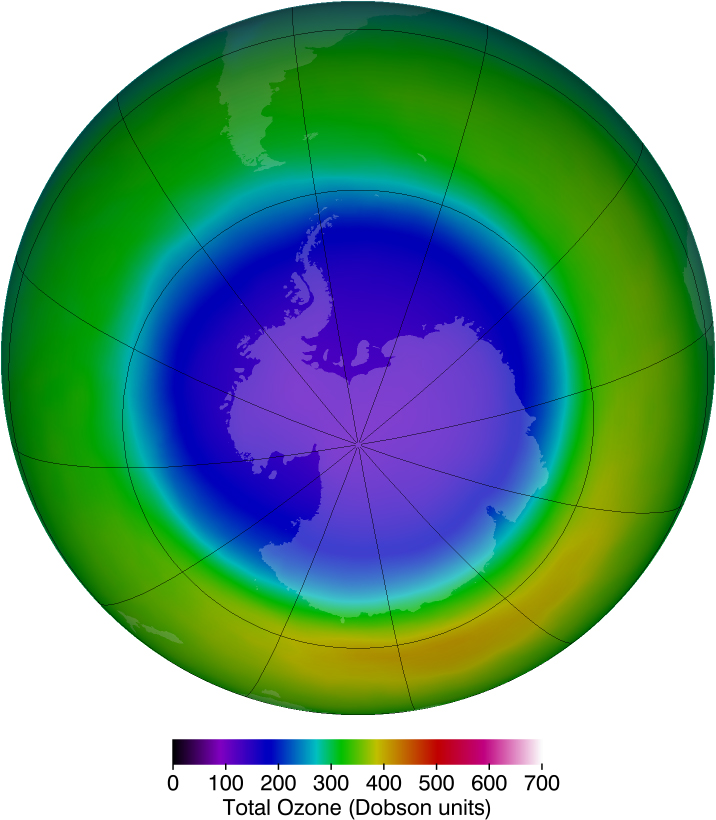
Unfortunately, today we are observing a depletion in ozone concentrations in the upper atmosphere. This depletion has led to the formation of an “ozone hole” in the upper atmosphere. The hole is more centered over the southern hemisphere, and changes with the seasons, being largest in the spring. This depletion is attributed to the breakdown of ozone molecules by refrigerant gases called chlorofluorocarbons (CFCs).
In the stratosphere, UV radiation dissociates CFC molecules, releasing highly reactive chlorine (Cl) atoms, which catalyze the destruction of ozone. For example, ultraviolet light can break a bond in a CFC molecule, releasing a chlorine atom:
.
(11.5.1)The Cl atom then catalyzes the breakdown of ozone as follows:
and .
(11.5.2)A single chlorine atom could destroy ozone molecules for up to two years before being transported down to the surface. The CFCs are relatively stable and will contribute to ozone depletion for years to come. CFCs are found in refrigerants, air conditioning systems, foams, and aerosols.
International concern over this problem led to the establishment of the “Montreal Protocol” agreement (1987) to phase out CFC production in most countries. However, continued participation by developing countries is needed to sustain the worldwide phase-out of CFCs. And while there are indicators that the Protocol has been a success, there is still substantial risk and variability in the ozone layer. The 2019 Antarctic ozone hole was small and short-lived, continuing the general trend toward recovery. But the 2020 Antarctic ozone hole was large and long-lasting, partially due to atmospheric conditions. Furthermore, emissions are not the only concern. Susan Solomon and her colleagues at MIT have uncovered the substantial impact of CFC “banks”, in certain regions, where outdated and deteriorating equipment (such as air conditioners) or materials can release enough CFCs to be detectable in the atmosphere and deplete the ozone layer. (See Figure 11.5.9.)
Benefits of UV Light
Besides the adverse effects of ultraviolet radiation, there are also benefits of exposure in nature and uses in technology. Vitamin D production in the skin (epidermis) results from exposure to UVB radiation, generally from sunlight. A number of studies indicate lack of vitamin D can result in the development of a range of cancers (prostate, breast, colon), so a certain amount of UV exposure is helpful. Lack of vitamin D is also linked to osteoporosis. Exposures (with no sunscreen) of 10 minutes a day to arms, face, and legs might be sufficient to provide the accepted dietary level. However, in the winter time north of about latitude, most UVB gets blocked by the atmosphere. UV radiation is also used in the treatment of some skin conditions.
Ultraviolet radiation is used to disinfect air, water, and exposed surfaces. UVC absorbed by microorganisms damages their DNA or RNA, preventing reproduction. This is a chemical effect of the absorbed radiation, rather than simply heating the material. Higher-frequency electromagnetic waves, including X-rays and gamma rays, have similar uses in treating food and sterilizing medical equipment.
UV radiation is also used as an analytical tool to identify substances. When exposed to ultraviolet, some substances, such as minerals, glow in characteristic visible wavelengths, a process called fluorescence. So-called black lights emit ultraviolet to cause posters and clothing to fluoresce in the visible. Ultraviolet is also used in special microscopes to detect details smaller than those observable with longer-wavelength visible-light microscopes.
X-Rays
In 1895, Wilhelm Conrad Röntgen discovered an invisible, penetrating form of radiation while experimenting with high-voltage electrical discharges in tubes filled with rarefied gases. He called this radiation X-rays because its nature was unknown. X-rays were later established to be very high frequency electromagnetic radiation.
Things Great and Small: A Submicroscopic View of X-Ray Production
X-rays can be created in a high-voltage discharge. They are emitted in the material struck by electrons in the discharge current. There are two mechanisms by which the electrons create X-rays.
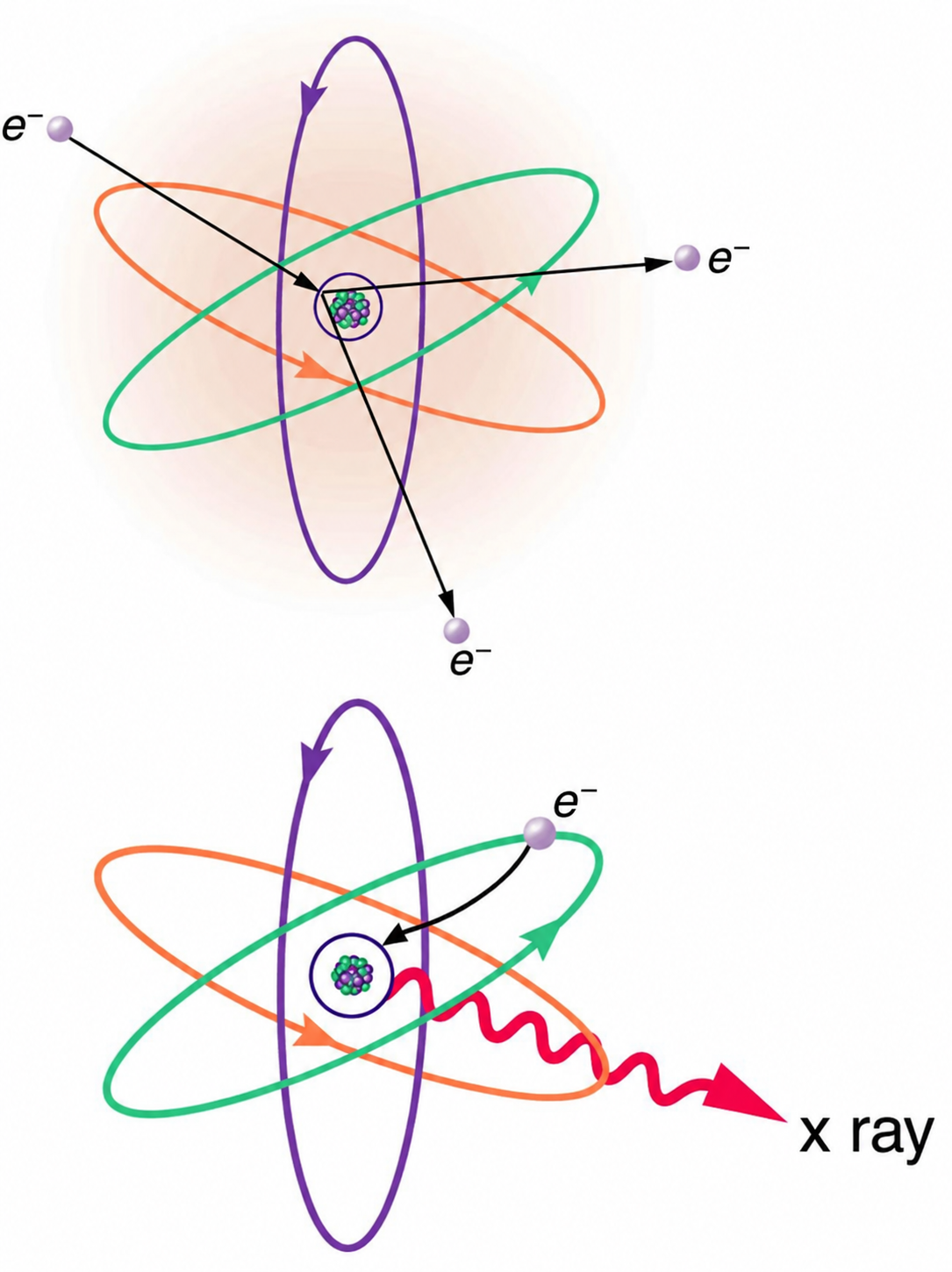
The first method is illustrated in Figure 11.5.10. An electron accelerated through a sufficiently large voltage strikes a metal target, such as copper, and ejects an inner-shell electron—one relatively close to and tightly bound to the nucleus—from one of its atoms. An electron from a higher-energy shell then fills the vacancy, releasing the energy difference as an X-ray. Since the electron energy levels are characteristic of the element, so is the energy of the emitted radiation, hence the name characteristic X-ray.
In the second method, energetic electrons entering a material are deflected by the electric fields of atomic nuclei. Accelerated charges radiate electromagnetic waves, so the electrons lose energy by emitting radiation, which can include X-rays. This radiation is called bremsstrahlung (German for “braking radiation”). The electrons can lose different amounts of energy in these encounters, producing a continuous spectrum of X-ray energies rather than the distinct energies of characteristic X-rays.
As described above, there are two methods by which X-rays are created—both are submicroscopic processes and can be caused by high-voltage discharges. While the low-frequency end of the X-ray range overlaps with the ultraviolet, X-rays extend to much higher frequencies (and energies).
X-rays have adverse effects on living cells similar to those of ultraviolet radiation, and they have the additional liability of being more penetrating, affecting more than the surface layers of cells. Cancer and genetic defects can be induced by exposure to X-rays. Because of their effect on rapidly dividing cells, X-rays can also be used to treat and even cure cancer.
The widest use of X-rays is for imaging objects that are opaque to visible light, such as the human body or aircraft parts. In humans, the risk of cell damage is weighed carefully against the benefit of the diagnostic information obtained. In 2009–2010, an FDA investigation documented accidental radiation overexposure during CT brain-perfusion scans, highlighting the importance of appropriate scan settings and dose monitoring.
The ability of X-rays to penetrate matter depends on density, and so an X-ray image can reveal very detailed density information. Figure 11.5.11 shows an example of the simplest type of X-ray image, an X-ray shadow on film. The amount of information in a simple X-ray image is impressive, but more sophisticated techniques, such as CT scans, can reveal three-dimensional information with details smaller than a millimeter.
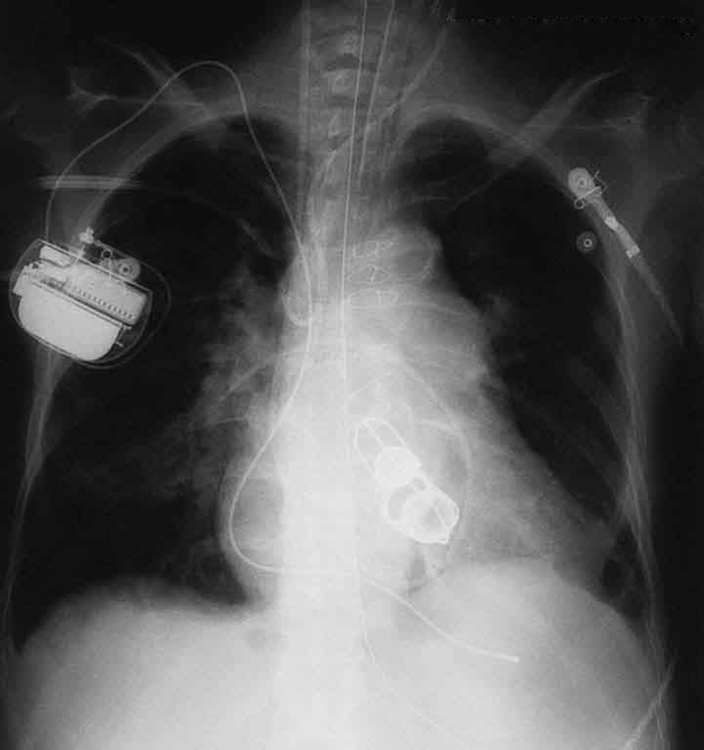
The use of X-ray technology in medicine is called radiology—an established and relatively cheap tool in comparison to more sophisticated technologies. Consequently, X-rays are widely available and used extensively in medical diagnostics. During World War I, mobile X-ray units, advocated by Marie Curie, were used to diagnose soldiers.
Because they can have wavelengths less than 0.01 nm, X-rays can be scattered (a process called X-ray diffraction) to detect the shape of molecules and the structure of crystals. X-ray diffraction was crucial to Crick, Watson, and Wilkins in the determination of the shape of the double-helix DNA molecule.
X-rays are also used as a precise tool for trace-metal analysis in X-ray induced fluorescence, in which the energy of the X-ray emissions are related to the specific types of elements and amounts of materials present.
Gamma Rays
Soon after nuclear radioactivity was first detected in 1896, it was found that at least three distinct types of radiation were being emitted. The most penetrating of these three types of radiation was called a gamma ray ( ray), continuing the naming sequence of alpha and beta rays. It was later found to be an extremely high frequency electromagnetic wave.
In nuclear physics, gamma rays are electromagnetic radiation emitted in transitions between nuclear energy levels. They can be produced by natural nuclear decay or induced nuclear processes in nuclear reactors and weapons. In astronomy, the term also includes very high-energy photons produced by other processes. The frequency ranges of gamma rays and X-rays overlap.
Gamma rays have characteristics identical to X-rays of the same frequency. In the nuclear-physics convention, the distinction is their source. Gamma rays often have higher frequencies than diagnostic X-rays and can penetrate more deeply into the body. They have many of the same uses as X-rays, including cancer therapy. Gamma radiation from radioactive materials is used in nuclear medicine. Figure 11.5.12 shows a medical image based on rays.
Exposing food to gamma radiation can greatly inhibit spoilage by killing the microorganisms that cause it. Food irradiation under approved conditions is considered safe by the FDA and does not make the food radioactive. Both X-ray and technologies are also used in scanning luggage at airports.

Astronomy Across the Electromagnetic Spectrum
The earliest telescopes, developed in the seventeenth century, collected visible light. Astronomers now use the entire electromagnetic spectrum to investigate stars and the universe. As noted earlier, Penzias and Wilson detected the microwave background radiation originating from the Big Bang.
Radio telescopes such as the Parkes radio telescope in Australia detect radio waves from astronomical sources. The James Clerk Maxwell Telescope in Hawaii observes at submillimeter wavelengths. Infrared telescopes use cooled detectors to reduce thermal noise. Cooling the telescope itself can also reduce infrared radiation that would otherwise obscure the signal being collected.
Earth’s atmosphere determines which wavelengths can reach telescopes on the ground. It transmits visible light and some radio and infrared wavelengths, but absorbs much of the ultraviolet radiation and prevents direct observations of astronomical X-rays and gamma rays from the ground. Space telescopes observe beyond this atmospheric barrier.
The Hubble Space Telescope gathers ultraviolet, visible, and near-infrared light. The Kepler Space Telescope discovered planets orbiting other stars by measuring the small, periodic decreases in starlight when planets passed in front of them. The James Webb Space Telescope observes primarily in the infrared, with wavelength coverage of about 0.6 to 28 μm. The Chandra X-ray Observatory and Fermi Gamma-ray Space Telescope extend these observations to higher frequencies.
Chapter questions and exercises