8.8
The First Law of Thermodynamics
Chapter contents: Chapter 8: Thermal Physics
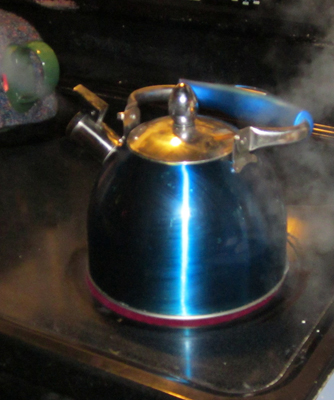
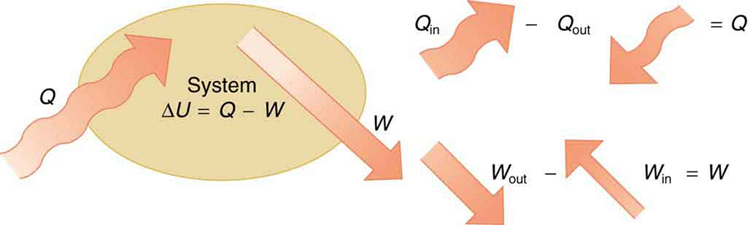
If we are interested in how heat transfer is converted into doing work, then the conservation of energy principle is important. The first law of thermodynamics applies the conservation of energy principle to systems where heat transfer and doing work are the methods of transferring energy into and out of the system. A closed system can exchange energy, but not matter, with its surroundings. An isolated system exchanges neither energy nor matter with its surroundings. Here we consider closed systems, with energy transferred by heat and work. The first law of thermodynamics states that the change in internal energy of a system equals the net heat transfer into the system minus the net work done by the system. In equation form, the first law of thermodynamics is
.
(8.8.1)Here is the change in internal energy of the system. is the net heat transferred into the system—that is, is the sum of all heat transfer into and out of the system. is the net work done by the system—that is, is the sum of all work done on or by the system. We use the following sign conventions: if is positive, then there is a net heat transfer into the system; if is positive, then there is net work done by the system. So positive adds energy to the system and positive takes energy from the system. Thus . Note also that if more heat transfer into the system occurs than work done, the difference is stored as internal energy. Heat engines are a good example of this—heat transfer into them takes place so that they can do work. (See Figure 8.8.2.) We will now examine , , and further.
Making Connections: Law of Thermodynamics and Law of Conservation of Energy
The first law of thermodynamics is actually the law of conservation of energy stated in a form most useful in thermodynamics. The first law gives the relationship between heat transfer, work done, and the change in internal energy of a system.
Heat Q and Work W
Heat transfer () and doing work () are the two everyday means of bringing energy into or taking energy out of a system. The processes are quite different. Heat transfer, a less organized process, is driven by temperature differences. Work, a quite organized process, involves a macroscopic force exerted through a distance. Nevertheless, heat and work can produce identical results.For example, both can cause a temperature increase. Heat transfer into a system, such as when the Sun warms the air in a bicycle tire, can increase its temperature, and so can work done on the system, as when the bicyclist pumps air into the tire. Once the temperature increase has occurred, it is impossible to tell whether it was caused by heat transfer or by doing work. This uncertainty is an important point. Heat transfer and work are both energy in transit—neither is stored as such in a system. However, both can change the internal energy of a system. Internal energy is a form of energy completely different from either heat or work.
Internal Energy U
Internal energy is energy associated with the system’s microscopic constituents and their interactions. It excludes the kinetic energy of the system’s overall motion and the potential energy associated with its position in an external field. Heat and work are ways of transferring energy. Because we cannot track every atom and molecule in a macroscopic system, we use averages and distributions to describe its microscopic energy.
A second way to view the internal energy of a system is in terms of its macroscopic characteristics, which are very similar to atomic and molecular average values. Internal energy is a property of the state of a system. For a fixed amount of an ideal gas, it depends only on temperature: raising the temperature increases the internal energy. For other materials, volume and physical state can also matter. For example, melting ice into water increases its internal energy even though its temperature remains constant during melting.
The change in internal energy depends only on the initial and final states, whereas the amounts of heat transferred and work done depend on the process connecting those states.
Making Connections: Macroscopic and Microscopic
In thermodynamics, we often use the macroscopic picture when making calculations of how a system behaves, while the atomic and molecular picture gives underlying explanations in terms of averages and distributions. We shall see this again in later sections of this chapter. For example, in the topic of entropy, calculations will be made using the atomic and molecular view.