8.8
The First Law of Thermodynamics
Chapter contents: Chapter 8: Thermal Physics
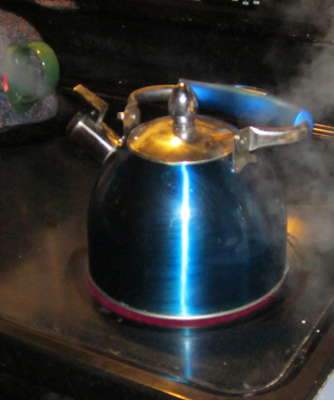
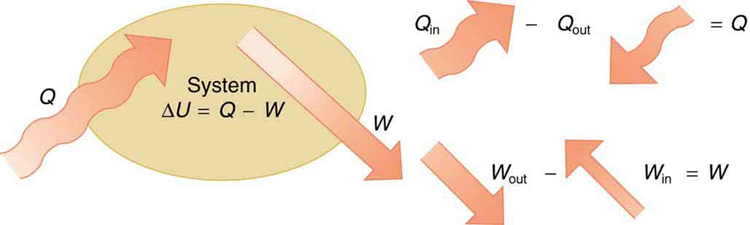
If we are interested in how heat transfer is converted into doing work, then the conservation of energy principle is important. The first law of thermodynamics applies the conservation of energy principle to systems where heat transfer and doing work are the methods of transferring energy into and out of the system. The first law of thermodynamics states that the change in internal energy of a system equals the net heat transfer into the system minus the net work done by the system. In equation form, the first law of thermodynamics is
(8.8.1)
Here is the change in internal energy of the system. is the net heat transferred into the system—that is, is the sum of all heat transfer into and out of the system. is the net work done by the system—that is, is the sum of all work done on or by the system. We use the following sign conventions: if is positive, then there is a net heat transfer into the system; if is positive, then there is net work done by the system. So positive adds energy to the system and positive takes energy from the system. Thus . Note also that if more heat transfer into the system occurs than work done, the difference is stored as internal energy. Heat engines are a good example of this—heat transfer into them takes place so that they can do work. (See Figure 8.8.2.) We will now examine , , and further.
Making Connections: Law of Thermodynamics and Law of Conservation of Energy
The first law of thermodynamics is actually the law of conservation of energy stated in a form most useful in thermodynamics. The first law gives the relationship between heat transfer, work done, and the change in internal energy of a system.
Heat Q and Work W
Heat transfer () and doing work () are the two everyday means of bringing energy into or taking energy out of a system. The processes are quite different. Heat transfer, a less organized process, is driven by temperature differences. Work, a quite organized process, involves a macroscopic force exerted through a distance. Nevertheless, heat and work can produce identical results.For example, both can cause a temperature increase. Heat transfer into a system, such as when the Sun warms the air in a bicycle tire, can increase its temperature, and so can work done on the system, as when the bicyclist pumps air into the tire. Once the temperature increase has occurred, it is impossible to tell whether it was caused by heat transfer or by doing work. This uncertainty is an important point. Heat transfer and work are both energy in transit—neither is stored as such in a system. However, both can change the internal energy of a system. Internal energy is a form of energy completely different from either heat or work.
Internal Energy U
We can think about the internal energy of a system in two different but consistent ways. The first is the atomic and molecular view, which examines the system on the atomic and molecular scale. The internal energy of a system is the sum of the kinetic and potential energies of its atoms and molecules. Recall that kinetic plus potential energy is called mechanical energy. Thus internal energy is the sum of atomic and molecular mechanical energy. Because it is impossible to keep track of all individual atoms and molecules, we must deal with averages and distributions. A second way to view the internal energy of a system is in terms of its macroscopic characteristics, which are very similar to atomic and molecular average values.
Macroscopically, we define the change in internal energy to be that given by the first law of thermodynamics:
(8.8.2)
Many detailed experiments have verified that , where is the change in total kinetic and potential energy of all atoms and molecules in a system. It has also been determined experimentally that the internal energy of a system depends only on the state of the system and not how it reached that state. More specifically, is found to be a function of a few macroscopic quantities (pressure, volume, and temperature, for example), independent of past history such as whether there has been heat transfer or work done. This independence means that if we know the state of a system, we can calculate changes in its internal energy from a few macroscopic variables.
Making Connections: Macroscopic and Microscopic
In thermodynamics, we often use the macroscopic picture when making calculations of how a system behaves, while the atomic and molecular picture gives underlying explanations in terms of averages and distributions. We shall see this again in later sections of this chapter. For example, in the topic of entropy, calculations will be made using the atomic and molecular view.
Section Summary
- The first law of thermodynamics is given as , where is the change in internal energy of a system, is the net heat transfer (the sum of all heat transfer into and out of the system), and is the net work done (the sum of all work done on or by the system).
- Both and are energy in transit; only represents an independent quantity capable of being stored.
- The internal energy of a system depends only on the state of the system and not how it reached that state.
Conceptual Questions
Exercise 26
Describe the photo of the tea kettle at the beginning of this section in terms of heat transfer, work done, and internal energy. How is heat being transferred? What is the work done and what is doing it? How does the kettle maintain its internal energy?
Exercise 27
The first law of thermodynamics and the conservation of energy are clearly related. How do they differ in the types of energy considered?
Exercise 28
Heat transfer and work done are always energy in transit, whereas internal energy is energy stored in a system. Give an example of each type of energy, and state specifically how it is either in transit or resides in a system.
Exercise 29
How do heat transfer and internal energy differ? In particular, which can be stored as such in a system and which cannot?
Exercise 30
If you run down some stairs and stop, what happens to your kinetic energy and your initial gravitational potential energy?
Exercise 31
Give an explanation of how food energy (calories) can be viewed as molecular potential energy (consistent with the atomic and molecular definition of internal energy).
Exercise 32
Identify the type of energy transferred to your body in each of the following as either internal energy, heat transfer, or doing work: (a) basking in sunlight; (b) eating food; (c) riding an elevator to a higher floor.
first law of thermodynamics
states that the change in internal energy of a system equals the net heat transfer into the system minus the net work done by the system
internal energy
the sum of the kinetic and potential energies of a system’s atoms and molecules
human metabolism
conversion of food into heat transfer, work, and stored fat