2.E: Dynamics (Exercise)
Conceptual Questions
2.2: Development of Force Concept
Conceptual Questions
Exercise 1
Propose a force standard different from the example of a stretched spring discussed in the text. Your standard must be capable of producing the same force repeatedly.
Exercise 2
What properties do forces have that allow us to classify them as vectors?
2.3: Newton’s First Law of Motion: Inertia
Conceptual Questions
Exercise 3
How are inertia and mass related?
Exercise 4
What is the relationship between weight and mass? Which is an intrinsic, unchanging property of a body?
2.4: Newton's Second Law of Motion: Force and Acceleration
Conceptual Questions
Exercise 5
Which statement is correct? (a) Net force causes motion. (b) Net force causes change in motion. Explain your answer and give an example.
Exercise 6
Why can we neglect forces such as those holding a body together when we apply Newton’s second law of motion?
Exercise 7
Explain how the choice of the “system of interest” affects which forces must be considered when applying Newton’s second law of motion.
Exercise 8
Describe a situation in which the net external force on a system is not zero, yet its speed remains constant.
Exercise 9
A system can have a nonzero velocity while the net external force on it is zero. Describe such a situation.
Exercise 10
A rock is thrown straight up. What is the net external force acting on the rock when it is at the top of its trajectory?
Exercise 11
(a) Give an example of different net external forces acting on the same system to produce different accelerations. (b) Give an example of the same net external force acting on systems of different masses, producing different accelerations. (c) What law accurately describes both effects? State it in words and as an equation.
Exercise 12
If the acceleration of a system is zero, are no external forces acting on it? What about internal forces? Explain your answers.
Exercise 13
If a constant, nonzero force is applied to an object, what can you say about the velocity and acceleration of the object?
Exercise 14
The gravitational force on the basketball in Figure 2.4.2 is ignored. When gravity is taken into account, what is the direction of the net external force on the basketball—above horizontal, below horizontal, or still horizontal?
2.5: Newton’s Third Law of Motion: Symmetry in Forces
Conceptual Questions
Exercise 15
When you take off in a jet aircraft, there is a sensation of being pushed back into the seat. Explain why you move backward in the seat—is there really a force backward on you? (The same reasoning explains whiplash injuries, in which the head is apparently thrown backward.)
Exercise 16
A device used since the 1940s to measure the kick or recoil of the body due to heart beats is the “ballistocardiograph.” What physics principle(s) are involved here to measure the force of cardiac contraction? How might we construct such a device?
Exercise 17
Describe a situation in which one system exerts a force on another and, as a consequence, experiences a force that is equal in magnitude and opposite in direction. Which of Newton’s laws of motion apply?
Exercise 18
Why does an ordinary rifle recoil (kick backward) when fired? The barrel of a recoilless rifle is open at both ends. Describe how Newton’s third law applies when one is fired. Can you safely stand close behind one when it is fired?
Exercise 19
An American football lineman reasons that it is senseless to try to out-push the opposing player, since no matter how hard he pushes he will experience an equal and opposite force from the other player. Use Newton’s laws and draw a free-body diagram of an appropriate system to explain how he can still out-push the opposition if he is strong enough.
Exercise 20
Newton’s third law of motion tells us that forces always occur in pairs of equal and opposite magnitude. Explain how the choice of the “system of interest” affects whether one such pair of forces cancels.
2.6: Normal Force and Tension
Conceptual Questions
Exercise 21
Find at least one example of each case from everyday experiences (find an example that is not in the textbook!): (a) a situation where normal force on a person is equal to the person's weight, (b) a situation where normal force on a person is greater than the person's weight, and (c) a situation where normal force on a person is less than the person's weight. Also, can you find an example (that is not in the textbook!) which covers each of all three cases, depending on changing circumstances?
Exercise 22
As noted in the text, the normal force and the tension force can only act in one direction: the normal force can only push, and the tension force can only pull. The numerical value of the force in these given directions is determined by what force is necessary to keep a body in the observed state of motion (either not accelerating, in presence of other forces, or accelerating at a particular rate). Under certain conditions, the normal force would go to zero (but not negative, as direction can't reverse), as would the tension force.
Explain qualitatively what you would see as: (a) the normal force goes to zero, and (b) the tension force goes to zero.
2.7: Spring Force: Hooke’s Law
Conceptual Questions
Exercise 23
Describe a system which undergoes an oscillation under a Hooke's law force.
Exercise 24
Imagine an object under a hypothetical force behaving opposite to Hooke's law force. That is, instead of restoring force (, with the negative sign indicating that the force acts in the opposite direction of displacement), the force reinforces an initial displacement: . What would happen to this object if it is placed at the equilibrium () and then very slightly disturbed?
2.8: Friction
Conceptual Questions
Exercise 25
Define normal force. What is its relationship to friction when friction behaves simply?
Exercise 26
The glue on a piece of tape can exert forces. Can these forces be a type of simple friction? Explain, considering especially that tape can stick to vertical walls and even to ceilings.
Exercise 27
When you learn to drive, you discover that you need to let up slightly on the brake pedal as you come to a stop or the car will stop with a jerk. Explain this in terms of the relationship between static and kinetic friction.
Exercise 28
When you push a piece of chalk across a chalkboard, it sometimes screeches because it rapidly alternates between slipping and sticking to the board. Describe this process in more detail, in particular explaining how it is related to the fact that kinetic friction is less than static friction. (The same slip-grab process occurs when tires screech on pavement.)
2.9: Newton’s Universal Law of Gravitation
Conceptual Questions
Exercise 29
Action at a distance, such as is the case for gravity, was once thought to be illogical and therefore untrue. What is the ultimate determinant of the truth in physics, and why was this action ultimately accepted?
Exercise 30
Two friends are having a conversation. Anna says a satellite in orbit is in freefall because the satellite keeps falling toward Earth. Tom says a satellite in orbit is not in freefall because the acceleration due to gravity is not . Who do you agree with and why?
Exercise 31
Newton’s laws of motion and gravity were among the first to convincingly demonstrate the underlying simplicity and unity in nature. Many other examples have since been discovered, and we now expect to find such underlying order in complex situations. Is there proof that such order will always be found in new explorations?
2.10: Centripetal Force
Conceptual Questions
Exercise 32
If you wish to reduce the stress (which is related to centripetal force) on high-speed tires, would you use large- or small-diameter tires? Explain.
Exercise 33
Define centripetal force. Can any type of force (for example, tension, gravitational force, friction, and so on) be a centripetal force? Can any combination of forces be a centripetal force?
Exercise 34
If centripetal force is directed toward the center, why do you feel that you are ‘thrown’ away from the center as a car goes around a curve? Explain.
Exercise 35
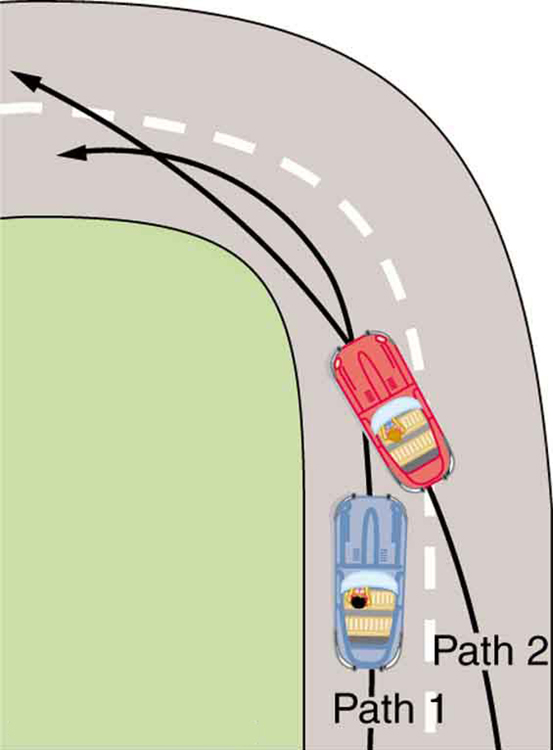
Race car drivers routinely cut corners as shown in Figure 2.E.1. Explain how this allows the curve to be taken at the greatest speed.
Exercise 36
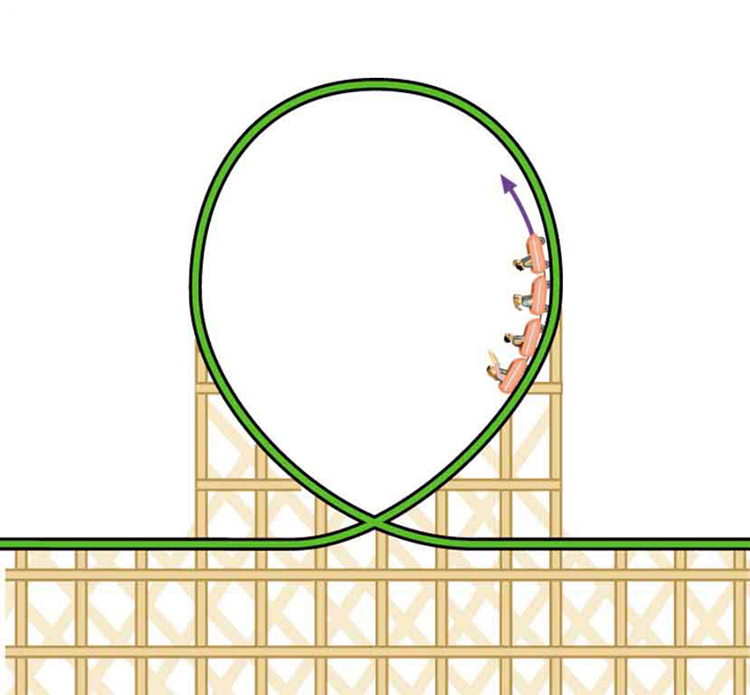
A number of amusement parks have rides that make vertical loops like the one shown in Figure 2.E.2. For safety, the cars are attached to the rails in such a way that they cannot fall off. If the car goes over the top at just the right speed, gravity alone will supply the centripetal force. What other force acts and what is its direction if:
(a) The car goes over the top at faster than this speed?
(b)The car goes over the top at slower than this speed?
Exercise 37
What is the direction of the force exerted by the car on the passenger as the car goes over the top of the amusement ride pictured in Figure 2.E.2 under the following circumstances:
(a) The car goes over the top at such a speed that the gravitational force is the only force acting?
(b) The car goes over the top faster than this speed?
(c) The car goes over the top slower than this speed?
Exercise 38
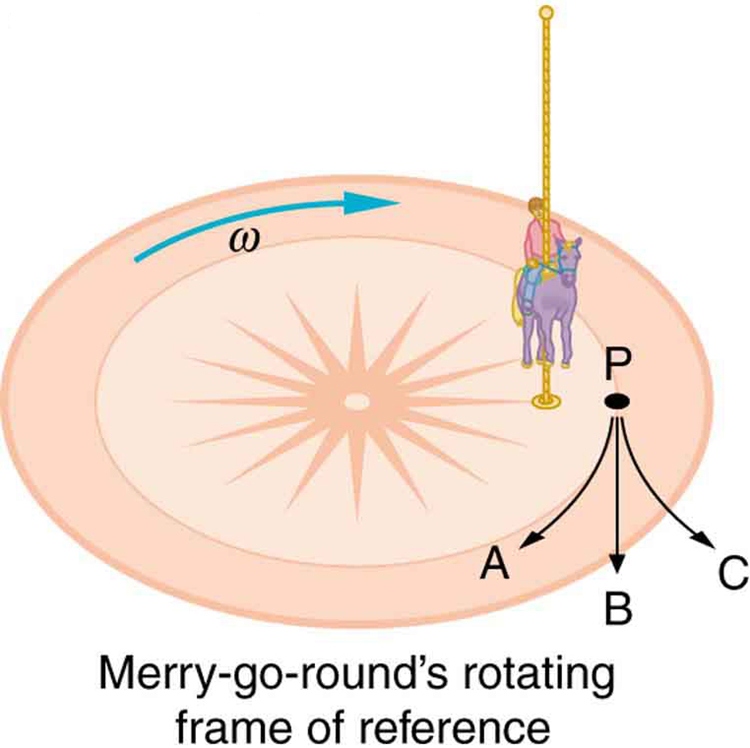
Suppose a child is riding on a merry-go-round at a distance about halfway between its center and edge. She has a lunch box resting on wax paper, so that there is very little friction between it and the merry-go-round. Which path shown in Figure 2.E.3 will the lunch box take when she lets go? The lunch box leaves a trail in the dust on the merry-go-round. Is that trail straight, curved to the left, or curved to the right? Explain your answer.
Exercise 39
Do you feel yourself thrown to either side when you negotiate a curve that is ideally banked for your car’s speed? What is the direction of the force exerted on you by the car seat?
Exercise 40
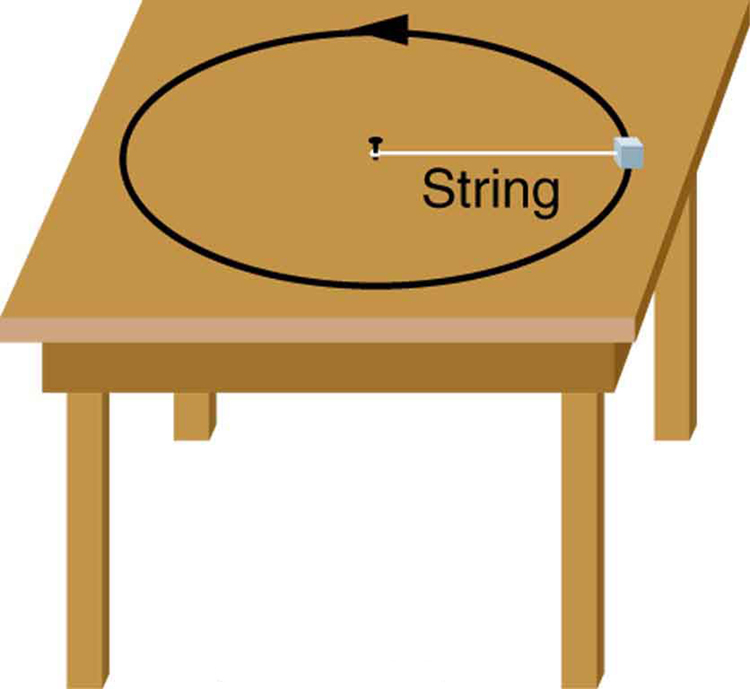
Suppose a mass is moving in a circular path on a frictionless table as shown in figure. In the Earth’s frame of reference, there is no centrifugal force pulling the mass away from the centre of rotation, yet there is a very real force stretching the string attaching the mass to the nail. Using concepts related to centripetal force and Newton’s third law, explain what force stretches the string, identifying its physical origin.