Chapter 2: Dynamics — Review and Exercises
Chapter contents: Chapter 2: Dynamics
Glossary
apparent weight
sensation of weight due to contact forces; usually the same as normal force
banked curve
the curve in a road that is sloping in a manner that helps a vehicle negotiate the curve
center of mass
the point where the entire mass of an object can be thought to be concentrated
centripetal force
the inward component of the net force responsible for the curvature of an object’s path; for uniform circular motion, it is the entire net force
deformation
a change in an object’s shape or size
dynamics
the study of how forces affect the motion of objects and systems
external force
a force acting on an object or system that originates outside of the object or system
force
a push or pull on an object with a specific magnitude and direction; can be represented by vectors; can be expressed as a multiple of a standard force
free-body diagram
a sketch showing all of the external forces acting on an object or system; the system is represented by a dot, and the forces are represented by vectors extending outward from the dot
friction
a force that opposes relative motion or attempts at motion between systems in contact
gravitational constant, G
a proportionality factor used in the equation for Newton’s universal law of gravitation; it is a universal constant—that is, it is thought to be the same everywhere in the universe
ideal banking
the sloping of a curve in a road, where the angle of the slope allows the vehicle to negotiate the curve at a certain speed without the aid of friction between the tires and the road; the net external force on the vehicle equals the horizontal centripetal force in the absence of friction
inertia
resistance to a change in velocity
kinetic friction
a force that opposes the motion of two systems that are in contact and moving relative to one another
law of inertia
see Newton’s first law of motion
mass
a measure of an object’s inertia
microgravity
an environment in which the acceleration of a body due to non-gravitational forces is small compared with that produced by Earth on its surface
net external force
the vector sum of all external forces acting on an object or system; causes a mass to accelerate
Newton’s first law of motion
a body at rest remains at rest, or, if in motion, remains in motion at a constant velocity unless acted on by a net external force; also known as the law of inertia
Newton’s second law of motion
The acceleration of a system is directly proportional to and in the same direction as the net external force acting on the system, and inversely proportional to its mass.
Newton’s third law of motion
Whenever one body exerts a force on a second body, the first body experiences a force by the second body that is equal in magnitude and opposite in direction to the force that it itself exerts.
Newton’s universal law of gravitation
every particle in the universe attracts every other particle with a force along a line joining them; the force is directly proportional to the product of their masses and inversely proportional to the square of the distance between them
normal force
the component of a contact force perpendicular to the surface of contact
restoring force
a force directed toward a stable equilibrium position when a system is displaced from it
spring constant
a measure of a spring’s stiffness: the ratio of restoring-force magnitude to displacement within the range where Hooke’s law applies
static friction
a contact force parallel to a surface that opposes the tendency of surfaces to slip relative to one another while they remain at rest relative to each other
system
the object or the group of objects under consideration
tension
the pulling force that acts along a medium, especially a stretched flexible connector, such as a rope or cable; when a rope supports the weight of an object, the force on the object due to the rope is called a tension force
thrust
a reaction force that pushes a body forward; rockets, airplanes, and cars are pushed forward by a thrust, a reaction force to propellants pushed backward
weight
the force due to gravity; for objects on Earth
Section Summary
2.2: Development of Force Concept
- Dynamics is the study of how forces affect the motion of objects.
- Force is a push or pull that can be defined in terms of various standards, and it is a vector having both magnitude and direction.
2.3: Newton’s First Law of Motion: Inertia
- Newton’s first law of motion states that a body at rest remains at rest, or, if in motion, remains in motion at a constant velocity unless acted on by a net external force. This is also known as the law of inertia.
- Inertia is the tendency of an object to remain at rest or remain in motion. Inertia is related to an object’s mass.
- Mass is the quantity of matter in a substance.
2.4: Newton’s Second Law of Motion: Force and Acceleration
- Acceleration, , is defined as a rate of change in velocity, resulting from a change in the magnitude and/or the direction of the velocity.
- An external force is one acting on a system from outside the system, as opposed to internal forces, which act between components within the system.
- Newton’s second law of motion states that the acceleration of a system is directly proportional to and in the same direction as the net external force acting on the system, and inversely proportional to its mass.
- In equation form, Newton’s second law of motion is , often written in the more familiar form: .
- The weight of an object is defined as the force of gravity acting on an object of mass . Given acceleration due to gravity , the magnitude of weight is:
(2.4.3)
2.5: Newton’s Third Law of Motion: Symmetry in Forces
- Newton’s third law of motion represents a basic symmetry in nature. It states: Whenever one body exerts a force on a second body, the first body experiences a force that is equal in magnitude and opposite in direction to the force that the first body exerts.
- A thrust is a reaction force that pushes a body forward in response to a backward force. Rockets, airplanes, and cars are pushed forward by a thrust reaction force.
2.6: Normal Force and Tension
- When objects rest on a surface, the surface applies a force to the object that supports the weight of the object. This supporting force acts perpendicular to and away from the surface. It is called a normal force, and it also goes by the name “apparent weight”.
- When objects rest on a non-accelerating horizontal surface, the magnitude of the normal force is equal to the weight of the object:
.
- The pulling force that acts along a stretched flexible connector, such as a rope or cable, is called tension, . When a rope supports the weight of an object that is at rest, the tension in the rope is equal to the weight of the object:
.
2.7: Spring Force: Hooke’s Law
- An oscillation is a back and forth motion of an object between two points of deformation.
- An oscillation may create a wave, which is a disturbance that propagates from where it was created.
- The simplest type of oscillations and waves are related to systems that can be described by Hooke’s law:
,(2.7.1)where is the restoring force, is the displacement from equilibrium or deformation, and is the spring constant of the system.
2.8: Friction
- Friction is a contact force between systems that opposes the motion or attempted motion between them. Simple friction is proportional to the normal force pushing the systems together. (A normal force is always perpendicular to the contact surface between systems.) Friction depends on both of the materials involved. The magnitude of static friction between systems stationary relative to one another is given by
where is the coefficient of static friction, which depends on both of the materials.,(2.8.1)
- The kinetic friction force between systems moving relative to one another is given by
where is the coefficient of kinetic friction, which also depends on both materials.,(2.8.3)
2.9: Newton’s Universal Law of Gravitation
- Newton’s universal law of gravitation: Every particle in the universe attracts every other particle with a force along a line joining them. The force is directly proportional to the product of their masses and inversely proportional to the square of the distance between them. In equation form, this is
,(2.9.1)where F is the magnitude of the gravitational force. is the gravitational constant, given by .
- Newton’s law of gravitation applies universally.
2.10: Centripetal Force
- Centripetal force is any force causing uniform circular motion. It is a “center-seeking” force that always points toward the center of rotation. It is perpendicular to linear velocity and has magnitude
,(2.10.1)which can also be expressed as.(2.10.2)
Questions and Exercises
2.2: Development of Force Concept
Exercise 1
Which of the following describe a force: Earth, the pull of a stretched spring, a ball moving upward, the push of a bat on a ball, and a car’s acceleration? For each force, identify the object exerting it and the object experiencing it.
Exercise 2
What properties do forces have that allow us to classify them as vectors?
Exercise 3
Propose a force standard different from the example of a stretched spring discussed in the text. Your standard must be capable of producing the same force repeatedly.
2.3: Newton’s First Law of Motion: Inertia
Exercise 4
How are inertia and mass related?
Exercise 5
What is the relationship between weight and mass? Which is an intrinsic, unchanging property of a body?
2.4: Newton’s Second Law of Motion: Force and Acceleration
Exercise 6
Choose the correct statement: “Net force causes motion” or “Net force causes a change in motion”. Explain your choice and give an example.
Exercise 7
A system can have a nonzero velocity while the net external force on it is zero. Describe such a situation.
Exercise 8
If the acceleration of a system is zero, are no external forces acting on it? What about internal forces? Explain your answers.
Exercise 9
Explain how the choice of the “system of interest” affects which forces must be considered when applying Newton’s second law of motion.
Exercise 10
The gravitational force on the basketball in Figure 2.4.2 is ignored. When gravity is taken into account, what is the direction of the net external force on the basketball—above horizontal, below horizontal, or still horizontal?
Exercise 11
(a) If the net force on an object doubles while its mass stays the same, how does its acceleration change? (b) If the same net force acts on an object with twice the mass, how does the acceleration compare? Explain your answers using Newton’s second law.
Exercise 12
If a constant, nonzero force is applied to an object, what can you say about the velocity and acceleration of the object?
Exercise 13
When a jet aircraft accelerates forward during takeoff, you feel pressed back into your seat. Explain this sensation. Is there a backward force acting on you?
Exercise 14
Describe a situation in which the net external force on a system is not zero, yet its speed remains constant.
Exercise 15
A rock is thrown straight up. What is the net external force acting on the rock when it is at the top of its trajectory?
2.5: Newton’s Third Law of Motion: Symmetry in Forces
Exercise 16
A book rests on a table.
(a) The table’s upward force on the book equals the Earth’s downward gravitational force on the book. Explain why these forces balance using Newton’s second law.
(b) The book pushes down on the table, and the table pushes up on the book with an equal force. Explain how these forces illustrate Newton’s third law.
Why do the forces in (a) balance, while those in (b) do not cancel each other on either object?
Exercise 17
You hold a garden hose while water sprays from its nozzle. Why do you feel the hose push backward? Identify the pair of forces related by Newton’s third law, and explain why they do not cancel each other on the hose.
Exercise 18
A ballistocardiograph detects small movements of the body caused by the heart pumping blood. Explain how Newton’s third law accounts for this recoil.
Exercise 19
An American football lineman reasons that it is senseless to try to out-push the opposing player, since no matter how hard he pushes he will experience an equal and opposite force from the other player. Use Newton’s laws and draw a free-body diagram of an appropriate system to explain how he can still out-push the opposition if he is strong enough.
Exercise 20
Newton’s third law of motion tells us that forces always occur in pairs of equal and opposite magnitude. Explain how the choice of the “system of interest” affects whether one such pair of forces cancels.
Exercise 21
Why can we neglect forces such as those holding a body together when we apply Newton’s second law of motion?
2.6: Normal Force and Tension
Exercise 22
Give an everyday example, not used in the textbook, in which the normal force on a person is (a) equal to, (b) greater than, and (c) less than the person’s weight. Can one situation illustrate all three cases as conditions change?
Exercise 23
A surface can push but cannot pull, and a rope can pull but cannot push.
What happens when maintaining contact with a surface would require it to pull on an object? What happens when keeping a rope taut would require it to push?
2.7: Spring Force: Hooke’s Law
Exercise 24
A spring stretches 2 cm when pulled with a force of 3 N. How far would it stretch under a force of 6 N, assuming it obeys Hooke’s law? Explain your reasoning.
Exercise 25
An object hangs at rest from a spring. How does the spring force compare with the object’s weight? If you pull the object farther downward and release it, which force has changed, and in which direction does the object initially accelerate?
Exercise 26
Describe a system which undergoes an oscillation under a Hooke’s law force.
Exercise 27
Imagine an object under a hypothetical force behaving opposite to Hooke’s law force. That is, instead of restoring force (, with the negative sign indicating that the force acts in the opposite direction of displacement), the force reinforces an initial displacement: . What would happen to this object if it is placed at the equilibrium () and then very slightly disturbed?
2.8: Friction
Exercise 28
As you start walking forward, your shoe pushes backward on the ground without slipping. In which direction does friction act on your shoe? Is this static or kinetic friction? Explain how friction helps you speed up.
Exercise 29
A box of mass 40 kg rests on a horizontal wooden floor. Tommy tries to push it horizontally.
(a) Tommy pushes with a force of 20 N, but the box does not move. What is the net force on the box? What are the magnitude and direction of the friction force?
(b) After getting the box moving, Tommy pushes with a force of 80 N, and it slides at a constant speed. What is the magnitude of the friction force?
(c) Tommy stops pushing while the box is still sliding on the wooden floor. What are the magnitude and direction of its acceleration?
(d) Still sliding without Tommy’s push, the box reaches a horizontal marble floor and slows down at 0.5 m/s². What is the magnitude of the kinetic friction force there?
(e) Explain why a smaller friction force in (a) than in (b) does not contradict the usual relationship between maximum static friction and kinetic friction.
Exercise 30
You slide an eraser across a tabletop at a constant speed. If you press down harder on the eraser, how does the normal force change? How does this affect the horizontal force needed to keep it sliding at the same speed? Explain.
Exercise 31
When you learn to drive, you discover that you need to let up slightly on the brake pedal as you come to a stop or the car will stop with a jerk. Explain this in terms of the relationship between static and kinetic friction.
Exercise 32
When you push a piece of chalk across a chalkboard, it sometimes screeches because it rapidly alternates between slipping and sticking to the board. Describe this process in more detail, in particular explaining how it is related to the fact that kinetic friction is less than static friction. (The same slip-grab process occurs when tires screech on pavement.)
2.9: Newton’s Universal Law of Gravitation
Exercise 33
Before Newton, falling objects and orbiting planets were often treated as different kinds of motion. How does Newton’s law of gravitation connect these two phenomena?
Exercise 34
Newton’s law of gravitation successfully predicted motion without explaining how gravity acts between distant objects. Can a physical law be useful without explaining the underlying mechanism? Explain, considering the role of observations and experiments.
Exercise 35
Earth pulls downward on a falling apple. How does the apple’s gravitational pull on Earth compare in magnitude and direction? Why are their accelerations so different?
Exercise 36
Two friends are having a conversation. Anna says a satellite in orbit is in freefall because the satellite keeps falling toward Earth. Tom says a satellite in orbit is not in freefall because the acceleration due to gravity is not . Who do you agree with and why?
2.10: Centripetal Force
Exercise 37
Define centripetal force. Can any type of force (for example, tension, gravitational force, friction, and so on) be a centripetal force? Can any combination of forces be a centripetal force?
Exercise 38
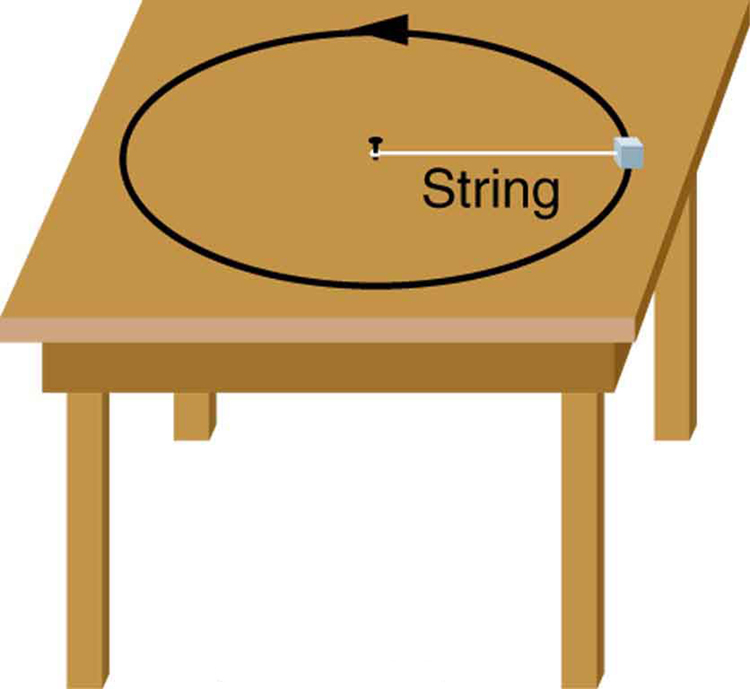
An object attached to a string moves in a circle on a frictionless table. The other end of the string is tied to a fixed nail.
(a) What force on the object provides its centripetal acceleration?
(b) What force does the object exert on the string? Explain using Newton’s third law.
Challenge: A student says that both tension and centripetal force pull the object toward the nail. Explain the mistake.
Exercise 39
If centripetal force is directed toward the center, why do you feel that you are “thrown” away from the center as a car goes around a curve? Explain.
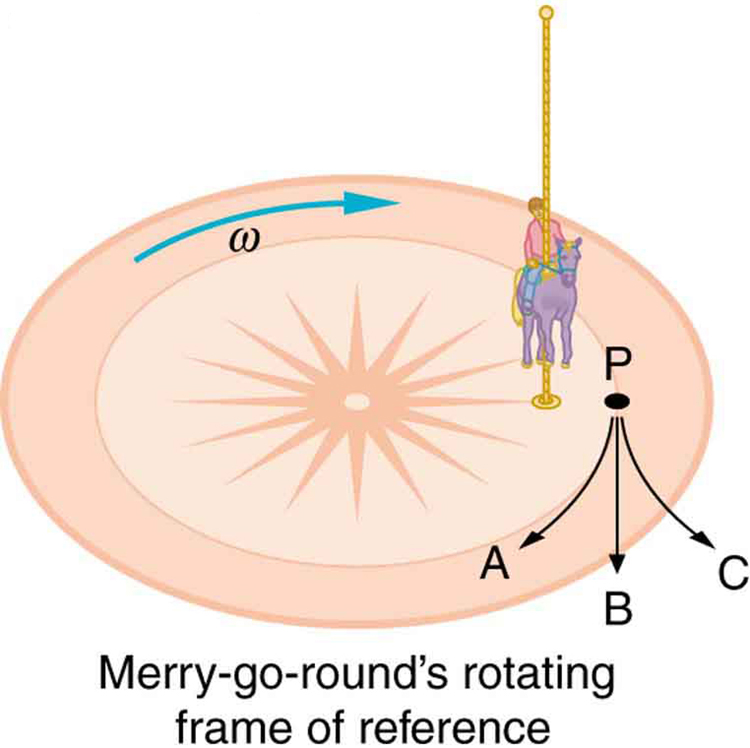
Exercise 40
A child riding on a merry-go-round releases a lunch box that slides with negligible friction. Which path shown in Figure 2.E.2 will it follow, as viewed by someone standing on the ground? Explain using Newton’s first law.
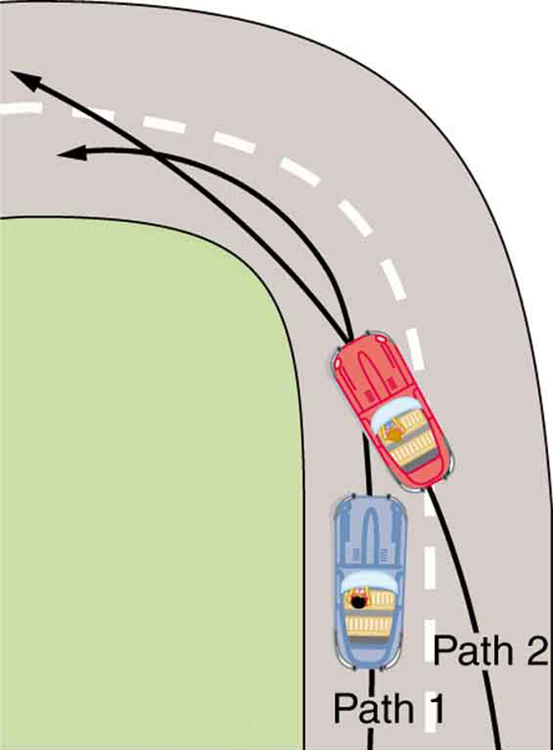
Exercise 41
Race car drivers routinely cut corners as shown in Figure 2.E.3. Explain how this allows the curve to be taken at the greatest speed.
Source sections: Development of Force Concept, Newton’s First Law of Motion: Inertia, Newton’s Second Law of Motion: Force and Acceleration, Newton’s Third Law of Motion: Symmetry in Forces, Normal Force and Tension, Spring Force: Hooke’s Law, Friction, Newton’s Universal Law of Gravitation, Centripetal Force. Credits and licenses appear with each source section.