Chapter 1: Kinematics — Review and Exercises
Chapter contents: Chapter 1: Kinematics
Glossary
acceleration
the rate of change in velocity; the change in velocity over time
acceleration due to gravity
acceleration an object undergoes while in free-fall
air resistance
a frictional force that slows the motion of objects as they travel through the air; when solving basic physics problems, air resistance is assumed to be zero
average acceleration
the change in velocity divided by the time over which it changes
average speed
distance traveled divided by time during which motion occurs
average velocity
displacement divided by time over which displacement occurs
centripetal acceleration
the inward component of acceleration for motion along a curved path; for uniform circular motion, it is the entire acceleration
displacement
the change in position of an object
distance
a nonnegative measure of separation or path length; the distance between two positions is their straight-line separation, whereas distance traveled is the total path length
distance traveled
the total length of the path traveled between two positions
elapsed time
the difference between the ending time and beginning time
free-fall
the state of movement that results from gravitational force only
instantaneous acceleration
acceleration at a specific point in time
instantaneous speed
magnitude of the instantaneous velocity
instantaneous velocity
velocity at a specific instant, or the average velocity over an infinitesimal time interval
kinematics
the study of motion without considering its causes
motion
a change in an object’s position over time relative to a chosen reference frame
position
the location of an object at a particular time
projectile
an object that travels through the air and experiences only acceleration due to gravity
projectile motion
the motion of an object that is subject only to the acceleration of gravity
range
the horizontal distance traveled by a projectile from launch to landing
scalar
a quantity that is described by magnitude, but not direction
time
the physical quantity used to describe when events occur and the intervals between them
trajectory
the path followed by a moving object
ultracentrifuge
a centrifuge optimized for spinning a rotor at very high speeds
uniform circular motion
an object moving in a circular path at constant speed
vector
a quantity that is described by both magnitude and direction
Section Summary
1.2: Displacement
- Kinematics is the study of motion without considering its causes. In this chapter, it is limited to motion along a straight line, called one-dimensional motion.
- Displacement is the change in position of an object.
- In symbols, displacement is defined to be
where is the initial position and is the final position. In this text, the Greek letter (delta) always means “change in” whatever quantity follows it. The SI unit for displacement is the meter (m). Displacement has a direction as well as a magnitude.,(1.2.1)
- When you start a problem, assign which direction will be positive.
- Distance is the magnitude of displacement between two positions.
- Distance traveled is the total length of the path traveled between two positions.
1.3: Vectors, Scalars, and Coordinate Systems
- A vector is any quantity that has magnitude and direction.
- A scalar is any quantity that has magnitude but no direction.
- Displacement and velocity are vectors, whereas distance and speed are scalars.
- In one-dimensional motion, direction is specified by a plus or minus sign to signify left or right, up or down, and the like.
1.4: Time, Velocity, and Speed
- Time is measured in terms of change, and its SI unit is the second (s). Elapsed time for an event is
where is the final time and is the initial time.,(1.4.1)
- Average velocity is defined as displacement divided by the travel time. In symbols, average velocity is
.(1.4.2)
- The SI unit for velocity is m/s.
- Velocity is a vector and thus has a direction.
- Instantaneous velocity is the velocity at a specific instant or the average velocity for an infinitesimal interval.
- Instantaneous speed is the magnitude of the instantaneous velocity.
- Instantaneous speed is a scalar quantity, as it has no direction specified.
- Average speed is the total distance traveled divided by the elapsed time. (Average speed is not the magnitude of the average velocity.) Speed is a scalar quantity; it has no direction associated with it.
1.5: Acceleration
- Acceleration is the rate at which velocity changes. In symbols, average acceleration is
.(1.5.1)
- The SI unit for acceleration is .
- Acceleration is a vector, and thus has a both a magnitude and direction.
- Acceleration can be caused by either a change in the magnitude or the direction of the velocity.
- Instantaneous acceleration is the acceleration at a specific instant in time.
- When an acceleration is in a direction opposite to that of the velocity of an object, the object slows down.
1.6: Motion Equations for Constant Acceleration in One Dimension
- To simplify calculations we take acceleration to be constant, so that at all times.
- We also take initial time to be zero.
- Initial position and velocity are given a subscript 0; final values have no subscript. Thus,
.
- The following kinematic equations for motion with constant are useful:
(1.6.1)(1.6.2)(1.6.3)(1.6.4)(1.6.5)
- In vertical motion, is substituted for .
1.7: Falling Objects
- An object in free-fall experiences constant acceleration if air resistance is negligible.
- On Earth, all free-falling objects have an acceleration due to gravity , which averages
.(1.7.1)
- Whether the acceleration should be taken as or is determined by your choice of coordinate system. If you choose the upward direction as positive, is negative. In the opposite case, is positive. Since acceleration is constant, the kinematic equations above can be applied with the appropriate or substituted for .
- For objects in free-fall, up is normally taken as positive for displacement, velocity, and acceleration.
1.8: Projectile Motion
- Projectile motion is the motion of an object through the air that is subject only to the acceleration of gravity.
- The most important fact regarding projectile motion is that motions along vertical direction and the horizontal direction are independent.
- The maximum horizontal distance traveled by a projectile is called the range. The range of a projectile on level ground launched at an angle above the horizontal with initial speed is given by
.(1.8.1)
1.9: Centripetal Acceleration
- Centripetal acceleration is the acceleration experienced while in uniform circular motion. It always points toward the center of rotation. It is perpendicular to the linear velocity and has the magnitude
.(1.9.1)
- The unit of centripetal acceleration is .
Questions and Exercises
1.2: Displacement
Exercise 1
Give an example in which there are clear distinctions among distance traveled, displacement, and magnitude of displacement. Specifically identify each quantity in your example.
Exercise 2
When does the total distance traveled equal the magnitude of displacement, and what kind of motion makes the total distance greater than the magnitude of displacement?
Exercise 3
Bacteria move back and forth by using their flagella (structures that look like little tails). Speeds of up to () have been observed. The total distance traveled by a bacterium is large for its size, while its displacement is small. Why is this?
Exercise 4
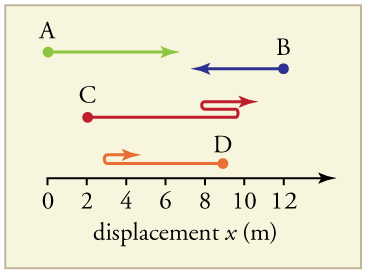
Find the following for path A in Figure 1.E.1: (a) The distance traveled. (b) The magnitude of the displacement from start to finish. (c) The displacement from start to finish.
Exercise 5
Find the following for path B in the figure in Exercise 4: (a) The distance traveled. (b) The magnitude of the displacement from start to finish. (c) The displacement from start to finish.
Exercise 6
Find the following for path C in the figure in Exercise 4: (a) The distance traveled. (b) The magnitude of the displacement from start to finish. (c) The displacement from start to finish.
Exercise 7
Find the following for path D in the figure in Exercise 4: (a) The distance traveled. (b) The magnitude of the displacement from start to finish. (c) The displacement from start to finish.
1.3: Vectors, Scalars, and Coordinate Systems
Exercise 8
A weather forecast states that the temperature is predicted to be the following day. Is this temperature a vector or a scalar quantity? Explain.
Exercise 9
A student writes, “A bird that is diving for prey has a speed of
.” What is wrong with the student’s statement? What has the student actually described? Explain.
Exercise 10
What is the speed of the bird in Exercise 9?
Exercise 11
Acceleration is the change in velocity over time. Given this information, is acceleration a vector or a scalar quantity? Explain.
1.4: Time, Velocity, and Speed
Exercise 12
Give an example (but not one from the text) of a device used to measure time and identify what change in that device indicates a change in time.
Exercise 13
Does a car’s odometer measure distance traveled or displacement? Does its speedometer measure speed or velocity?
Exercise 14
How are instantaneous velocity and instantaneous speed related to one another? How do they differ?
Exercise 15
There is a distinction between average speed and the magnitude of average velocity. Give an example that illustrates the difference between these two quantities.
Exercise 16
If you divide the total distance traveled on a car trip (as determined by the odometer) by the time for the trip, are you calculating the average speed or the magnitude of the average velocity? Under what circumstances are these two quantities the same?
Exercise 17
You hear thunder 3 seconds after seeing lightning. Taking the speed of sound as 340 m/s and neglecting the travel time of light, estimate the distance to the lightning.
1.5: Acceleration
Exercise 18
Can both meters per second squared and miles per hour per second describe acceleration? Explain what each unit tells you.
Exercise 19
Is it possible for velocity to be constant while acceleration is not zero? Explain.
Exercise 20
Is it possible for speed to be constant while acceleration is not zero? Give an example of such a situation.
Exercise 21
Give an example in which velocity is zero yet acceleration is not.
Exercise 22
If a subway train is moving to the left (has a negative velocity) and then comes to a stop, what is the direction of its acceleration? Is the acceleration positive or negative?
Exercise 23
Plus and minus signs are used in one-dimensional motion to indicate direction. What is the sign of an acceleration that reduces the magnitude of a negative velocity? Of a positive velocity?
1.6: Motion Equations for Constant Acceleration in One Dimension
Exercise 24
In a constant-acceleration motion, how does the position change? How does the velocity change?
Exercise 25
Describe the relationship between the position and the velocity in a constant-acceleration motion.
Exercise 26
Describe the relationship between the velocity and the acceleration in a constant-acceleration motion.
Exercise 27
Sketch velocity–time graphs for an object moving with constant positive velocity and for one starting from rest with constant positive acceleration. Explain the difference between their slopes.
Exercise 28
In a constant-acceleration motion starting from rest, how does the distance traveled change with the duration of motion? If the motion continues for double the time (total), how much does the distance traveled increase (total)?
Exercise 29
A car brakes to a stop with constant acceleration. If its initial speed doubles but the magnitude of its braking acceleration stays the same, how does its braking distance change?
1.7: Falling Objects
Exercise 30
Neglecting air resistance, is a ball thrown upward in free fall (a) while rising, (b) at its highest point, and (c) while descending? Explain.
Exercise 31
What is the acceleration of a rock thrown straight upward (a) on the way up, (b) at the top of its flight, and (c) on the way down?
Exercise 32
An object that is thrown straight up falls back to Earth. This is one-dimensional motion. (a) When is its velocity zero? (b) Does its velocity change direction? (c) Does the acceleration due to gravity have the same sign on the way up as on the way down?
Exercise 33
Suppose you throw a rock nearly straight up at a coconut in a palm tree, and the rock misses on the way up but hits the coconut on the way down. Neglecting air resistance, how does the speed of the rock when it hits the coconut on the way down compare with what it would have been if it had hit the coconut on the way up? Is it more likely to dislodge the coconut on the way up or down? Explain.
Exercise 34
If an object is thrown straight up and air resistance is negligible, then its speed when it returns to the starting point is the same as when it was released. If air resistance were not negligible, how would its speed upon return compare with its initial speed? How would the maximum height to which it rises be affected?
Exercise 35
The severity of a fall depends on your speed when you strike the ground. All factors but the acceleration due to gravity being the same, how many times higher could a safe fall on the Moon be than on Earth (gravitational acceleration on the Moon is about 1/6 that of the Earth)?
Exercise 36
How many times higher could an astronaut jump on the Moon than on Earth if his takeoff speed is the same in both locations (gravitational acceleration on the Moon is about 1/6 of on Earth)?
1.8: Projectile Motion
Exercise 37
During a lecture demonstration, a professor places two coins on the edge of a table. She then flicks one of the coins horizontally off the table, simultaneously nudging the other over the edge. Describe the subsequent motion of the two coins, in particular discussing whether they hit the floor at the same time.
Exercise 38
A cart moves at constant velocity along a level track and launches a ball vertically relative to the cart. Neglecting air resistance, does the ball land ahead of, behind, or back in the launcher? Explain.
Exercise 39
Answer the following questions for projectile motion on level ground assuming negligible air resistance (the initial angle being neither nor ): (a) Is the acceleration ever zero? (b) Is the acceleration ever in the same direction as a component of velocity? (c) Is the acceleration ever opposite in direction to a component of velocity?
Exercise 40
For the projectile motion described in Exercise 39, answer the following questions: (a) Is the velocity ever zero? (b) When is the speed smallest, and when is it greatest? (c) Can the velocity ever be the same as the initial velocity at a time other than at ? (d) Can the speed ever be the same as the initial speed at a time other than at ?
Exercise 41
For a fixed initial speed, the range of a projectile is determined by the angle at which it is fired. For all but the maximum, there are two angles that give the same range. Considering factors that might affect the ability of an archer to hit a target, such as wind, explain why the smaller angle (closer to the horizontal) is preferable. When would it be necessary for the archer to use the larger angle? Why does the punter in a football game use the higher trajectory?
1.9: Centripetal Acceleration
Exercise 42
Give examples of centripetal acceleration from everyday experience.
Exercise 43
Can centripetal acceleration change the speed of circular motion? Explain.
Exercise 44
A satellite in a circular orbit around the Earth is undergoing a centripetal acceleration. Explain how this description is consistent with the description that the satellite in free-fall.
Source sections: Displacement, Vectors, Scalars, and Coordinate Systems, Time, Velocity, and Speed, Acceleration, Motion Equations for Constant Acceleration in One Dimension, Falling Objects, Projectile Motion, Centripetal Acceleration. Credits and licenses appear with each source section.