Chapter 11: Light — Review and Exercises
Chapter contents: Chapter 11: Light
Glossary
amplitude modulation (AM)
a method of carrying information by varying the amplitude of a carrier wave
axis of a polarizing filter
the direction along which the filter passes the electric field of an EM wave
bandwidth
the width of the frequency band needed to carry a signal
birefringent
having different refractive indices for different polarization modes
bremsstrahlung
electromagnetic radiation emitted when moving charged particles are deflected or slowed; German for “braking radiation”
carrier wave
an electromagnetic wave that carries a signal by modulation of its amplitude or frequency
characteristic X-ray
an X-ray emitted when an electron fills an inner-shell vacancy, with an energy characteristic of the element
converging lens
a lens that brings rays parallel to its principal axis toward a focus; a convex lens in air is a common example
converging mirror
a concave mirror that brings rays close and parallel to its principal axis toward a focus
direction of polarization
for linearly polarized light, the fixed direction along which its electric field oscillates
dispersion
the dependence of a wave’s propagation speed in a medium on frequency; for light, it can cause different colors to refract through different angles
diverging lens
a lens that causes rays parallel to its principal axis to spread out as if from a focal point; a concave lens in air is a common example
diverging mirror
a convex mirror in which light rays that strike it parallel to its axis bend away (diverge) from its axis
electromagnetic spectrum
the full range of wavelengths or frequencies of electromagnetic radiation
electromagnetic waves
radiation in the form of waves of electric and magnetic energy
electromagnetism
electric and magnetic phenomena and their relationships
extremely low frequency (ELF)
radio waves near the low-frequency end of the spectrum, such as the 76-Hz signals formerly used to communicate with submerged submarines
focal length
the signed distance from the center of a thin lens, or the vertex of a mirror, to its principal focal point
focal point
the point where rays initially parallel to the principal axis converge, or from which they appear to diverge, in the ideal lens or mirror approximation
frequency modulation (FM)
a method of carrying information by varying the frequency of a carrier wave while keeping its amplitude constant
gamma ray
a photon emitted in a nuclear transition; in astronomy, the term also includes very high-energy photons produced by other processes
horizontally polarized
linearly polarized with a horizontal electric-field direction, perpendicular to propagation
index of refraction
for a material, the ratio of the speed of light in vacuum to that in the material
infrared radiation (IR)
electromagnetic radiation with wavelengths longer than visible red light, extending toward the microwave region
law of reflection
angle of reflection equals the angle of incidence
lens power
the reciprocal of a lens’s focal length, ; measured in diopters when is in meters. Converging lenses have positive power, and diverging lenses have negative power
magnification
ratio of image height to object height
Maxwell’s equations
four equations relating electric and magnetic fields to charges, currents, and changes in the fields; together they describe classical electromagnetism and predict electromagnetic waves
microwaves
electromagnetic waves with wavelengths in the range from 1 mm to 1 m; they can be produced by currents in macroscopic circuits and devices
mirror
smooth surface that reflects light at specific angles, forming an image of the person or object in front of it
optically active
substances that rotate the plane of polarization of light passing through them
polarization
the pattern of directions of a transverse wave’s oscillation; for light, described by the electric field
polarized light
light whose electric-field oscillations have a definite directional pattern. For linearly polarized light, the electric field oscillates along a fixed direction perpendicular to propagation
radar
a system that uses reflected radio waves to detect objects and determine their distance or motion
radiation pressure
pressure exerted by an electromagnetic wave on a surface
radio waves
electromagnetic waves in the lowest-frequency region of the spectrum, including microwaves
rainbow
dispersion of sunlight into a continuous distribution of colors according to wavelength, produced by the refraction and reflection of sunlight by water droplets in the sky
real image
an image formed where light rays from each object point actually converge; it can be recorded on a screen placed there
refraction
changing of a light ray’s direction when it passes through variations in matter
sidebands
frequency components produced by modulation above and below the carrier frequency
solar sail
a spacecraft that utilizes radiation pressure due to solar radiation in its propulsion
speed of light
in a vacuum, such as space, the speed of light is a constant 3 x 10⁸ m/s
ultra-high frequency (UHF)
radio frequencies from 300 to 3000 MHz; parts of this band are used for television and other communications
ultraviolet radiation (UV)
electromagnetic radiation in the range extending upward in frequency from violet light and overlapping with the lowest X-ray frequencies, with wavelengths from 400 nm down to about 10 nm
unpolarized
having no persistent preferred polarization direction
vertically polarized
linearly polarized with a vertical electric-field direction, perpendicular to propagation
very high frequency (VHF)
radio frequencies from 30 to 300 MHz; parts of this band are used for FM radio and television
virtual image
an image at the apparent origin of diverging rays; the rays do not actually converge at the image location
visible light
the narrow segment of the electromagnetic spectrum to which the normal human eye responds
X-ray
invisible, penetrating form of very high frequency electromagnetic radiation, overlapping both the ultraviolet range and the -ray range
Section Summary
11.2: Maxwell’s Equations: Electromagnetic Waves Predicted and Observed
- Electromagnetic waves consist of oscillating electric and magnetic fields and propagate at the speed of light . They were predicted by Maxwell.
- Maxwell’s prediction of electromagnetic waves resulted from his formulation of a complete and symmetric theory of electricity and magnetism, known as Maxwell’s equations.
- These four equations are paraphrased in this text, rather than presented numerically, and encompass the major laws of electricity and magnetism. First is Gauss’s law for electricity, second is Gauss’s law for magnetism, third is Faraday’s law of induction, including Lenz’s law, and fourth is Ampere’s law in a symmetric formulation that adds another source of magnetism—changing electric fields.
11.3: Production and Properties of Electromagnetic Waves
- Electromagnetic waves are created by oscillating charges (which radiate whenever accelerated) and have the same frequency as the oscillation.
- Since the electric and magnetic fields in most electromagnetic waves are perpendicular to the direction in which the wave moves, it is ordinarily a transverse wave.
- Electromagnetic waves carry momentum and exert radiation pressure.
- The momentum of an electromagnetic wave is directly proportional to its energy.
11.4: The Electromagnetic Spectrum: an Overview
- The relationship among the speed of propagation, wavelength, and frequency for any wave is given by , so that for electromagnetic waves,
where is the frequency, is the wavelength, and is the speed of light.,(11.4.1)
- The electromagnetic spectrum is separated into many categories and subcategories, based on the frequency and wavelength, source, and uses of the electromagnetic waves.
11.5: The Electromagnetic Spectrum: Application Notes
- The electromagnetic spectrum is separated into many categories and subcategories, based on the frequency and wavelength, source, and uses of the electromagnetic waves.
- Radio waves occupy the lowest-frequency region of the electromagnetic spectrum and can be produced by oscillating currents in antennas. Radio waves are divided into many types, depending on their applications, ranging up to microwaves at their highest frequencies.
- Infrared radiation lies below visible light in frequency and is produced by thermal motion and the vibration and rotation of atoms and molecules. Infrared’s lower frequencies overlap with the highest-frequency microwaves.
- Visible light is largely produced by electronic transitions in atoms and molecules, and is defined as being detectable by the human eye. Its colors vary with frequency, from red at the lowest to violet at the highest.
- Ultraviolet radiation starts with frequencies just above violet in the visible range and is produced primarily by electronic transitions in atoms and molecules.
- X-rays can be produced when energetic electrons are deflected by atomic nuclei or when electrons fill vacancies in inner atomic shells. Their lowest frequencies overlap the ultraviolet range but extend to much higher values, overlapping at the high end with gamma rays.
- Gamma rays are emitted in nuclear processes and other high-energy processes. Their frequencies overlap those of X-rays and extend to the highest-frequency region of the electromagnetic spectrum.
11.6: Reflection
- The angle of reflection equals the angle of incidence.
- A mirror has a smooth surface and reflects light at specific angles.
- Light is diffused when it reflects from a rough surface.
- Mirror images can be photographed and videotaped by instruments.
11.7: Refraction
- The changing of a light ray’s direction when it passes through variations in matter is called refraction.
- The speed of light in vacuum .
- Index of refraction , where is the speed of light in the material, is the speed of light in vacuum, and is the index of refraction.
11.8: Dispersion: The Rainbow and Prisms
- The spreading of white light into its full spectrum of wavelengths is called dispersion.
- Rainbows are produced by a combination of refraction and reflection and involve the dispersion of sunlight into a continuous distribution of colors.
- Dispersion produces beautiful rainbows but also causes problems in certain optical systems.
11.9: Image Formation by Lenses
- Light rays entering a converging lens parallel to its axis cross one another at a single point on the opposite side.
- For a converging lens, the focal point is the point at which converging light rays cross; for a diverging lens, the focal point is the point from which diverging light rays appear to originate.
- The distance from the center of the lens to its focal point is called the focal length .
- Power of a lens is defined to be the inverse of its focal length, .
- A lens that causes the light rays to bend away from its axis is called a diverging lens.
- Ray tracing is the technique of graphically determining the paths that light rays take.
- The image in which light rays from one point on the object actually cross at the location of the image and can be projected onto a screen, a piece of film, or the retina of an eye is called a real image.
- Thin lens equations are and (magnification).
- The distance of the image from the center of the lens is called image distance.
- An image that is on the same side of the lens as the object and cannot be projected on a screen is called a virtual image.
11.10: Image Formation by Mirrors
- The characteristics of an image formed by a flat mirror are: (a) The image and object are the same distance from the mirror, (b) The image is a virtual image, and (c) The image is situated behind the mirror.
- For a spherical mirror in the small-angle approximation, focal length is half the radius of curvature. (11.10.1)
- A convex mirror is a diverging mirror and forms only one type of image, namely a virtual image.
11.11: Polarization
- Polarization is the attribute that wave oscillations have a definite direction relative to the direction of propagation of the wave.
- EM waves are transverse waves that may be polarized.
- The direction of polarization is defined to be the direction parallel to the electric field of the EM wave.
- Unpolarized light is composed of many rays having random polarization directions.
- Light can be polarized by passing it through a polarizing filter or other polarizing material. The intensity of polarized light after passing through a polarizing filter depends on the direction of polarization and the axis of the filter.
- Polarization is also produced by reflection.
- Polarization can also be produced by scattering.
- There are a number of types of optically active substances that rotate the direction of polarization of light passing through them.
Questions and Exercises
11.2: Maxwell’s Equations: Electromagnetic Waves Predicted and Observed
Exercise 1
Choose the four statements that represent Maxwell’s equations.
A. Electric field lines originate on positive charges and terminate on negative charges.
B. Magnetic field lines have no beginning or end.
C. A changing magnetic field induces an electric field.
D. Magnetic fields can be produced by electric currents or changing electric fields.
E. An object maintains constant velocity unless acted on by a net force.
F. Energy is conserved.
Which selected statement contains Maxwell’s addition to the theory?
11.3: Production and Properties of Electromagnetic Waves
Exercise 2
Which of the following motions of an electric charge produces electromagnetic radiation: remaining at rest, moving with constant velocity, or oscillating back and forth? Explain what distinguishes the radiating motion from the others.
Exercise 3
An electromagnetic wave travels horizontally to the right, and its electric field oscillates vertically. Describe the direction in which its magnetic field oscillates. Explain why this is a transverse wave.
Exercise 4
IKAROS demonstrated propulsion using a reflecting solar sail.
(a) Explain how sunlight can exert a force on the solar sail and accelerate the spacecraft.
(b) Why use a reflecting sail rather than one that absorbs the sunlight? Explain in terms of momentum transfer.
11.4: The Electromagnetic Spectrum: an Overview
Exercise 5
Two radio waves travel through vacuum. One has a frequency of 1 MHz and the other 100 MHz. (a) How do their speeds compare? (b) Which has the longer wavelength, and by what factor? Explain without calculating either wavelength separately.
Exercise 6
Compare red and blue light traveling through vacuum. Which has the higher frequency? Which has the longer wavelength? How do their speeds compare?
11.5: The Electromagnetic Spectrum: Application Notes
Exercise 7
How do fluorescent soap residues make clothing look “brighter and whiter” in outdoor light? Would this be effective in candlelight?
Exercise 8
Give an example of resonance in the reception of electromagnetic waves.
Exercise 9
Ultraviolet microscopes can reveal smaller details than visible-light microscopes. Explain how this is related to the wavelengths of ultraviolet and visible light.
Exercise 10
Why don’t buildings block radio waves as completely as they do visible light?
Exercise 11
Make a list of some everyday objects and decide whether they are transparent or opaque to each of the types of electromagnetic waves.
Exercise 12
Your friend says that more patterns and colors can be seen on the wings of birds if viewed in ultraviolet light. Would you agree with your friend? Explain your answer.
Exercise 13
Optical fibers can carry far more telephone conversations than a narrow-band radio link because they offer much greater communication bandwidth. Why would the very narrow bandwidth available for ELF communication limit the information sent to submarines?
Exercise 14
Give an example of energy carried by an electromagnetic wave.
Exercise 15
An MRI scan can resolve details much smaller than the wavelength of the radio waves it uses. Explain how this is possible.
Exercise 16
Laser vision correction often uses an excimer laser that produces 193-nm electromagnetic radiation. This wavelength is extremely strongly absorbed by the cornea and ablates it in a manner that reshapes the cornea to correct vision defects. Explain how the strong absorption helps concentrate the energy in a thin layer and thus give greater accuracy in shaping the cornea. Also explain how this strong absorption limits damage to the lens and retina of the eye.
11.6: Reflection
Exercise 17
Using the law of reflection, explain how powder takes the shine off of a person’s nose. What is the name of the optical effect?
Exercise 18
Does the law of reflection apply to a curved mirror? Explain how you would determine the normal used to measure the angles of incidence and reflection at a particular point on the mirror.
11.7: Refraction
Exercise 19
Diffusion by reflection from a rough surface is described in this chapter. Light can also be diffused by refraction. Describe how this occurs in a specific situation, such as light interacting with crushed ice.
Exercise 20
Why is the index of refraction always greater than or equal to 1?
Exercise 21
Does the fact that the light flash from lightning reaches you before its sound prove that the speed of light is extremely large or simply that it is greater than the speed of sound? Would measuring the delay between the flash and the thunder be enough to determine the speed of light? Explain what additional information you would need.
Exercise 22
Will light change direction toward or away from the perpendicular when it goes from air to water? Water to glass? Glass to air?
Exercise 23
Explain why an object in water always appears to be at a depth shallower than it actually is? Why do people sometimes sustain neck and spinal injuries when diving into unfamiliar ponds or waters?
Exercise 24
Explain why a person’s legs appear very short when wading in a pool. Justify your explanation with a ray diagram showing the path of rays from the feet to the eye of an observer who is out of the water.
Exercise 25
A ray of light enters a glass pane obliquely from air and emerges into air on the other side. The pane’s two faces are parallel. Sketch the ray’s path through both boundaries. Is the emerging ray parallel to the incident ray? Is it on the same line? Explain.
Exercise 26
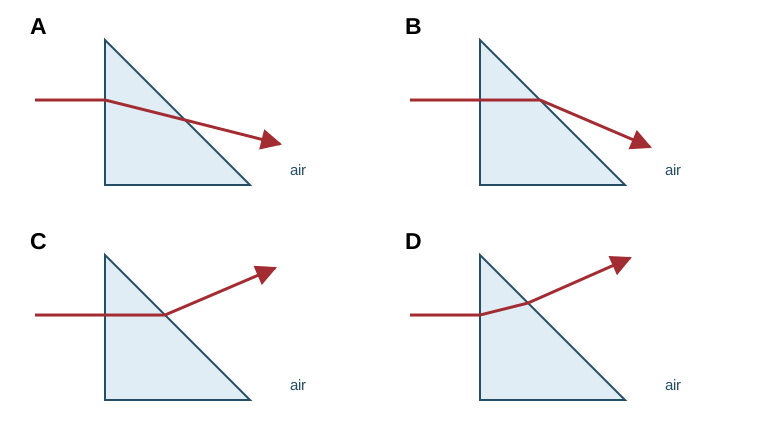
The diagrams show possible paths of a light ray entering a transparent prism from air on the left and emerging into air on the right. The ray strikes the first face perpendicularly. Which diagram correctly shows the direction of bending at each face? Explain your choice.
Exercise 27
What is the speed of light in water? In glycerine?
Exercise 28
What is the speed of light in air? In crown glass?
Exercise 29
Calculate the index of refraction for a medium in which the speed of light is , and identify the most likely substance based on Table 11.7.1.
Exercise 30
In what substance in Table 11.7.1 is the speed of light ?
Exercise 31
There was a major collision of an asteroid with the Moon in medieval times. It was described by monks at Canterbury Cathedral in England as a red glow on and around the Moon. How long after the asteroid hit the Moon, which is away, would the light first arrive on Earth?
Exercise 32
Components of some computers communicate with each other through optical fibers having an index of refraction . What time in nanoseconds is required for a signal to travel 0.200 m through such a fiber?
Exercise 33
Astronauts placed retroreflectors on the Moon that return laser pulses sent from Earth. The distance to a reflector is calculated from the round-trip travel time. Suppose the Moon is directly overhead, and take the distance from the observing station to the reflector to be . For this estimate, model Earth’s atmosphere as an equivalent uniform layer 8.0 km thick with a constant index of refraction ; treat the rest of the path as vacuum. By what percentage would the calculated distance exceed the actual distance if the slowing of light in the atmosphere were ignored?
11.8: Dispersion: The Rainbow and Prisms
Exercise 34
(a) What is the ratio of the speed of red light to violet light in diamond, based on Table 11.8.1? (b) What is this ratio in polystyrene? (c) Which is more dispersive?
Exercise 35
White light passes through a glass prism and emerges as a spectrum. Is the prism creating these colors or separating colors already present in the light? Explain why different colors emerge in different directions.
11.9: Image Formation by Lenses
Exercise 36
It can be argued that a flat piece of glass, such as in a window, is like a lens with an infinite focal length. If so, where does it form an image? That is, how are and related?
Exercise 37
You can often see a reflection when looking at a sheet of glass, particularly if it is darker on the other side. Explain why you can often see a double image in such circumstances.
Exercise 38
When you focus a camera, you adjust the distance of the lens from the film. If the camera lens acts like a thin lens, why can it not be a fixed distance from the film for both near and distant objects?
Exercise 39
A thin lens has two focal points, one on either side, at equal distances from its center, and should behave the same for light entering from either side. Look through your eyeglasses (or those of a friend) backward and forward and comment on whether they are thin lenses.
Exercise 40
A converging glass lens is moved from air into water. Will its focal length increase, decrease, or remain unchanged? Explain using refraction at the lens surfaces.
Exercise 41
Two thin glass lenses are surrounded by air. One is thicker at its center than at its edges; the other is thinner at its center. Classify each as converging or diverging, and sketch what happens to parallel rays passing through each lens.
11.10: Image Formation by Mirrors
Exercise 42
What are the differences between real and virtual images? How can you tell (by looking) whether an image formed by a single lens or mirror is real or virtual?
Exercise 43
Can you see a virtual image? Can you photograph one? Can one be projected onto a screen with additional lenses or mirrors? Explain your responses.
Exercise 44
Can you see a real image without projecting it onto a screen? Explain.
Exercise 45
Under what circumstances will an image be located at the focal point of a lens or mirror?
Exercise 46
What is meant by a negative magnification? What is meant by a magnification that is less than 1 in magnitude?
Exercise 47
(a) Figure 11.10.4 shows an image that is larger than the object, yet its magnification is negative. Explain how the sign and magnitude of the magnification describe different features of this image. (b) Keeping the same mirror, could you move the object so that its real image is smaller than the object? Draw a ray diagram to support your answer.
Exercise 48
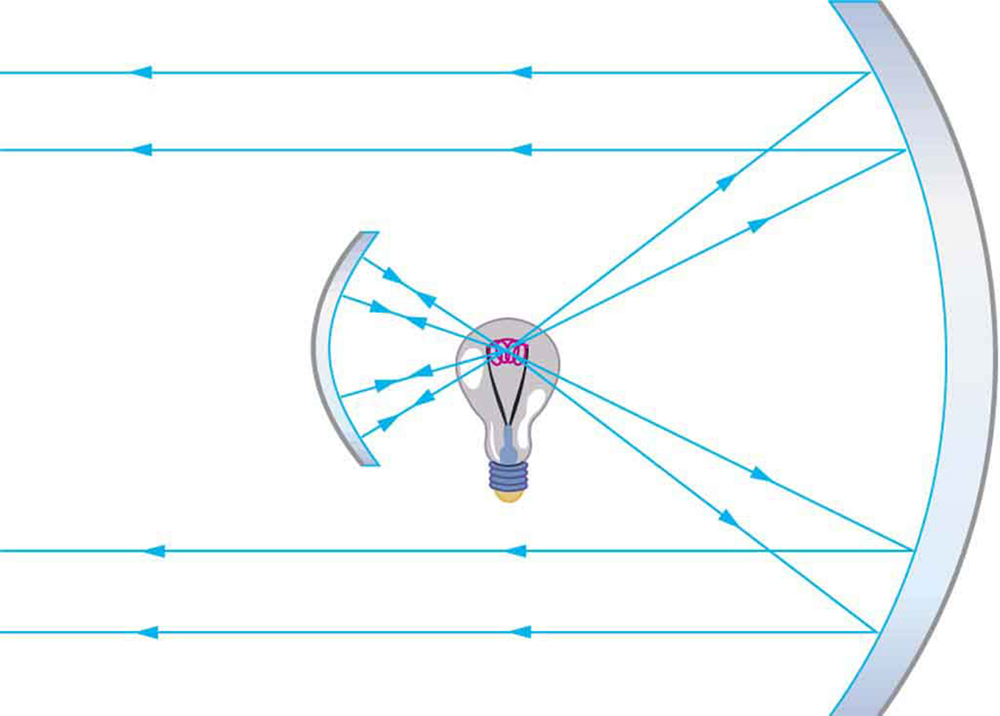
Figure 11.E.2 shows a light bulb between two mirrors. One mirror produces a beam of light with parallel rays; the other keeps light from escaping without being put into the beam. Where is the filament of the light in relation to the focal point or radius of curvature of each mirror?
Exercise 49
Devise an arrangement of mirrors allowing you to see the back of your head. What is the minimum number of mirrors needed for this task?
Exercise 50
If you wish to see your entire body in a flat mirror (from head to toe), how tall should the mirror be? Does its size depend upon your distance away from the mirror? Provide a sketch.
Exercise 51
It can be argued that a flat mirror has an infinite focal length. If so, where does it form an image? That is, how are and related?
Exercise 52
Why are diverging mirrors often used for rear-view mirrors in vehicles? What is the main disadvantage of using such a mirror compared with a flat one?
11.11: Polarization
Exercise 53
Can a sound wave in air be polarized? Explain.
Exercise 54
No light passes through two perfect polarizing filters with perpendicular axes. However, if a third polarizing filter is placed between the original two, some light can pass. Why is this? Under what circumstances does most of the light pass?
Exercise 55
Explain what happens to the energy carried by light that it is dimmed by passing it through two crossed polarizing filters.
Exercise 56
(a) Light scattered by air molecules is partially polarized. Explain how you could demonstrate this using a polarizing filter while looking at a clear sky.
(b) When the scattering particles are much smaller than the wavelength of light, the amount of scattering is proportional to . Which is scattered more strongly: red light or blue light? Use this to explain why the daytime sky appears blue.
(c) Near sunset, sunlight travels through more of Earth’s atmosphere before reaching your eyes than it does at midday. Explain why the Sun often appears red or orange near sunset.
Exercise 57
(a) What does the direction of polarization specify about an electromagnetic wave?
(b) Light reflected from a horizontal water surface is often predominantly horizontally polarized. How should the transmission axis of a polarizing filter be oriented to reduce this glare? Explain.
Source sections: Maxwell’s Equations: Electromagnetic Waves Predicted and Observed, Production and Properties of Electromagnetic Waves, The Electromagnetic Spectrum: an Overview, The Electromagnetic Spectrum: Application Notes, Reflection, Refraction, Dispersion: The Rainbow and Prisms, Image Formation by Lenses, Image Formation by Mirrors, Polarization. Credits and licenses appear with each source section.