6.E: Rotation (Exercise)
Conceptual Questions
6.2: Angular Acceleration
Conceptual Questions
Exercise 1
Analogies exist between rotational and translational physical quantities. Identify the rotational term analogous to each of the following: acceleration, force, mass, work, translational kinetic energy, linear momentum, impulse.
Exercise 2
Explain why centripetal acceleration changes the direction of velocity in circular motion but not its magnitude.
Exercise 3
In circular motion, a tangential acceleration can change the magnitude of the velocity but not its direction. Explain your answer.
Exercise 4
Suppose a piece of food is on the edge of a rotating microwave oven plate. Does it experience nonzero tangential acceleration, centripetal acceleration, or both when: (a) The plate starts to spin? (b) The plate rotates at constant angular velocity? (c) The plate slows to a halt?
6.3: Dynamics of Rotational Motion: Rotational Inertia
Conceptual Questions
Exercise 5
The moment of inertia of a long rod spun around an axis through one end perpendicular to its length is . Why is this moment of inertia greater than it would be if you spun a point mass at the location of the center of mass of the rod (at
)? (That would be .)
Exercise 6
Why is the moment of inertia of a hoop that has a mass and a radius greater than the moment of inertia of a disk that has the same mass and radius? Why is the moment of inertia of a spherical shell that has a mass and a radius greater than that of a solid sphere that has the same mass and radius?
Exercise 7
Give an example in which a small force exerts a large torque. Give another example in which a large force exerts a small torque.
Exercise 8
While reducing the mass of a racing bike, the greatest benefit is realized from reducing the mass of the tires and wheel rims. Why does this allow a racer to achieve greater accelerations than would an identical reduction in the mass of the bicycle’s frame?

Exercise 9
A ball slides up a frictionless ramp. It is then rolled without slipping and with the same initial velocity up another frictionless ramp (with the same slope angle). In which case does it reach a greater height, and why?
6.4: Rotational Kinetic Energy
Conceptual Questions
Exercise 10
Describe the energy transformations involved when a yo-yo is thrown downward and then climbs back up its string to be caught in the user’s hand.
Exercise 11
What energy transformations are involved when a dragster engine is revved, its clutch let out rapidly, its tires spun, and it starts to accelerate forward? Describe the source and transformation of energy at each step.
Exercise 12
The Earth has more rotational kinetic energy now than did the cloud of gas and dust from which it formed. Where did this energy come from?

6.5: Angular Momentum and Its Conservation
Conceptual Questions
Exercise 13
When you start the engine of your car with the transmission in neutral, you notice that the car rocks in the opposite sense of the engine’s rotation. Explain in terms of conservation of angular momentum. Is the angular momentum of the car conserved for long (for more than a few seconds)?
Exercise 14
Suppose a child walks from the outer edge of a rotating merry-go round to the inside. Does the angular velocity of the merry-go-round increase, decrease, or remain the same? Explain your answer.
Exercise 15
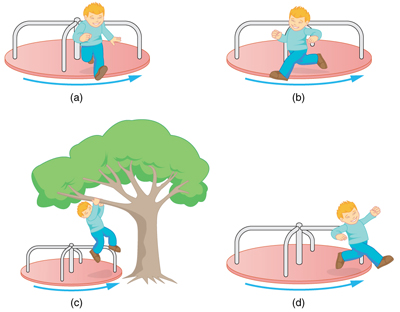
Suppose a child gets off a rotating merry-go-round. Does the angular velocity of the merry-go-round increase, decrease, or remain the same if: (a) He jumps off radially? (b) He jumps backward to land motionless? (c) He jumps straight up and hangs onto an overhead tree branch? (d) He jumps off forward, tangential to the edge? Explain your answers. (Refer to Figure 6.E.3).
Exercise 16
Helicopters have a small propeller on their tail to keep them from rotating in the opposite direction of their main lifting blades. Explain in terms of Newton’s third law why the helicopter body rotates in the opposite direction to the blades.
Exercise 17
Whenever a helicopter has two sets of lifting blades, they rotate in opposite directions (and there will be no tail propeller). Explain why it is best to have the blades rotate in opposite directions.
Exercise 18
Describe how work is done by a skater pulling in her arms during a spin. In particular, identify the force she exerts on each arm to pull it in and the distance each moves, noting that a component of the force is in the direction moved. Why is angular momentum not increased by this action?
Exercise 19
When there is a global heating trend on Earth, the atmosphere expands and the length of the day increases very slightly. Explain why the length of a day increases.
Exercise 20
Nearly all conventional piston engines have flywheels on them to smooth out engine vibrations caused by the thrust of individual piston firings. Why does the flywheel have this effect?
Exercise 21
Jet turbines spin rapidly. They are designed to fly apart if something makes them seize suddenly, rather than transfer angular momentum to the plane’s wing, possibly tearing it off. Explain how flying apart conserves angular momentum without transferring it to the wing.
Exercise 22
An astronaut tightens a bolt on a satellite in orbit. He rotates in a direction opposite to that of the bolt, and the satellite rotates in the same direction as the bolt. Explain why. If a handhold is available on the satellite, can this counter-rotation be prevented? Explain your answer.
Exercise 23
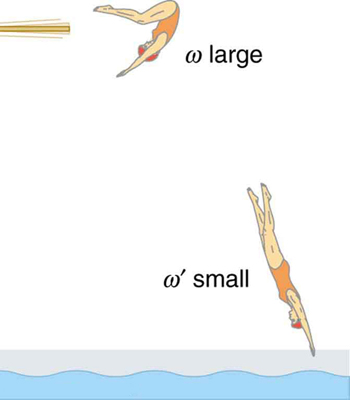
Competitive divers pull their limbs in and curl up their bodies when they do flips. Just before entering the water, they fully extend their limbs to enter straight down. Explain the effect of both actions on their angular velocities. Also explain the effect on their angular momenta.
Exercise 24
Draw a free body diagram to show how a diver gains angular momentum when leaving the diving board.
Exercise 25
In terms of angular momentum, what is the advantage of giving a football or a rifle bullet a spin when throwing or releasing it?
6.6: Gyroscopic Effects: Vector Aspects of Angular Momentum
Conceptual Questions
Exercise 26
While driving his motorcycle at highway speed, a physics student notices that pulling back lightly on the right handlebar tips the cycle to the left and produces a left turn. Explain why this happens.
Exercise 27
Gyroscopes used in guidance systems to indicate directions in space must have an angular momentum that does not change in direction. Yet they are often subjected to large forces and accelerations. How can the direction of their angular momentum be constant when they are accelerated?
Exercise 28
Consider a gyroscope or a spinning bicycle wheel as in Figure 6.6.4 or Figure 6.6.3. Under the torque due to gravitational force, they precess around a vertical axis. If this gyroscope or spinning bicycle wheel started out by spinning faster (larger angular momentum), will it precess faster or slower?