Chapter 6: Rotation — Review and Exercises
Chapter contents: Chapter 6: Rotation
Glossary
angular acceleration
the rate of change of angular velocity with time
angular momentum
the product of moment of inertia and angular velocity
angular velocity
the rate of change of angular position with time
law of conservation of angular momentum
angular momentum is conserved, i.e., the initial angular momentum is equal to the final angular momentum when no external torque is applied to the system
lever arm
the perpendicular distance from the axis of rotation to the line along which a force acts
precession
a type of motion that an object possessing angular momentum undergoes, as a torque perpendicular to the direction of angular momentum is applied, causing the direction of angular momentum to change; the circular wobbling motion traced by a slightly tilted circular top is an example
radian
a unit of angular measure defined by the arc length covered by the angle divided by the radius of the circle that the arc length is part of; one full circle is radians.
right-hand rule
direction of angular velocity ω and angular momentum L in which the thumb of your right hand points when you curl your fingers in the direction of the disk’s rotation
rotational inertia
resistance to change of angular velocity; also called moment of inertia; for a point mass,
rotational kinetic energy
the kinetic energy due to the rotation of an object. This is part of its total kinetic energy
tangential acceleration
the acceleration in a direction tangent to the circle at the point of interest in circular motion
torque
the turning effectiveness of a force
Section Summary
6.2: Angular Acceleration
- Uniform circular motion is the motion with a constant angular velocity .
- In non-uniform circular motion, the velocity changes with time and the rate of change of angular velocity (i.e. angular acceleration) is .
- Linear or tangential acceleration refers to changes in the magnitude of velocity but not its direction, given as .
- Linear or tangential motion variables , , and are proportional to the rotational quantities , , and . They are also proportional to the radius of the rotational motion.
6.3: Dynamics of Rotational Motion: Rotational Inertia
- For the same rotational inertia, a greater net torque produces a greater angular acceleration. For the same net torque, a greater rotational inertia produces a smaller angular acceleration.
- The torque magnitude is the force magnitude times the perpendicular lever arm. For the tangential force considered here, the lever arm equals the radius: .
- Using the torque, we can discover the rotational version of Newton’s Second Law. It says , where is rotational inertia, defined for a point mass moving in a circle of radius as .
- The formula for rotational inertia of an extended body can be complicated. But they are all proportional to the mass of the object and proportional to the square of the size of the object.
6.4: Rotational Kinetic Energy
- The rotational kinetic energy for an object with a moment of inertia and an angular velocity is given by
.(6.4.1)
- Helicopters store large amounts of rotational kinetic energy in their blades. This energy must be put into the blades before takeoff and maintained until the end of the flight. The engines do not have enough power to simultaneously provide lift and put significant rotational energy into the blades.
- Work and energy in rotational motion are completely analogous to work and energy in translational motion.
6.5: Angular Momentum and Its Conservation
- Every rotational phenomenon has a direct translational analog , likewise angular momentum can be defined as .
- This equation is an analog to the definition of linear momentum as . The relationship between torque and angular momentum is .
- Angular momentum, like energy and linear momentum, is conserved. This universally applicable law is another sign of underlying unity in physical laws. Angular momentum is conserved when net external torque is zero, just as linear momentum is conserved when the net external force is zero.
6.6: Gyroscopic Effects: Vector Aspects of Angular Momentum
- Torque is perpendicular to the plane formed by and and is the direction your right thumb would point if you curled the fingers of your right hand in the direction of . The direction of the torque is thus the same as that of the change in angular momentum it produces.
- The gyroscope precesses around a vertical axis, since the torque is always horizontal and perpendicular to . If the gyroscope is not spinning, it acquires angular momentum in the direction of the torque (), and it rotates about a horizontal axis, falling over just as we would expect.
- Earth itself acts like a gigantic gyroscope. Its angular momentum is along its axis and points at Polaris, the North Star.
Questions and Exercises
6.2: Angular Acceleration
Exercise 1
Analogies exist between rotational and translational physical quantities. Identify the rotational term analogous to each of the following: acceleration, force, mass, work, translational kinetic energy, linear momentum, impulse.
Exercise 2
Explain why centripetal acceleration changes the direction of velocity in circular motion but not its magnitude.
Exercise 3
In circular motion, a tangential acceleration can change the magnitude of the velocity but not its direction. Explain your answer.
Exercise 4
Suppose a piece of food is on the edge of a rotating microwave oven plate. Does it experience nonzero tangential acceleration, centripetal acceleration, or both when: (a) The plate starts to spin? (b) The plate rotates at constant angular velocity? (c) The plate slows to a halt?
6.3: Dynamics of Rotational Motion: Rotational Inertia
Exercise 5
Give an example in which a small force exerts a large torque. Give another example in which a large force exerts a small torque.
Exercise 6
A rigid wheel rotates about a fixed axis at constant angular velocity with negligible friction. (a) Does it need a net torque to keep rotating? (b) What would a constant nonzero net torque do? Explain.
Exercise 7
A uniform rod can rotate about an axis through its midpoint or about a parallel axis through one end. Both axes are perpendicular to the rod. For the same net torque, about which axis is it harder to angularly accelerate the rod? Explain why the same object can have different rotational inertias.
Exercise 8
A uniform rod of mass and length rotates about an axis through one end, perpendicular to its length (see Figure 6.3.3). Its rotational inertia is . Now imagine concentrating all of its mass at the rod’s midpoint, a distance from the same rotation axis. Why is the resulting rotational inertia, , smaller?
Exercise 9
Why is the moment of inertia of a hoop that has a mass and a radius greater than the moment of inertia of a disk that has the same mass and radius? Why is the moment of inertia of a spherical shell that has a mass and a radius greater than that of a solid sphere that has the same mass and radius?
Exercise 10
Equal net torques are applied to a thin hoop and a uniform solid disk with the same mass and radius. Each rotates about a fixed axis through its center, perpendicular to its plane. Which has the greater angular acceleration? Explain in terms of rotational inertia.
Exercise 11
While reducing the mass of a racing bike, the greatest benefit is realized from reducing the mass of the tires and wheel rims. Why does this allow a racer to achieve greater accelerations than would an identical reduction in the mass of the bicycle’s frame?

6.4: Rotational Kinetic Energy
Exercise 12
An object’s angular speed doubles while its rotational inertia stays unchanged. By what factor does its rotational kinetic energy change? How does this compare with doubling the speed of an object of fixed mass moving without rotating? Explain.
Exercise 13
A thin hoop, a thin spherical shell, a uniform solid disk, and a uniform solid sphere have equal masses and radii. All spin at the same angular speed about axes through their centers; the axes of the hoop and disk are perpendicular to their planes. Rank their rotational kinetic energies from greatest to least. You may use Figure 6.3.3. Explain your ranking.
Exercise 14
Describe the energy transformations involved when a yo-yo is thrown downward and then climbs back up its string to be caught in the user’s hand.
Exercise 15
A ball slides without rotating up a frictionless ramp. In a separate trial, it rolls without slipping up a ramp with enough friction to maintain rolling. Its initial forward speed is the same in both trials. Neglect air resistance and rolling resistance. In which trial does it reach a greater height? Explain using energy.
Exercise 16
What energy transformations are involved when a dragster engine is revved, its clutch let out rapidly, its tires spun, and it starts to accelerate forward? Describe the source and transformation of energy at each step.
Exercise 17
The Earth has more rotational kinetic energy now than did the cloud of gas and dust from which it formed. Where did this energy come from?

6.5: Angular Momentum and Its Conservation
Exercise 18
Draw a free body diagram to show how a diver gains angular momentum when leaving the diving board.
Exercise 19
A comet experiences the Sun’s gravitational force, directed toward the Sun. Neglect other forces and treat the Sun as fixed. Can the comet’s angular momentum about the Sun remain constant even though its velocity changes? Explain by considering the torque about the Sun.
Exercise 20
When a handheld electric drill starts, its body tends to twist opposite to the rotation of the chuck and bit. Explain why. What role does your hand play in preventing the drill’s body from rotating?
Exercise 21
Helicopters have a small propeller on their tail to keep them from rotating in the opposite direction of their main lifting blades. Explain in terms of Newton’s third law why the helicopter body rotates in the opposite direction to the blades.
Exercise 22
Whenever a helicopter has two sets of lifting blades, they rotate in opposite directions (and there will be no tail propeller). Explain why it is best to have the blades rotate in opposite directions.
Exercise 23
An astronaut tightens a bolt on a satellite in orbit. He rotates in a direction opposite to that of the bolt, and the satellite rotates in the same direction as the bolt. Explain why. If a handhold is available on the satellite, can this counter-rotation be prevented? Explain your answer.
Exercise 24
A person sits initially at rest on a stool that can turn freely about a vertical axis. They hold a spinning bicycle wheel with its axle vertical, so the wheel lies in a horizontal plane. Viewed from above, the wheel spins clockwise. The person turns the wheel upside down and holds its axle vertical again, so that its spin is now counterclockwise as viewed from above. Neglect external torque about the stool’s axis. Which way do the person and stool turn, as viewed from above? Explain using conservation of angular momentum.
Exercise 25
Suppose a child walks from the outer edge of a rotating merry-go round to the inside. Does the angular velocity of the merry-go-round increase, decrease, or remain the same? Explain your answer.
Exercise 26
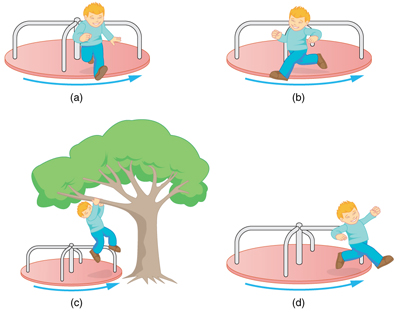
Suppose a child gets off a rotating merry-go-round. Does the angular velocity of the merry-go-round increase, decrease, or remain the same if: (a) He jumps off radially? (b) He jumps backward to land motionless? (c) He jumps straight up and hangs onto an overhead tree branch? (d) He jumps off forward, tangential to the edge? Explain your answers. (Refer to Figure 6.E.3).
Exercise 27
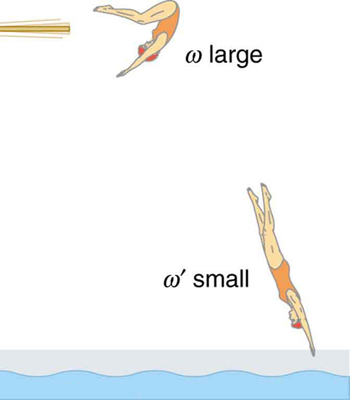
Competitive divers pull their limbs in and curl up their bodies when they do flips. Just before entering the water, they fully extend their limbs to enter straight down. Explain the effect of both actions on their angular velocities. Also explain the effect on their angular momenta.
Exercise 28
Describe how work is done by a skater pulling in her arms during a spin. In particular, identify the force she exerts on each arm to pull it in and the distance each moves, noting that a component of the force is in the direction moved. What effect does this work have on her rotational kinetic energy? Why is angular momentum not increased by this action?
Exercise 29
As polar land ice melts and the water spreads through the oceans, mass is redistributed farther from Earth’s rotation axis. (a) Explain why this tends to lengthen the day, using conservation of angular momentum. (b) Leap seconds have been added to keep atomic-clock time aligned with Earth’s rotation. Why would a day slightly longer than 86,400 seconds cause the two ways of keeping time to drift apart? (See NIST, “Leap Seconds FAQs”.)
Exercise 30
Nearly all conventional piston engines have flywheels on them to smooth out engine vibrations caused by the thrust of individual piston firings. Why does the flywheel have this effect?
Exercise 31
Jet turbines spin rapidly. They are designed to fly apart if something makes them seize suddenly, rather than transfer angular momentum to the plane’s wing, possibly tearing it off. Explain how flying apart conserves angular momentum without transferring it to the wing.
6.6: Gyroscopic Effects: Vector Aspects of Angular Momentum
Exercise 32
Gyroscopes used in guidance systems to indicate directions in space must have an angular momentum that does not change in direction. Yet they are often subjected to large forces and accelerations. How can the direction of their angular momentum be constant when they are accelerated?
Exercise 33
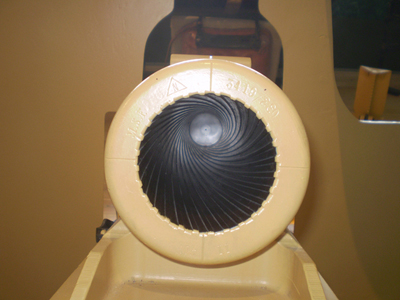
In terms of angular momentum, what is the advantage of giving a football or a rifle bullet a spin when throwing or releasing it?
Exercise 34
A spinning gyroscope precesses steadily about a vertical axis while its spin speed remains constant. Is its angular momentum constant? Explain what changes and what causes that change.
Exercise 35
Consider a gyroscope or a spinning bicycle wheel as in Figure 6.6.4 or Figure 6.6.3. Under the torque due to gravitational force, they precess around a vertical axis. If this gyroscope or spinning bicycle wheel started out by spinning faster (larger angular momentum), will it precess faster or slower?
Source sections: Angular Acceleration, Dynamics of Rotational Motion: Rotational Inertia, Rotational Kinetic Energy, Angular Momentum and Its Conservation, Gyroscopic Effects: Vector Aspects of Angular Momentum. Credits and licenses appear with each source section.