Chapter 3: Work and Energy — Review and Exercises
Chapter contents: Chapter 3: Work and Energy
Glossary
chemical energy
internal energy associated with the arrangement and interactions of atoms and electrons
conservation of mechanical energy
the rule that the sum of the kinetic energies and potential energies remains constant if only conservative forces act on and within a system
conservative force
a force for which the work done by the force depends only on the starting and ending points of a motion and not on the particular path taken
elastic potential energy
potential energy stored as a result of deformation of an elastic object, such as the stretching of a spring
electrical energy
energy associated with electric charges and electric fields
energy
a conserved quantity that can be transferred between systems and converted between forms
gravitational potential energy
the energy an object has due to its position in a gravitational field
horsepower
an older non-SI unit of power, with
joule
SI unit of work and energy, equal to one newton-meter
kilowatt-hour
unit used primarily for electrical energy provided by electric utility companies
kinetic energy
the energy an object has by reason of its motion, equal to for the translational (i.e., non-rotational) motion of an object of mass moving at speed
law of conservation of energy
the general law that total energy is constant in any process; energy may change in form or be transferred from one system to another, but the total remains the same
mechanical energy
the sum of kinetic energy and potential energy
net work
work done by the net force, or vector sum of all the forces, acting on an object
nuclear energy
energy released by changes within atomic nuclei, such as the fusion of two light nuclei or the fission of a heavy nucleus
potential energy
energy due to position, shape, or configuration
power
the rate at which work is done
radiant energy
the energy carried by electromagnetic waves
thermal energy
the part of internal energy associated with disordered microscopic motion and interactions
watt (W)
SI unit of power, with
work
the transfer of energy by a force that causes an object to be displaced; the product of the component of the force in the direction of the displacement and the magnitude of the displacement
work-energy theorem
the result, based on Newton’s laws, that the net work done on an object is equal to its change in kinetic energy
Section Summary
3.2: Work: The Scientific Definition
- Work is the transfer of energy by a force acting on an object as it is displaced.
- The work that a force does on an object is the product of the magnitude of the force parallel to the motion, times the magnitude of the displacement. In symbols (see Equation 3.2.2),
.(3.2.2)
- The SI unit for work and energy is the joule (J), where .
- The work done by a force is zero if the displacement is either zero or perpendicular to the force.
- The work done is positive if the force and displacement have the same direction, and negative if they have opposite direction.
3.3: Kinetic Energy and the Work-Energy Theorem
- The net work is the work done by the net force acting on an object.
- Work done on an object transfers energy to the object.
- The translational kinetic energy of an object of mass moving at speed is .
- The work-energy theorem states that the net work
on a system changes its kinetic energy (see Equation 3.3.1):
.(3.3.1)
3.4: Gravitational Potential Energy
- Work done against gravity in lifting an object becomes potential energy of the object-Earth system.
- The change in gravitational potential energy, , is , with being the change in height and the acceleration due to gravity.
- The gravitational potential energy of an object near Earth’s surface is due to its position in the mass-Earth system. Only differences in gravitational potential energy, , have physical significance.
- As an object descends without friction, its gravitational potential energy changes into kinetic energy corresponding to increasing speed, so that .
3.5: Conservative Forces, Potential Energy, and Conservation of Energy
- A conservative force is one for which work depends only on the starting and ending points of a motion, not on the path taken.
- We can define potential energy () for any conservative force, just as we defined for the gravitational force.
- Mechanical energy is the sum of kinetic and potential energy, .
- When only conservative forces act on and within a system, the total mechanical energy is conserved, .
- The law of conservation of energy states that the total energy, including the mechanical energy and other forms of energy, is constant in any process. Energy may change in form or be transferred from one system to another, but the total remains the same.
- Commonly encountered forms of energy include electric energy, chemical energy, radiant energy, nuclear energy, and thermal energy.
3.6: Spring Potential Energy
- Hooke’s law describes force exerted by a spring being deformed,
,(2.7.1)where is the restoring force, is the displacement from equilibrium or deformation, and is the force constant of the system.
- Elastic potential energy stored in the deformation of a system that can be described by Hooke’s law is given by
.(3.6.1)
3.7: Power
- Power is the rate at which work is done, or in equation form, for the average power for work done over a time , .
- The SI unit for power is the watt (W), where .
- The power of many devices such as electric motors is also often expressed in horsepower (hp), where .
Questions and Exercises
3.2: Work: The Scientific Definition
Exercise 1
Give an example of something we think of as work in everyday circumstances that is not work in the scientific sense. Is energy transferred or changed in form in your example? If so, explain how this is accomplished without doing work.
Exercise 2
Describe a situation in which a force is exerted for a long time but does no work. Explain.
Exercise 3
Give an example of a situation in which there is a force and a displacement, but the force does no work. Explain why it does no work.
3.3: Kinetic Energy and the Work-Energy Theorem
Exercise 4
Work done on a system puts energy into it. Work done by a system removes energy from it. Give an example for each statement.
Exercise 5
The person in Figure 3.2.1(a) does work on the lawn mower. Under what conditions would the mower gain energy? Under what conditions would it lose energy?
Exercise 6
A shopper pushes a grocery cart 10 m across a level floor at constant speed, using a horizontal force of 20 N. (a) How much work does the shopper do? (b) What is the net work done on the cart? (c) How much work do the resistive forces do? Explain how your answers are consistent with the cart’s constant speed.
Exercise 7
A car increases its speed from 30 mph to 60 mph. (a) By what factor does its kinetic energy change? (b) By what factor would its kinetic energy change if its mass doubled while its speed remained unchanged? Explain.
Exercise 8
When solving for speed in Example 3.3.3, we kept only the positive root. Why?
3.4: Gravitational Potential Energy
Exercise 9
A delivery driver lifts a 10-kg package through a height of 0.50 m to load it into a truck. Use . (a) By how much does its gravitational potential energy increase? (b) Where does this energy come from? (c) How much work does gravity do on the package? Include the sign.
Exercise 10
Does the work you do on a book when you lift it onto a shelf depend (a) on the path taken, (b) on the time taken, (c) on the height of the shelf, or (d) on the mass of the book? Briefly explain your answer to each part.
Exercise 11
In Example 3.4.2, we calculated the final speed of a roller coaster that descended 20 m in height and had an initial speed of 5 m/s downhill. Suppose the roller coaster had had an initial speed of 5 m/s uphill instead, and it coasted uphill, stopped, and then rolled back down to a final point 20 m below the start. Would its final speed be greater than, less than, or equal to the final speed in the original example? Explain in terms of conservation of energy.
3.5: Conservative Forces, Potential Energy, and Conservation of Energy
Exercise 12
What is a conservative force?
Exercise 13
What is the relationship of potential energy to conservative force?
Exercise 14
The force exerted by a diving board is conservative, provided the internal friction is negligible. Assuming friction is negligible, describe changes in the potential energy of a diving board as a swimmer dives from it, starting just before the swimmer steps on the board until just after his feet leave it.
Exercise 15
Define mechanical energy. What is the relationship of mechanical energy to nonconservative forces? What happens to mechanical energy if only conservative forces act?
Exercise 16
Consider the two paths in Figure 3.5.1. The toy car is launched with the same spring compression on either path. Assume it reaches the common endpoint on both paths. (a) If friction is negligible, must its final speed be the same on both paths? (b) Must the work done by gravity be the same? (c) If friction is significant, must its final speed still be the same? Briefly explain each answer.
Exercise 17
List four different forms or types of energy. Give one example of a conversion from each of these forms to another form.
Exercise 18
List the energy conversions that occur when riding a bicycle.
Exercise 19
Describe the energy transfers and transformations for a javelin, starting from the point at which an athlete picks up the javelin and ending when the javelin is stuck into the ground after being thrown.
Exercise 20
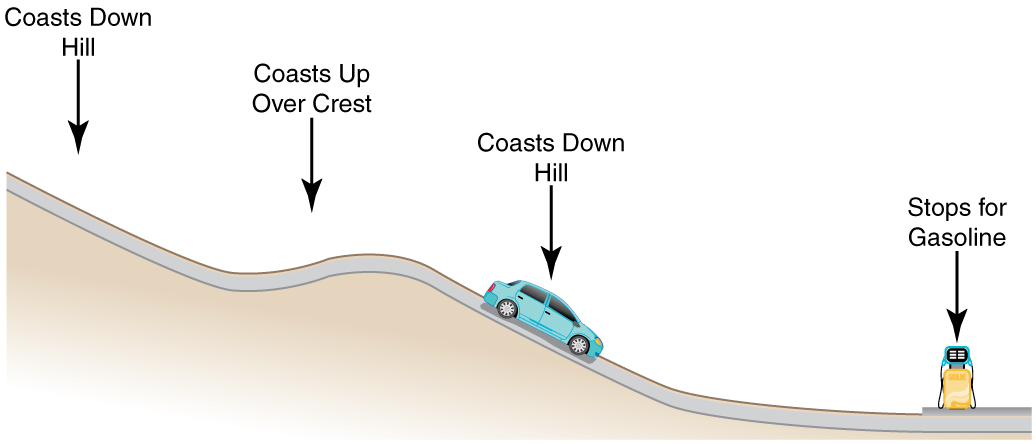
Consider the following scenario. A car for which friction is not negligible accelerates from rest down a hill, running out of gasoline after a short distance. The driver lets the car coast farther down the hill, then up and over a small crest. He then coasts down that hill into a gas station, where he brakes to a stop and fills the tank with gasoline. Identify the forms of energy the car has, and how they are changed and transferred in this series of events. (See Figure 3.E.1.)
3.6: Spring Potential Energy
Exercise 21
Describe a system in which elastic potential energy is stored.
Exercise 22
A spring is compressed twice as far as before, within the range where Hooke’s law applies. (a) By what factor does the required holding force increase? (b) By what factor does the stored elastic potential energy increase? Explain why the factors differ.
3.7: Power
Exercise 23
Most electrical appliances are rated in watts. Does this rating depend on how long the appliance is on? (When off, it is a zero-watt device.) Explain in terms of the definition of power.
Exercise 24
A spark of static electricity, such as that you might receive from a doorknob on a cold dry day, may carry a few hundred watts of power. Explain why you are not injured by such a spark.
Exercise 25
Explain, in terms of the definition of power, why energy consumption is sometimes listed in kilowatt-hours rather than joules. What is the relationship between these two energy units?
Source sections: Work: The Scientific Definition, Kinetic Energy and the Work-Energy Theorem, Gravitational Potential Energy, Conservative Forces, Potential Energy, and Conservation of Energy, Spring Potential Energy, Power. Credits and licenses appear with each source section.