8.11
Carnot’s Perfect Heat Engine: The Second Law of Thermodynamics Restated
Chapter contents: Chapter 8: Thermal Physics

We know from the second law of thermodynamics that a heat engine cannot be 100% efficient, since there must always be some heat transfer to the environment, which is often called waste heat. How efficient, then, can a heat engine be? This question was answered at a theoretical level in 1824 by a young French engineer, Sadi Carnot (1796–1832), in his study of the then-emerging heat engine technology crucial to the Industrial Revolution. He devised a theoretical cycle, now called the Carnot cycle, which is the most efficient cyclical process possible. The second law of thermodynamics can be restated in terms of the Carnot cycle, and so what Carnot actually discovered was this fundamental law. Any heat engine employing the Carnot cycle is called a Carnot engine.
The ideal Carnot cycle considered here uses only reversible processes. Irreversible processes involve dissipative factors, such as friction and turbulence. Heat transfer through a finite temperature difference is also irreversible. Reversible processes idealize away these imperfections and maximize the efficiency of the resulting heat engine cycle for given hot and cold reservoir temperatures.
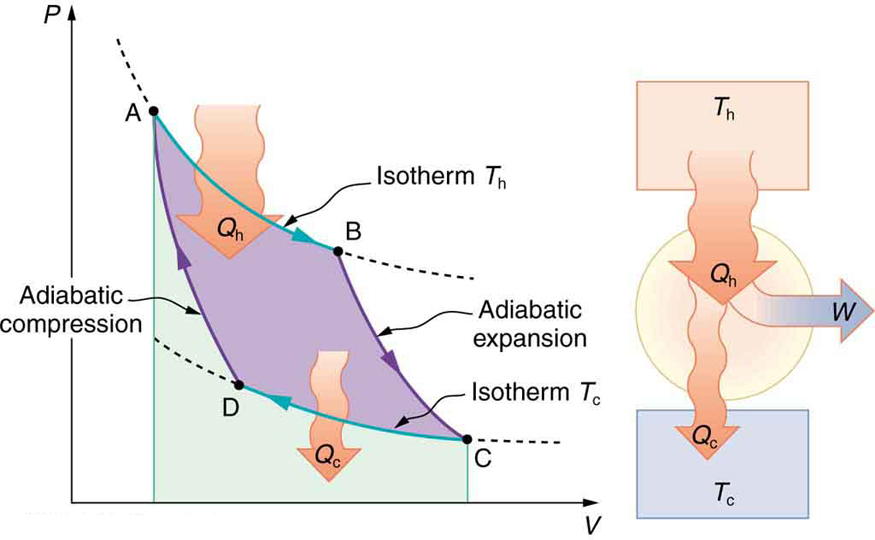
Figure 8.11.2 shows the diagram for a Carnot cycle. The cycle comprises two reversible isothermal and two reversible adiabatic processes.
Carnot also determined the efficiency of a perfect heat engine—that is, a Carnot engine. It is always true that the efficiency of a cyclical heat engine is given by:
.
What Carnot found was that for a perfect heat engine, the ratio equals the ratio of the absolute temperatures of the heat reservoirs. That is, for a Carnot engine, so that the maximum or Carnot efficiency is given by
,
(8.11.1)where and are in kelvins (or any other absolute temperature scale). No real heat engine can do as well as the Carnot efficiency. The ideal Carnot engine transfers heat through infinitesimal temperature differences. In a practical engine, this would make heat transfer extremely slow and give very little power. To deliver useful power, real engines operate with finite temperature differences, at the cost of lower efficiency.
Carnot’s interesting result implies that 100% efficiency would be possible only if —that is, only if the cold reservoir were at absolute zero, a practical and theoretical impossibility.
Carnot’s Principle
No engine working between two reservoirs at constant temperatures can have a greater efficiency than a reversible engine.
This principle can be viewed as another statement of the second law of thermodynamics and can be shown to be equivalent to the heat-transfer and heat-engine statements introduced in the preceding section.
It is also apparent that the greatest efficiencies are obtained when the ratio is as small as possible. This means that Carnot efficiency is greatest for the highest possible temperature of the hot reservoir and lowest possible temperature of the cold reservoir. The actual reservoir temperatures of a heat engine are usually related to the type of heat source and the temperature of the environment into which heat transfer occurs. Consider the following example.
Example 8.11.1
Maximum Theoretical Efficiency for a Nuclear Reactor
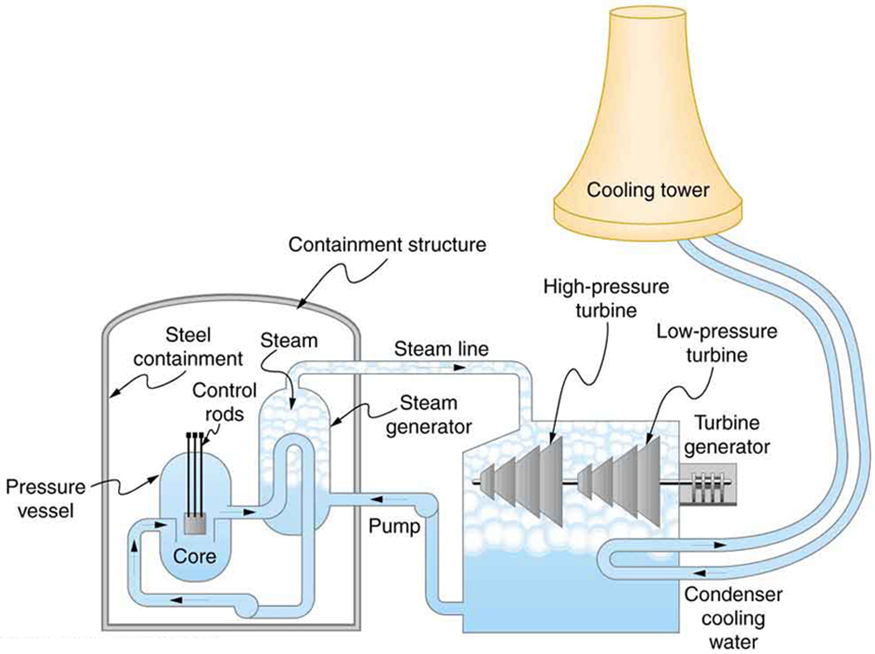
A nuclear power reactor has pressurized water at . (Higher temperatures are theoretically possible but practically not, due to limitations with materials used in the reactor.) Heat transfer from this water is a complex process (see Figure 8.11.3). Steam, produced in the steam generator, is used to drive the turbine-generators. Eventually the steam is condensed to water at and then heated again to start the cycle over. Calculate the maximum theoretical efficiency for a heat engine operating between these two temperatures.
Strategy
Since temperatures are given for the hot and cold reservoirs of this heat engine, can be used to calculate the Carnot (maximum theoretical) efficiency. Those temperatures must first be converted to kelvins.
Solution
The hot and cold reservoir temperatures are given as and , respectively. In kelvins, then, and
, so that the maximum efficiency is
.
Thus,
.
Discussion
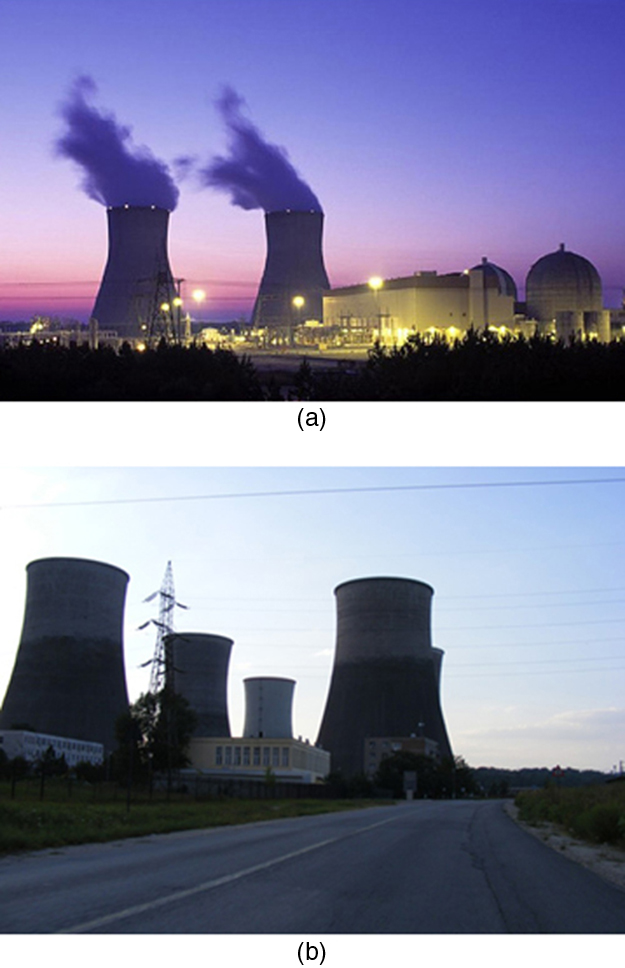
A typical nuclear power station’s actual efficiency is about 35%, a little better than 0.7 times the maximum possible value, a tribute to superior engineering. Electrical power stations fired by coal, oil, and natural gas have greater actual efficiencies (about 42%), because their boilers can reach higher temperatures and pressures. The cold reservoir temperature in any of these power stations is limited by the local environment. Figure 8.11.4 shows (a) the exterior of a nuclear power station and (b) the exterior of a coal-fired power station. Both have cooling towers into which water from the condenser enters the tower near the top and is sprayed downward, cooled by evaporation.
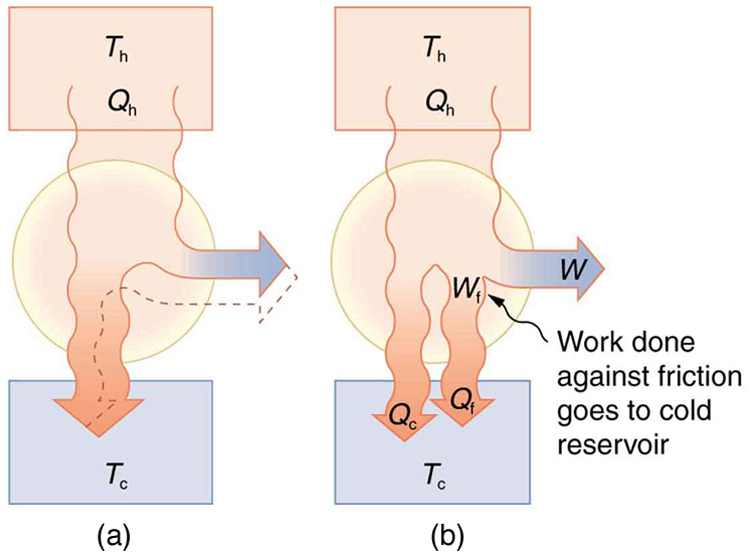
Since all real processes are irreversible, the actual efficiency of a heat engine can never be as great as that of a Carnot engine, as illustrated in Figure 8.11.5(a). Even with the best heat engine possible, there are always dissipative processes in peripheral equipment, such as electrical transformers or car transmissions. These further reduce the overall efficiency by converting some of the engine’s work output back into heat transfer, as shown in Figure 8.11.5(b).