1.9
Centripetal Acceleration
Chapter contents: Chapter 1: Kinematics
We defined acceleration as a change in velocity, either in its magnitude or in its direction, or both. When an object moves along a circular path, the direction of its velocity changes constantly, so there is always an associated acceleration, even if the speed of the object is constant. You experience this acceleration yourself when you turn a corner in your car. What you notice is a sideways acceleration because you and the car are changing direction. The sharper the curve and the greater your speed, the more noticeable this acceleration will become. In this section we briefly examine the direction and magnitude of that acceleration.
Figure 1.9.1 shows an object moving in a circular path at constant speed, called uniform circular motion. The direction of the instantaneous velocity is shown at two points along the path. Acceleration is in the direction of the change in velocity, which points directly toward the center of rotation (the center of the circular path). This pointing is shown with the vector diagram in the figure. We call the acceleration of an object moving in uniform circular motion (resulting from a net external force) the centripetal acceleration(); centripetal means “toward the center” or “center seeking.”
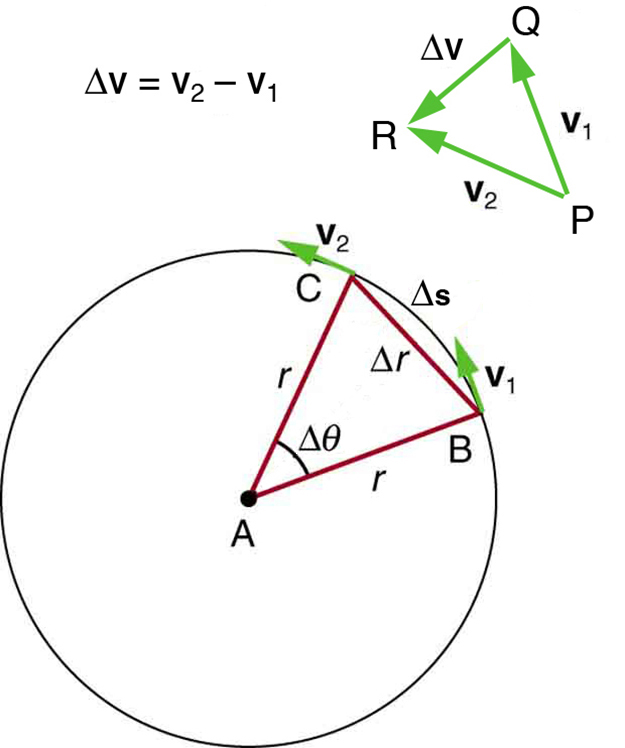
The direction of centripetal acceleration is toward the center of curvature, but what is its magnitude? If we use the geometry shown in Figure 1.9.1 along with some kinematics equations, we can obtain (detailed derivation skipped)
(1.9.1)
which is the acceleration of an object in a circle of radius at a speed . Verify for yourself that has unit of , as expected for acceleration.
We see in Equation 1.9.1 that centripetal acceleration is greater at high speeds and in sharp curves (smaller radius), as you have noticed when driving a car. But it is a bit surprising that is proportional to speed squared, implying, for example, that it is four times as hard to take a curve at 100 km/h than at 50 km/h. A sharp corner has a small radius, so that is greater for tighter turns, as you have probably noticed.
Section Summary
- Centripetal acceleration is the acceleration experienced while in uniform circular motion. It always points toward the center of rotation. It is perpendicular to the linear velocity and has the magnitude
(1.9.2)
- The unit of centripetal acceleration is .
Conceptual Questions
Exercise 32
Give examples of centripetal acceleration from everyday experience.
Exercise 33
A satellite in a circular orbit around the Earth is undergoing a centripetal acceleration. Explain how this description is consistent with the description that the satellite in free-fall.
Exercise 34
Can centripetal acceleration change the speed of circular motion? Explain.
centripetal acceleration
the acceleration of an object moving in a circle, directed toward the center
ultracentrifuge
a centrifuge optimized for spinning a rotor at very high speeds
uniform circular motion
an object moving in a circular path at constant speed