9.7
Conductors and Applications of Electrostatics
Chapter contents: Chapter 9: Electricity
Conductors contain free charges that move easily. When excess charge is placed on a conductor or the conductor is put into a static electric field, charges in the conductor quickly respond to reach a steady state called electrostatic equilibrium.
Figure 9.7.1 shows the effect of an electric field on free charges in a conductor. The free charges move until the field is perpendicular to the conductor’s surface. There can be no component of the field parallel to the surface in electrostatic equilibrium, since, if there were, it would produce further movement of charge.
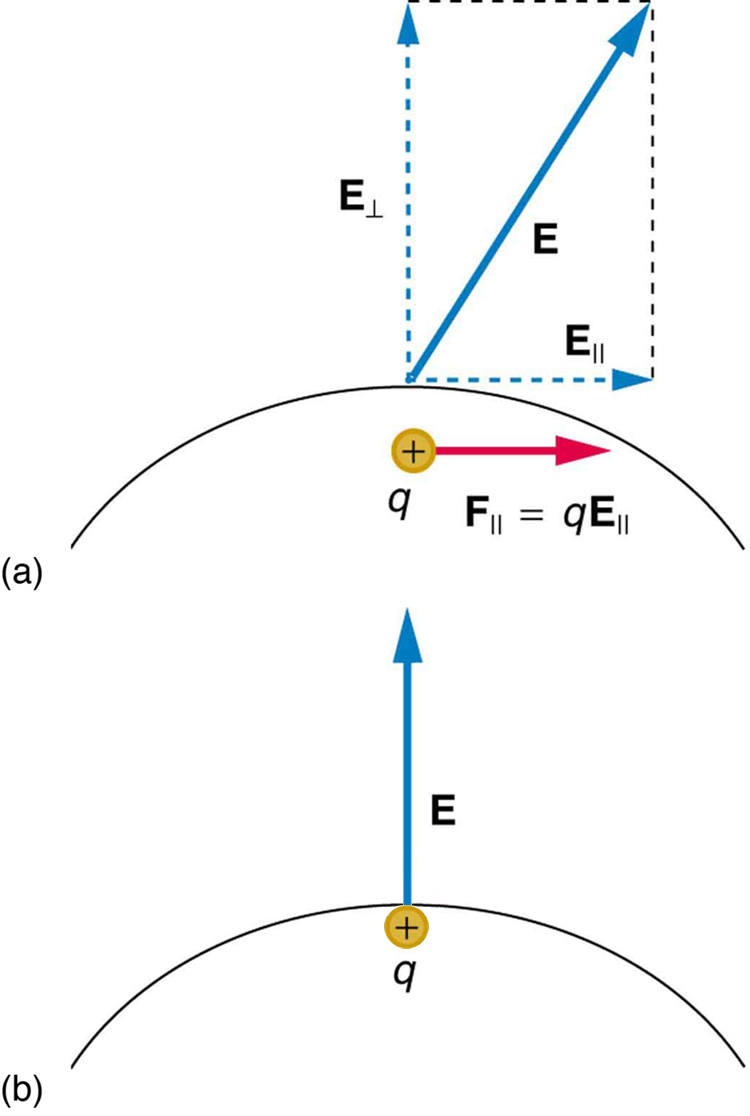
Electric polarization: separation or displacement of positive and negative charge within a material, without necessarily changing its net charge.
A conductor placed in an electric field will be polarized. Figure 9.7.2 shows the result of placing a neutral conductor in an originally uniform electric field. The field becomes stronger near the conductor but entirely disappears inside it.
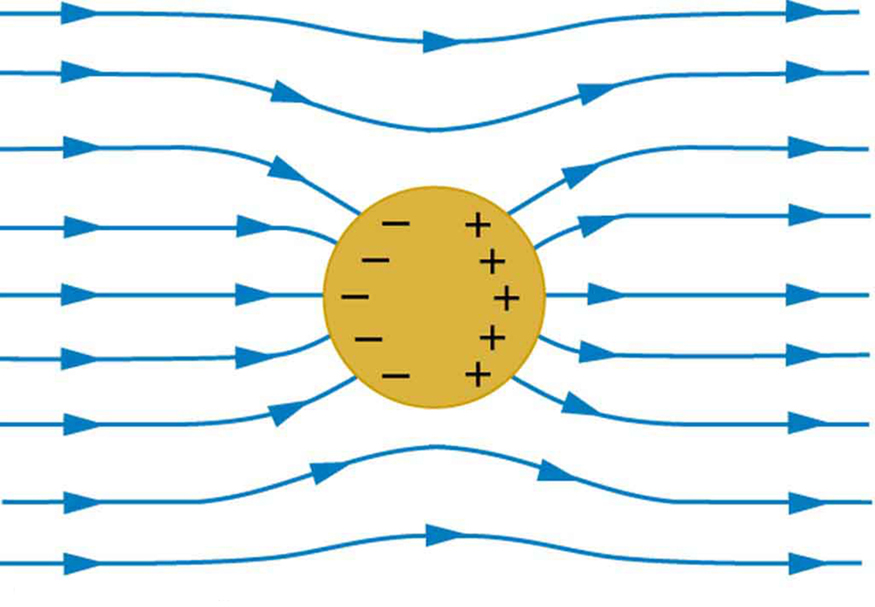
Misconception Alert: Electric Field inside a Conductor
Excess charges placed on a spherical conductor repel and move until they are evenly distributed, as shown in Figure 9.7.3. Excess charge is forced to the surface until the field inside the conductor is zero. Outside the conductor, the field is exactly the same as if the conductor were replaced by a point charge at its center equal to the excess charge.
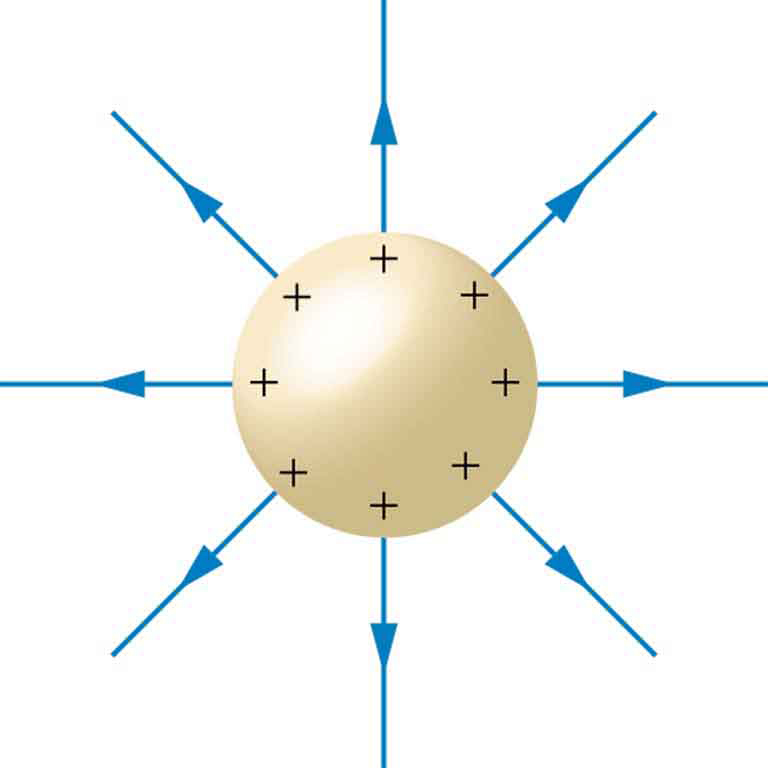
Properties of a Conductor in Electrostatic Equilibrium
- The electric field is zero inside a conductor.
- Just outside a conductor, the electric field lines are perpendicular to its surface, ending or beginning on charges on the surface.
- Any excess charge resides entirely on the surface or surfaces of a conductor.
The properties of a conductor are consistent with the situations already discussed and can be used to analyze any conductor in electrostatic equilibrium. This can lead to some interesting new insights, such as described below.
How can a very uniform electric field be created? Consider a system of two metal plates with opposite charges on them, as shown in Figure 9.7.4. The properties of conductors in electrostatic equilibrium indicate that the electric field between the plates will be uniform in strength and direction. Except near the edges (which can be ignored when plates are close to each other), the excess charges distribute themselves uniformly, producing field lines that are uniformly spaced (hence uniform in strength) and perpendicular to the surfaces (hence uniform in direction, since the plates are flat).
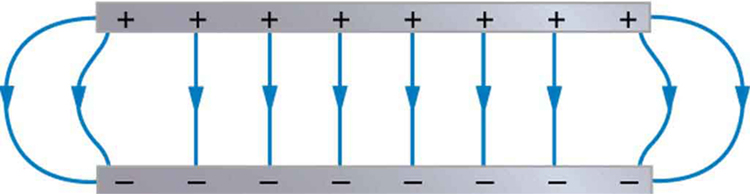
In fact, this is a particular example of electric circuit elements called capacitors. This particular example is called a parallel-plate capacitor and can be used to analyze properties of capacitors in general, such as how many charges can be stored using two nearby conductors set at a certain electric potential difference (voltage) apart. Capacitors find wide use in electric circuits alongside the resistors and inductors that you will learn about later.
Electric Fields on Uneven Surfaces
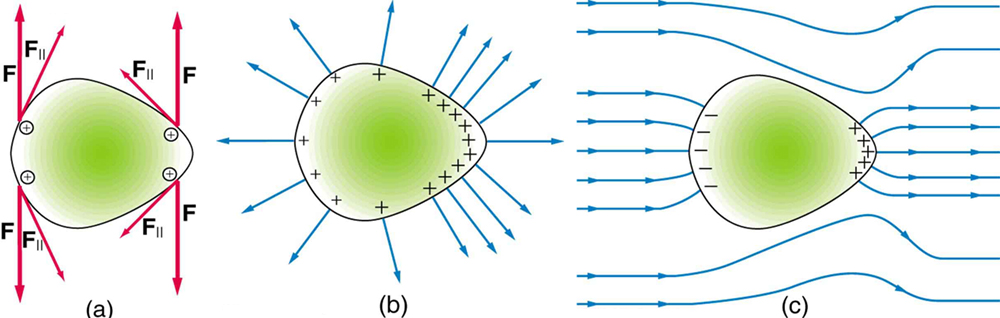
So far we have considered excess charges on a smooth, symmetrical conductor surface. What happens if a conductor has sharp corners or is pointed? Excess charges on a nonuniform conductor become concentrated at the sharpest points. Additionally, excess charge may move on or off the conductor at the sharpest points. To see how and why this happens, consider the charged conductor in Figure 9.7.5. The electrostatic repulsion of like charges is most effective in moving them apart on the flattest surface, and so they become least concentrated there. The same effect is produced on a conductor by an externally applied electric field, as seen in Figure 9.7.5 (c). Since the field lines must be perpendicular to the surface, more of them are concentrated on the most curved parts.
Applications of Conductors
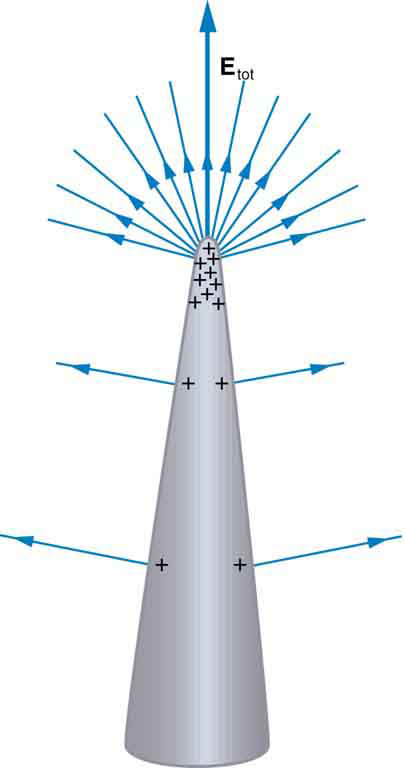
Near a sharply curved conducting surface, such as the point shown in Figure 9.7.6, the electric field can become strong enough to ionize nearby air. The resulting charged particles allow charge to flow between the conductor and the air, a process called corona discharge.
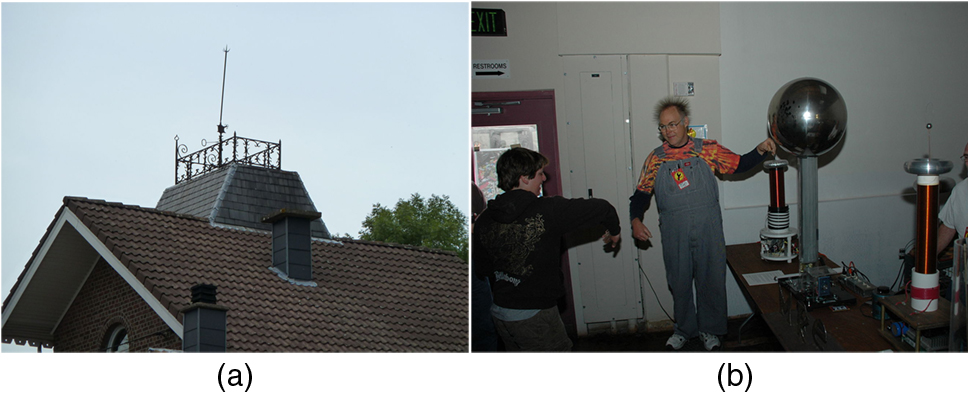
This charge leakage can occur at the pointed tip of a lightning rod when a storm cloud produces a strong electric field near the building. It does not reliably prevent a lightning strike, however. The rod’s principal protective role is to provide a conducting path to ground if lightning strikes.
Of course, we sometimes wish to prevent the transfer of charge rather than to facilitate it. In that case, the conductor should be very smooth and have as large a radius of curvature as possible (see Figure 9.7.7, which shows a Van de Graaff generator). Smooth surfaces are used on high-voltage transmission lines, for example, to avoid leakage of charge into the air.
Another device that makes use of some of these principles is a Faraday cage. This is a metal shield that encloses a volume. In electrostatic equilibrium, a closed conducting shield protects an empty cavity from external electric fields. With no charge inside the cavity, excess charge resides on the shield’s outer surface and the field in the cavity is zero. A Faraday cage is used to prohibit stray electrical fields in the environment from interfering with sensitive measurements, such as the electrical signals inside a nerve cell.
During electrical storms if you are driving a car, it is best to stay inside the car as its metal body acts as a Faraday cage with zero electrical field inside. If in the vicinity of a lightning strike, its effect is felt on the outside of the car and the inside is unaffected, provided you remain totally inside. This is also true if an active (“hot”) electrical wire was broken (in a storm or an accident) and fell on your car.
Below are additional applications of electrostatics, the study of electricity in electrostatic equilibrium, many of them using conductors for their properties just discussed above.
The Van de Graaff Generator
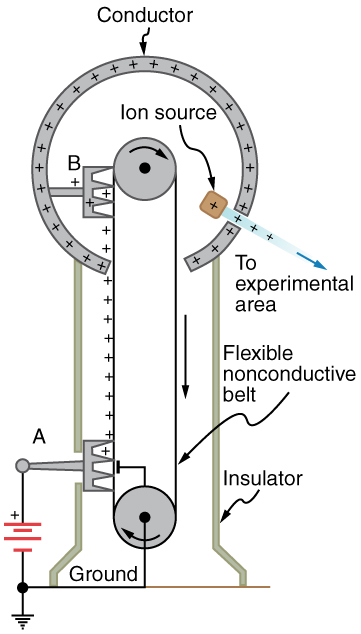
Van de Graaff generators (or Van de Graaffs) are not only spectacular devices used to demonstrate high voltage due to static electricity—they are also used for serious research. The first was built by Robert Van de Graaff in 1931 (based on original suggestions by Lord Kelvin) for use in nuclear physics research. Figure 9.7.8 shows a schematic of a large research version. Van de Graaffs utilize both smooth and pointed surfaces, and conductors and insulators to generate large static charges and, hence, large voltages.
A very large excess charge can be deposited on the sphere, because it moves quickly to the outer surface. Practical limits arise because the large electric fields polarize and eventually ionize surrounding materials, creating free charges that neutralize excess charge or allow it to escape. Nevertheless, voltages of 15 million volts are well within practical limits.
Take-Home Experiment: Electrostatics and Humidity
Rub a comb through your hair and use it to lift pieces of paper. It may help to tear the pieces of paper rather than cut them neatly. Repeat the exercise in your bathroom after you have had a long shower and the air in the bathroom is moist. Is it easier to get electrostatic effects in dry or moist air? Why would torn paper be more attractive to the comb than cut paper? Explain your observations.
Xerography
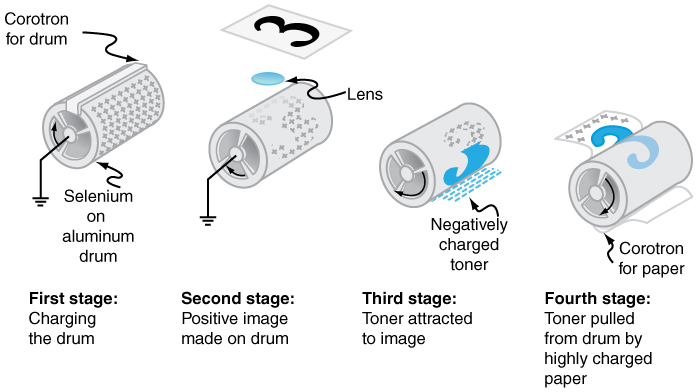
Most copy machines use an electrostatic process called xerography—a word coined from the Greek words xeros for dry and graphos for writing. The heart of the process is shown in simplified form in Figure 9.7.9.
A selenium-coated aluminum drum is sprayed with positive charge from points on a device called a corotron. Selenium is a substance with an interesting property—it is a photoconductor. That is, selenium is an insulator when in the dark and a conductor when exposed to light.
In the first stage of the xerography process, the conducting aluminum drum is grounded so that a negative charge is induced under the thin layer of uniformly positively charged selenium. In the second stage, the surface of the drum is exposed to the image of whatever is to be copied. Where the image is light, the selenium becomes conducting, and the positive charge is neutralized. In dark areas, the positive charge remains, and so the image has been transferred to the drum.
The third stage takes a dry black powder, called toner, and sprays it with a negative charge so that it will be attracted to the positive regions of the drum. Next, a blank piece of paper is given a greater positive charge than on the drum so that it will pull the toner from the drum. Finally, the paper and electrostatically held toner are passed through heated pressure rollers, which melt and permanently adhere the toner within the fibers of the paper.
Laser Printers
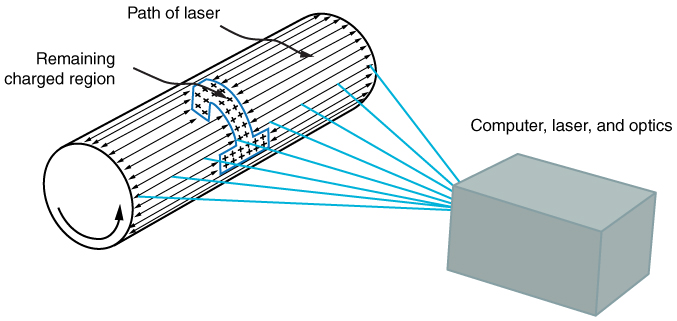
Laser printers use the xerographic process to make high-quality images on paper, employing a laser to produce an image on the photoconducting drum as shown in Figure 9.7.10. In its most common application, the laser printer receives output from a computer, and it can achieve high-quality output because of the precision with which laser light can be controlled. Many laser printers do significant information processing, such as making sophisticated letters or fonts, and may contain a computer more powerful than the one giving them the raw data to be printed.
Ink Jet Printers and Electrostatic Painting
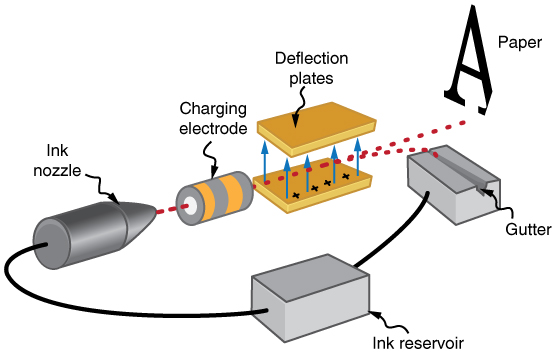
The ink jet printer, commonly used to print computer-generated text and graphics, also employs electrostatics. A nozzle makes a fine spray of tiny ink droplets, which are then given an electrostatic charge. (See Figure 9.7.11.)
Once charged, the droplets can be directed, using pairs of charged plates, with great precision to form letters and images on paper. Ink jet printers can produce color images by using a black jet and three other jets with primary colors, usually cyan, magenta, and yellow, much as a color television produces color. (This is more difficult with xerography, requiring multiple drums and toners.)
Electrostatic painting employs electrostatic charge to spray paint onto odd-shaped surfaces. Mutual repulsion of like charges causes the paint to fly away from its source. Surface tension forms drops, which are then attracted by unlike charges to the surface to be painted. Electrostatic painting can reach those hard-to-get at places, applying an even coat in a controlled manner. If the object is a conductor, the electric field is perpendicular to the surface, tending to bring the drops in perpendicularly. Corners and points on conductors will receive extra paint. Felt can similarly be applied.
Smoke Precipitators and Electrostatic Air Cleaning
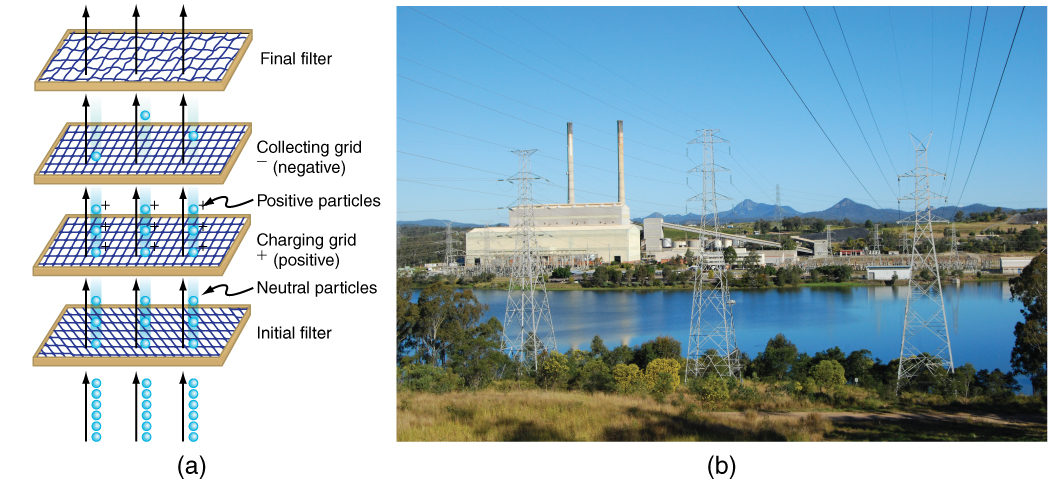
Another important application of electrostatics is found in air cleaners, both large and small. The electrostatic part of the process places excess (usually positive) charge on smoke, dust, pollen, and other particles in the air and then passes the air through an oppositely charged grid that attracts and retains the charged particles. (See Figure 9.7.12.)
Large electrostatic precipitators are used industrially to remove over 99% of the particles from stack gas emissions associated with the burning of coal and oil. Home precipitators, often in conjunction with the home heating and air conditioning system, are very effective in removing polluting particles, irritants, and allergens.
Chapter questions and exercises