9.8
Current
Chapter contents: Chapter 9: Electricity
Electric Current
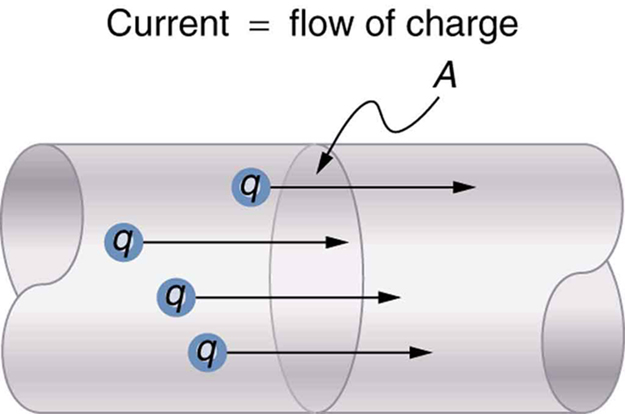
Electric current is defined to be the rate at which charge flows. A large current, such as that used to start a truck engine, moves a large amount of charge in a small time, whereas a small current, such as that used to operate a hand-held calculator, moves a small amount of charge over a long period of time. In equation form, electric current is defined to be
(9.8.1)
where is the amount of charge passing through a given area in time . (As in previous chapters, initial time is often taken to be zero, in which case .) (See Figure 9.8.1.) The SI unit for current is the ampere (A), named for the French physicist André-Marie Ampère (1775–1836). Since , we see that an ampere is one coulomb per second:
Not only are fuses and circuit breakers rated in amperes (or amps), so are many electrical appliances.
Example 9.8.1
Calculating Currents: Current in a Truck Battery and a Handheld Calculator
(a) What is the current involved when a truck battery sets in motion 720 C of charge in 4.00 s while starting an engine? (b) How long does it take 1.00 C of charge to flow through a handheld calculator if a 0.300-mA current is flowing?
Strategy
We can use the definition of current in the equation to find the current in part (a), since charge and time are given. In part (b), we rearrange the definition of current and use the given values of charge and current to find the time required.
Solution for (a)
Entering the given values for charge and time into the definition of current gives
Discussion for (a)
This large value for current illustrates the fact that a large charge is moved in a small amount of time. The currents in these “starter motors” are fairly large because large frictional forces need to be overcome when setting something in motion.
Solution for (b)
Solving the relationship for time , and entering the known values for charge and current gives
Discussion for (b)
This time is slightly less than an hour. The small current used by the hand-held calculator takes a much longer time to move a smaller charge than the large current of the truck starter. So why can we operate our calculators only seconds after turning them on? It’s because calculators require very little energy. Such small current and energy demands allow handheld calculators to operate from solar cells or to get many hours of use out of small batteries. Remember, calculators do not have moving parts in the same way that a truck engine has with cylinders and pistons, so the technology requires smaller currents.
Figure 9.8.2 shows a simple circuit and the standard schematic representation of a battery, conducting path, and load (a resistor). Schematics are very useful in visualizing the main features of a circuit. A single schematic can represent a wide variety of situations. The schematic in Figure 9.8.2 (b), for example, can represent anything from a truck battery connected to a headlight lighting the street in front of the truck to a small battery connected to a penlight lighting a keyhole in a door. Such schematics are useful because the analysis is the same for a wide variety of situations. We need to understand a few schematics to apply the concepts and analysis to many more situations.
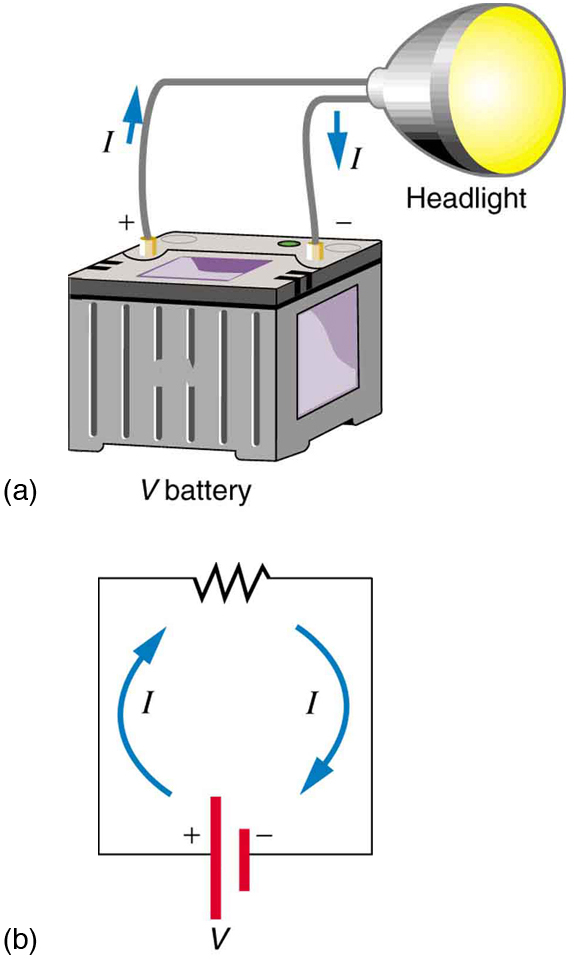
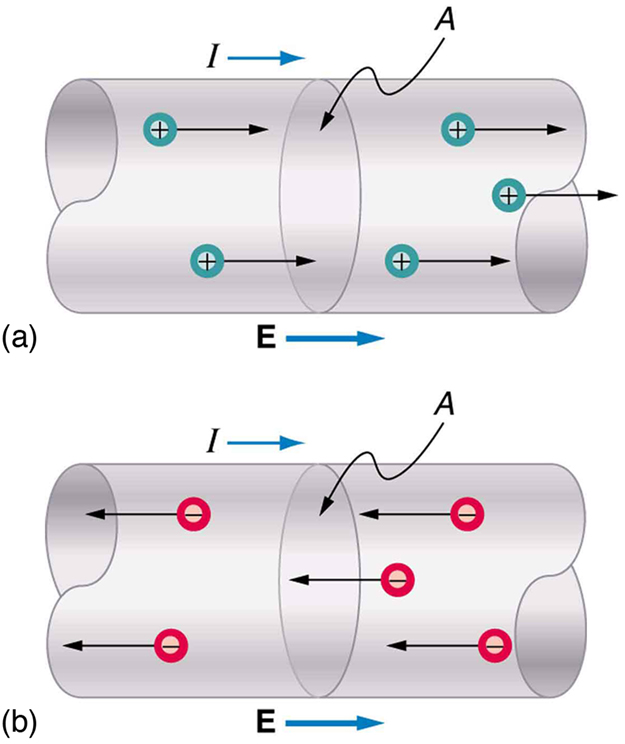
Note that the direction of current flow in Figure 9.8.2 is from positive to negative. The direction of conventional current is the direction that positive charge would flow. Depending on the situation, positive charges, negative charges, or both may move. In metal wires, for example, current is carried by electrons—that is, negative charges move. In ionic solutions, such as salt water, both positive and negative charges move. This is also true in nerve cells. A Van de Graaff generator used for nuclear research can produce a current of pure positive charges, such as protons. Figure 9.8.3 illustrates the movement of charged particles that compose a current. The fact that conventional current is taken to be in the direction that positive charge would flow can be traced back to American politician and scientist Benjamin Franklin in the 1700s. He named the type of charge associated with electrons negative, long before they were known to carry current in so many situations. Franklin, in fact, was totally unaware of the small-scale structure of electricity.
It is important to realize that there is an electric field in conductors responsible for producing the current, as illustrated in Figure 9.8.3. Unlike static electricity, where a conductor in equilibrium cannot have an electric field in it, conductors carrying a current have an electric field and are not in static equilibrium. An electric field is needed to supply energy to move the charges.
Making Connections: Take-Home Investigation—Electric Current Illustration
Find a straw and little peas that can move freely in the straw. Place the straw flat on a table and fill the straw with peas. When you pop one pea in at one end, a different pea should pop out the other end. This demonstration is an analogy for an electric current. Identify what compares to the electrons and what compares to the supply of energy. What other analogies can you find for an electric current?
Note that the flow of peas is based on the peas physically bumping into each other; electrons flow due to mutually repulsive electrostatic forces.
Example 9.8.2
Calculating the Number of Electrons that Move through a Calculator
If the 0.300-mA current through the calculator mentioned in the Example 9.8.1 example is carried by electrons, how many electrons per second pass through it?
Strategy
The current calculated in the previous example was defined for the flow of positive charge. For electrons, the magnitude is the same, but the sign is opposite,
.Since each electron has a charge of , we can convert the current in coulombs per second to electrons per second.
Solution
Starting with the definition of current, we have
(9.8.5)
We divide this by the charge per electron, so that
Discussion
There are so many charged particles moving, even in small currents, that individual charges are not noticed, just as individual water molecules are not noticed in water flow. Even more amazing is that they do not always keep moving forward like soldiers in a parade. Rather they are like a crowd of people with movement in different directions but a general trend to move forward. There are lots of collisions with atoms in the metal wire and, of course, with other electrons.
Section Summary
- Electric current is the rate at which charge flows, given by
where is the amount of charge passing through an area in time .(9.8.7)
- The direction of conventional current is taken as the direction in which positive charge moves.
- The SI unit for current is the ampere (A), where
- Current is the flow of free charges, such as electrons and ions.
Conceptual Questions
Exercise 30
Can a wire carry a current and still be neutral—that is, have a total charge of zero? Explain.
Exercise 31
Car batteries are rated in ampere-hours (). To what physical quantity do ampere-hours correspond (voltage, charge, . . .), and what relationship do ampere-hours have to energy content?
Exercise 32
Why are two conducting paths from a voltage source to an electrical device needed to operate the device?
Exercise 33
In cars, one battery terminal is connected to the metal body. How does this allow a single wire to supply current to electrical devices rather than two wires?
Exercise 34
Why isn’t a bird sitting on a high-voltage power line electrocuted? Contrast this with the situation in which a large bird hits two wires simultaneously with its wings.
Problems & Exercises
Exercise 101
What is the current in milliamperes produced by the solar cells of a pocket calculator through which 4.00 C of charge passes in 4.00 h?
Solution
0.278 mA
Exercise 102
A total of 600 C of charge passes through a flashlight in 0.500 h. What is the average current?
Exercise 103
What is the current when a typical static charge of moves from your finger to a metal doorknob in ?
Solution
0.250 A
Exercise 104
Find the current when 2.00 nC jumps between your comb and hair over a time interval.
Exercise 105
A large lightning bolt had a 20,000-A current and moved 30.0 C of charge. What was its duration?
Solution
1.50ms
Exercise 106
The 200-A current through a spark plug moves 0.300 mC of charge. How long does the spark last?
Exercise 107
(a) A defibrillator passes 12.0 A of current through the torso of a person for 0.0100 s. How much charge moves? (b) How many electrons pass through the wires connected to the patient? (See figure two problems earlier.)
Solution
(a) 0.120 C
(b)
Exercise 108
A clock battery wears out after moving 10,000 C of charge through the clock at a rate of 0.500 mA. (a) How long did the clock run? (b) How many electrons per second flowed?
Exercise 109
The batteries of a submerged non-nuclear submarine supply 1000 A at full speed ahead. How long does it take to move Avogadro’s number () of electrons at this rate?
Solution
96.3 s
Exercise 110
Electron guns are used in X-ray tubes. The electrons are accelerated through a relatively large voltage and directed onto a metal target, producing X-rays. (a) How many electrons per second strike the target if the current is 0.500 mA? (b) What charge strikes the target in 0.750 s?
Exercise 111
A large cyclotron directs a beam of nuclei onto a target with a beam current of 0.250 mA. (a) How many nuclei per second is this? (b) How long does it take for 1.00 C to strike the target? (c) How long before 1.00 mol of nuclei strike the target?
Solution
(a)
(b)
(c)
electric current
the rate at which charge flows, I = ΔQ/Δt
ampere
(amp) the SI unit for current; 1 A = 1 C/s