10.5
Magnetic Field Strength: Force on a Moving Charge in a Magnetic Field
Chapter contents: Chapter 10: Magnetism
What is the mechanism by which one magnet exerts a force on another? The answer is related to the fact that all magnetism is caused by current, the flow of charge. Magnetic fields exert forces on moving charges, and so they exert forces on other magnets, all of which have moving charges.
Magnetic Force on a Moving Charge
The magnetic force on a moving charge is one of the most fundamental known. Magnetic force is as important as the electrostatic or Coulomb force. Yet the magnetic force is more complex, in both the number of factors that affects it and in its direction, than the relatively simple Coulomb force.
The magnitude of the magnetic force on a charge depends on: the quantity of charge , its speed , the strength of magnetic field , and the direction of motion relative to the magnetic field's direction. Motion, and its direction, are critical.
The maximum force occurs when the direction of motion and the magnetic field's direction are perpendicular to one another (i.e. ninety degree angle between directions).
In that situation, the magnitude of the magnetic force is
The minimum force occurs when the direction of motion and the magnetic field's direction are parallel to one another (i.e. zero or 180 degree angle between directions).
In that situation, the magnitude of the magnetic force is
We define the magnetic field strength in terms of the force on a charged particle moving in a magnetic field. The SI unit for magnetic field strength is called the tesla (T) after the eccentric but brilliant inventor Nikola Tesla (1856–1943). To determine how the tesla relates to other SI units, we solve for the magnetic field strength.
(10.5.1)
So, the tesla is
(note that C/s = A).
Another smaller unit, called the gauss (G), where , is sometimes used. The strongest permanent magnets have fields near 2 T; superconducting electromagnets may attain 10 T or more. The Earth’s magnetic field on its surface is only about , or 0.5 G.
Making Connections: Charges and Magnets
There is no magnetic force on static charges. However, there is a magnetic force on moving charges. When charges are stationary, their electric fields do not affect magnets. But, when charges move, they produce magnetic fields that exert forces on other magnets. When there is relative motion, a connection between electric and magnetic fields emerges—each affects the other.
Direction of Force: Right Hand Rule 1
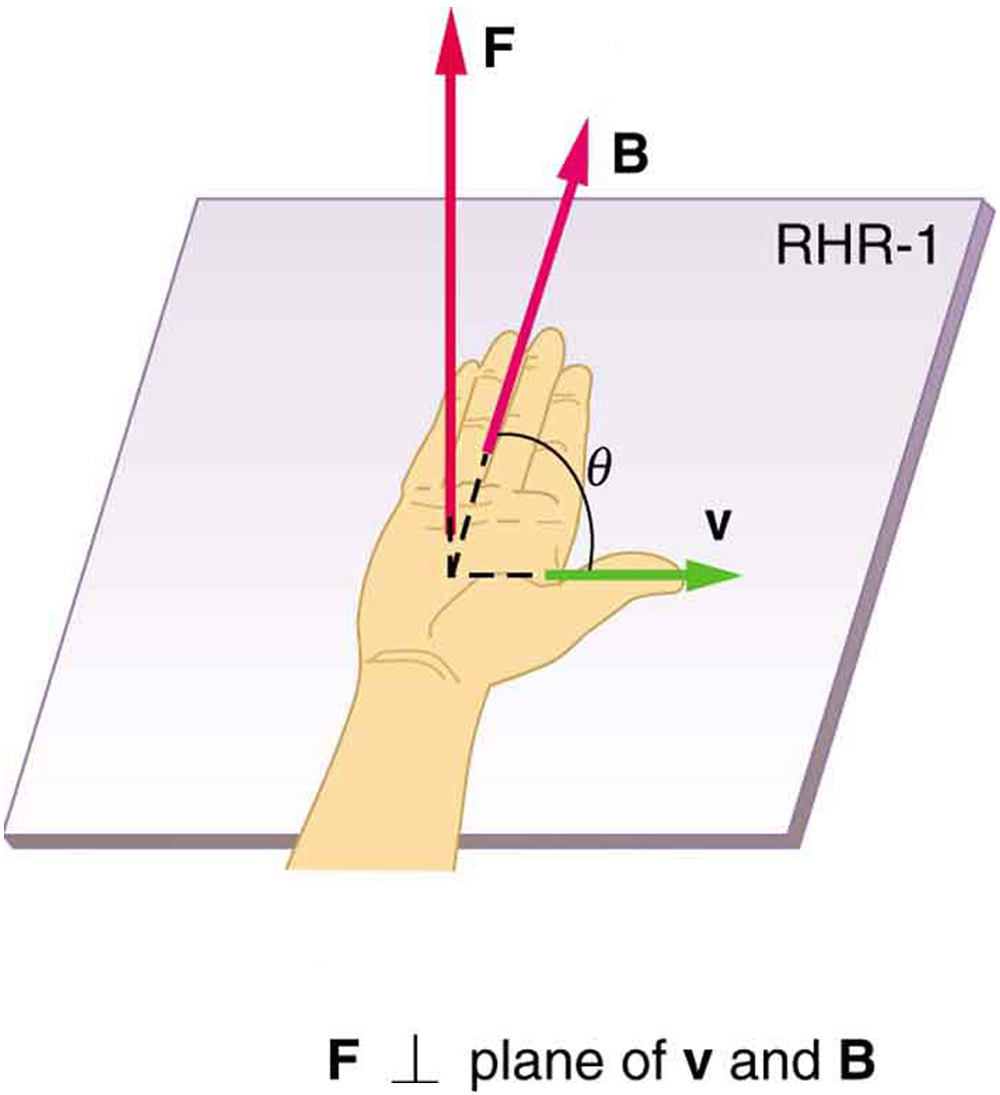
The direction of the magnetic force is perpendicular to the plane formed by and , as determined by the right hand rule 1 (or RHR-1), which is illustrated in Figure 10.5.1. RHR-1 states that, to determine the direction of the magnetic force on a positive moving charge, you point the thumb of the right hand in the direction of , the fingers in the direction of , and a perpendicular to the palm points in the direction of . One way to remember this is that there is one velocity, and so the thumb represents it. There are many field lines, and so the fingers represent them. The force is in the direction you would push with your palm. The force on a negative charge is in exactly the opposite direction to that on a positive charge.
Section Summary
- The maximum force a magnetic field can exert on a moving charge is
- The SI unit for magnetic field strength is the tesla (T), which is related to other units by
(10.5.3)
- The direction of the force on a moving charge is given by right hand rule 1 (RHR-1): Point the thumb of the right hand in the direction of , the fingers in the direction of , and a perpendicular to the palm points in the direction of .
- The force is perpendicular to the plane formed by and . Since the force is zero if is parallel to , charged particles often follow magnetic field lines rather than cross them.
Conceptual Questions
Exercise 6
If a charged particle moves in a straight line through some region of space, can you say that the magnetic field in that region is necessarily zero?
Problems & Exercises
Exercise 20
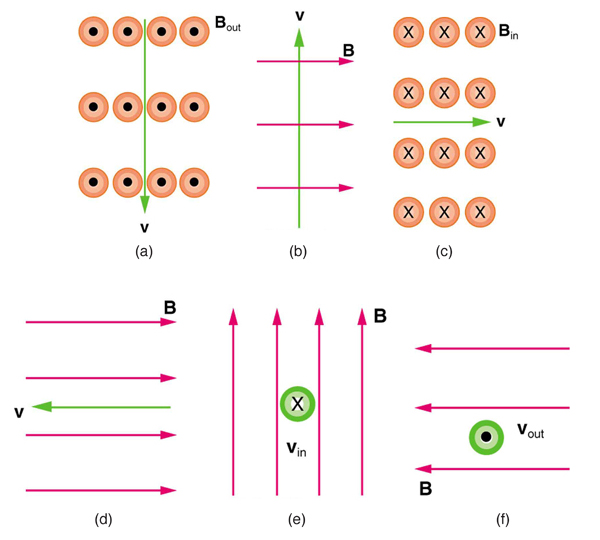
What is the direction of the magnetic force on a positive charge that moves as shown in each of the six cases shown in Figure 10.E.2? Note that indicates "coming out of the page" and means "going into the page."
Solution
(a) Left (West)
(b) Into the page
(c) Up (North)
(d) No force
(e) Right (East)
(f) Down (South)
Exercise 21
Repeat Exercise 20 for a negative charge.
Exercise 22
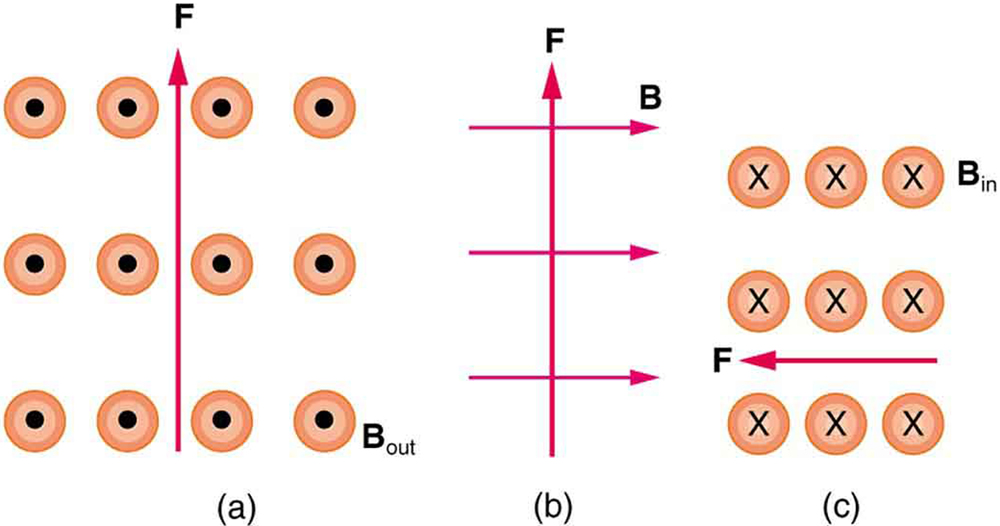
What is the direction of the velocity of a negative charge that experiences the magnetic force shown in each of the three cases in Figure 10.E.3, assuming it moves perpendicular to Note that indicates "coming out of the page" and means "going into the page."
Solution
(a) East (right)
(b) Into page
(c) South (down)
Exercise 23
Repeat Exercise 22 for a positive charge.
Exercise 24
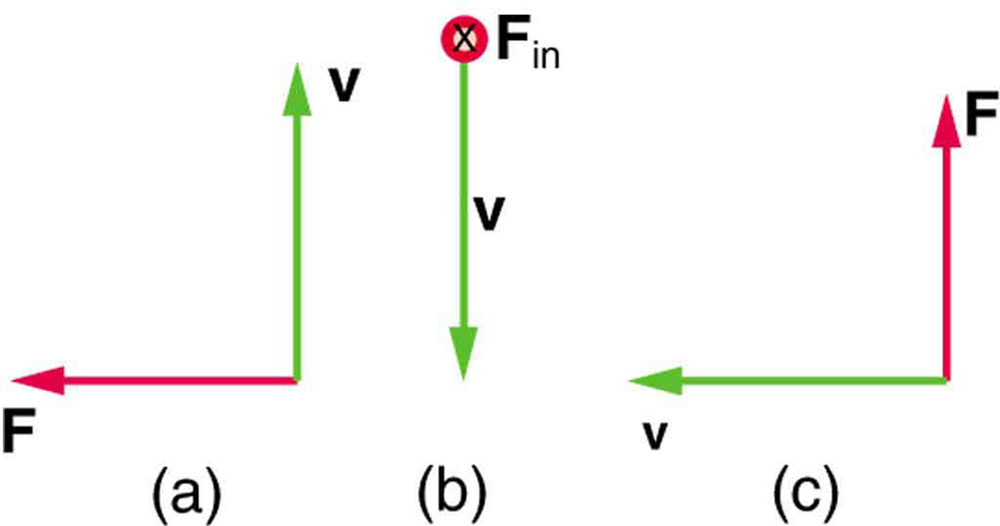
What is the direction of the magnetic field that produces the magnetic force on a positive charge as shown in each of the three cases in the figure below, assuming is perpendicular to ? Note that means "going into the page."
Solution
(a) Into page
(b) West (left)
(c) Out of page
Exercise 25
Repeat Exercise 24 for a negative charge.
Exercise 26
What is the maximum force on an aluminum rod with a charge that you pass between the poles of a 1.50-T permanent magnet at a speed of 5.00 m/s? In what direction is the force?
Solution
perpendicular to both the magnetic field lines and the velocity
Exercise 27
(a) Aircraft sometimes acquire small static charges. Suppose a supersonic jet has a charge and flies due west at a speed of 660 m/s over the Earth’s south magnetic pole, where the magnetic field points straight up. What are the direction and the magnitude of the magnetic force on the plane? (b) Discuss whether the value obtained in part (a) implies this is a significant or negligible effect.
right hand rule 1 (RHR-1)
the rule to determine the direction of the magnetic force on a positive moving charge: when the thumb of the right hand points in the direction of the charge’s velocity and the fingers point in the direction of the magnetic field , then the force on the charge is perpendicular and away from the palm; the force on a negative charge is perpendicular and into the palm
tesla
T, the SI unit of the magnetic field strength;
magnetic force
the force on a charge produced by its motion through a magnetic field
gauss
G, the unit of the magnetic field strength;