10.7
Motors and Meters
Chapter contents: Chapter 10: Magnetism
Motors are the most common application of magnetic force on current-carrying wires. Motors have loops of wire in a magnetic field. When current is passed through the loops, the magnetic field exerts force on the loops, which rotates a shaft. Electrical energy is converted to mechanical work in the process. (See Figure 10.7.1.)
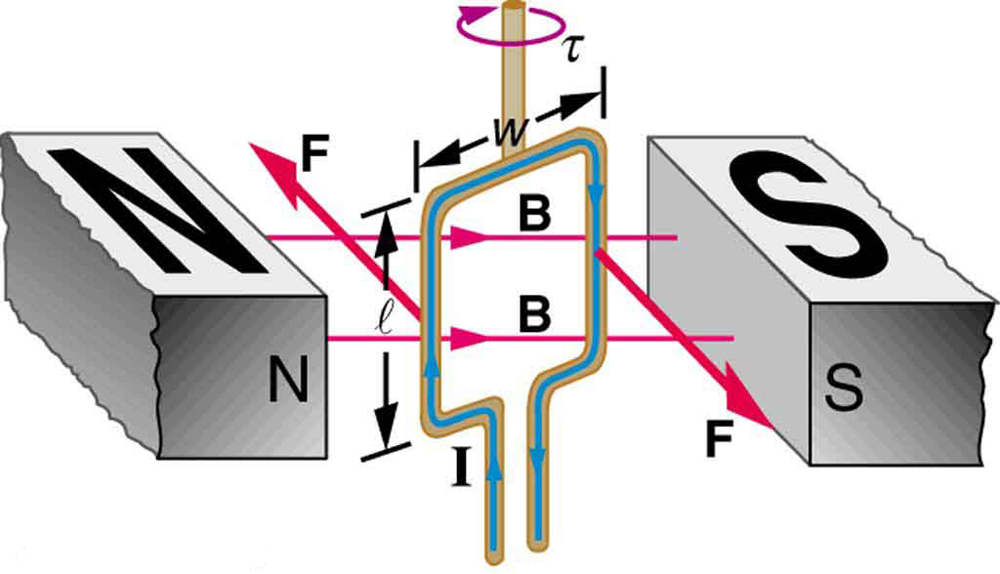
As the coil rotates, the force decreases to zero at . The force then reverses its direction once the coil rotates past .
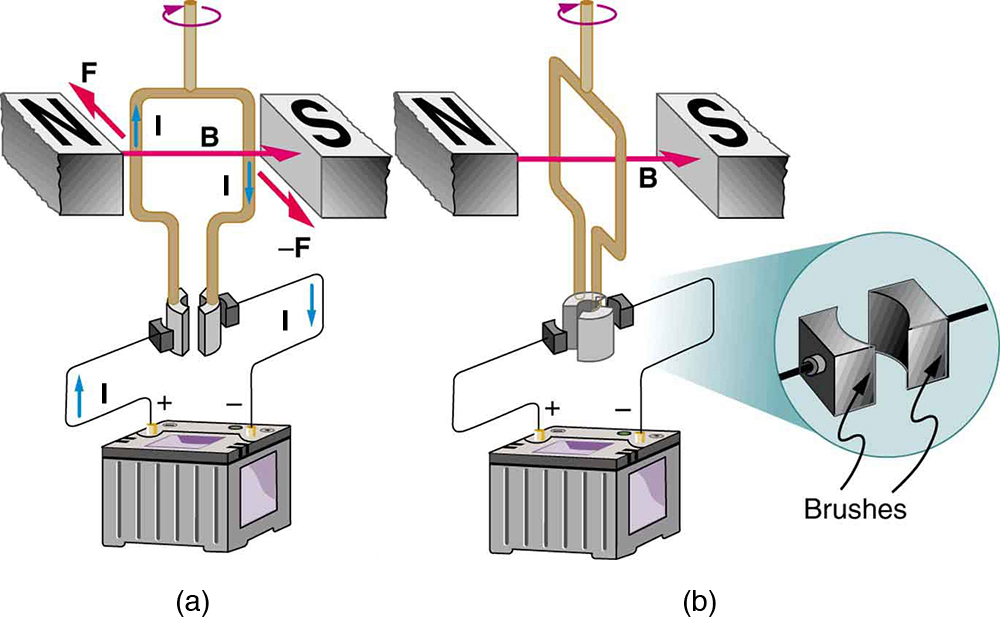
This means that, unless we do something, the coil will oscillate back and forth about equilibrium at . To get the coil to continue rotating in the same direction, we can reverse the current as it passes through with automatic switches called brushes. (See Figure 10.7.2.)
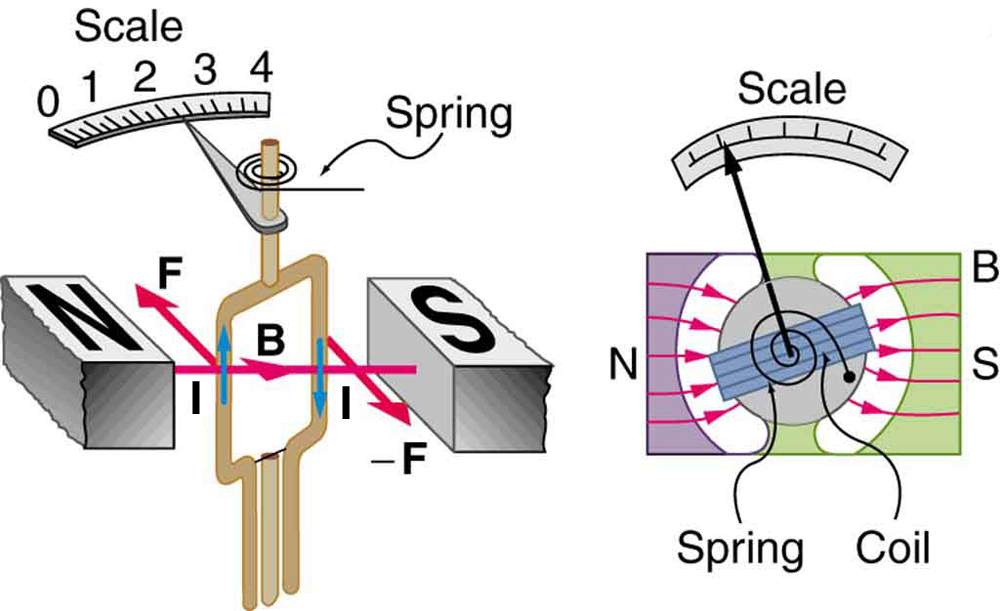
Meters, such as those in analog fuel gauges on a car, are another common application of magnetic force on a current-carrying loop. Figure 10.7.3 shows that a meter is very similar in construction to a motor. The meter in the figure has its magnets shaped to limit the effect of by making perpendicular to the loop over a large angular range.
A linear spring exerts a counter-force that balances the current-produced force. This makes the needle deflection proportional to . If an exact proportionality cannot be achieved, the gauge reading can be calibrated. To produce a galvanometer for use in analog voltmeters and ammeters that have a low resistance and respond to small currents, we use a large loop area , high magnetic field , and low-resistance coils.
motor
loop of wire in a magnetic field; when current is passed through the loops, the magnetic field exerts force on the loops, which rotates a shaft; electrical energy is converted to mechanical work in the process
meter
common application of magnetic force on a current-carrying loop that is very similar in construction to a motor; by design, the force is proportional to and not , so the needle deflection is proportional to the current