14.13
Particles, Patterns, and Conservation Laws
Chapter contents: Chapter 14: Nuclear and Particle Physics
In the early 1930s only a small number of subatomic particles were known to exist—the proton, neutron, electron, photon and, indirectly, the neutrino. Nature seemed relatively simple in some ways, but mysterious in others. Why, for example, should the particle that carries positive charge be almost 2000 times as massive as the one carrying negative charge? Why does a neutral particle like the neutron have a magnetic moment? Does this imply an internal structure with a distribution of moving charges? Why is it that the electron seems to have no size other than its wavelength, while the proton and neutron are about 1 fermi in size? So, while the number of known particles was small and they explained a great deal of atomic and nuclear phenomena, there were many unexplained phenomena and hints of further substructures.
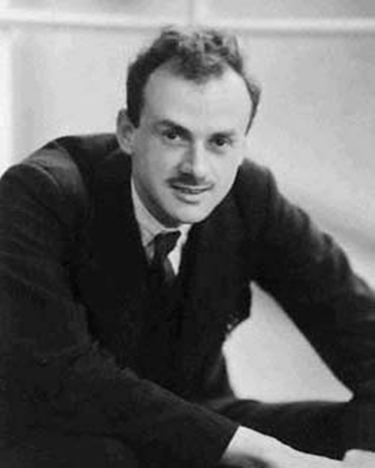
Things soon became more complicated, both in theory and in the prediction and discovery of new particles. In 1928, the British physicist P.A.M. Dirac (see Figure 14.13.1) developed a highly successful relativistic quantum theory that laid the foundations of quantum electrodynamics (QED). His theory, for example, explained electron spin and magnetic moment in a natural way. But Dirac’s theory also predicted negative energy states for free electrons. By 1931, Dirac, along with Oppenheimer, realized this was a prediction of positively charged electrons (or positrons). In 1932, American physicist Carl Anderson discovered the positron in cosmic ray studies. The positron, or , is the same particle as emitted in decay and was the first antimatter that was discovered. In 1935, Yukawa predicted pions as the carriers of the strong nuclear force, and they were eventually discovered. Muons were discovered in cosmic ray experiments in 1937, and they seemed to be heavy, unstable versions of electrons and positrons. After World War II, accelerators energetic enough to create these particles were built. Not only were predicted and known particles created, but many unexpected particles were observed. Initially called elementary particles, their numbers proliferated to dozens and then hundreds, and the term “particle zoo” became the physicist’s lament at the lack of simplicity. But patterns were observed in the particle zoo that led to simplifying ideas such as quarks, as we shall soon see.
Matter and Antimatter
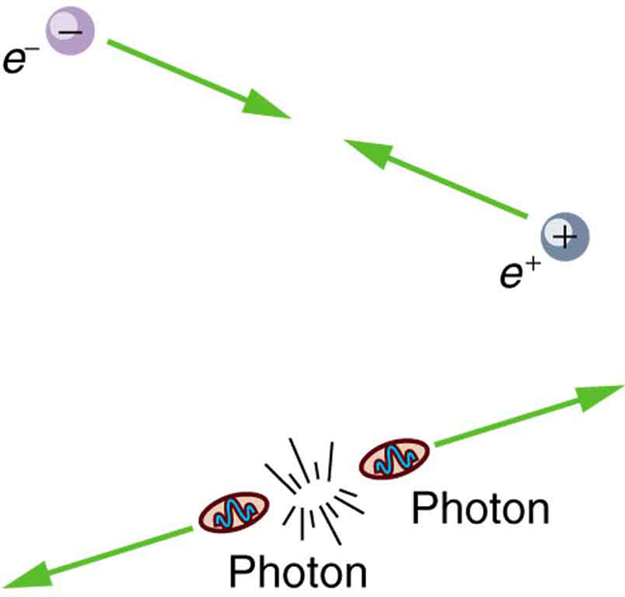
The positron was only the first example of antimatter. Every particle in nature has an antimatter counterpart, although some particles, like the photon, are their own antiparticles. Antimatter has charge opposite to that of matter (for example, the positron is positive while the electron is negative) but is nearly identical otherwise, having the same mass, intrinsic spin, half-life, and so on. When a particle and its antimatter counterpart interact, they annihilate one another, usually totally converting their masses to pure energy in the form of photons as seen in Figure 14.13.2. Neutral particles, such as neutrons, have neutral antimatter counterparts, which also annihilate when they interact. Certain neutral particles are their own antiparticle and live correspondingly short lives. For example, the neutral pion is its own antiparticle and has a half-life about shorter than and , which are each other’s antiparticles. Without exception, nature is symmetric—all particles have antimatter counterparts. For example, antiprotons and antineutrons were first observed in accelerator experiments in 1955 and 1956, respectively and the antiproton is negative. Antihydrogen atoms, consisting of an antiproton and antielectron, were observed in 1995 at CERN, too. Antiprotons can be stored in electromagnetic traps that use electric and magnetic fields to keep them away from ordinary matter. Repulsion between the trapped antiprotons limits how densely they can be confined for given trapping fields. Maintaining the required vacuum, low temperatures, and stable confinement presents substantial technical challenges, so storing macroscopic quantities remains impractical. At any rate, we now see that negative charge is associated with both low-mass (electrons) and high-mass particles (antiprotons) and the apparent asymmetry is not there. This raises a deeper question: why does the observable universe contain so much more matter than antimatter? The origin of this imbalance remains an open problem in physics, beyond the scope of this textbook.
Hadrons and Leptons
Particles can also be revealingly grouped according to what forces they feel between them. All particles (even those that are massless) are affected by gravity, since gravity affects the space and time in which particles exist. All charged particles are affected by the electromagnetic force, as are neutral particles that have an internal distribution of charge (such as the neutron with its magnetic moment). Hadrons are composite particles whose constituents are bound by the strong interaction. Protons, neutrons, and pions are examples. Leptons are elementary particles that do not participate in the strong interaction; examples include electrons, muons, neutrinos, and their antiparticles. Both hadrons and leptons participate in weak interactions, so the weak interaction does not distinguish these two groups.
Table 14.13.1 lists the characteristics of some of the most important subatomic particles, including the directly observed carrier particles for the electromagnetic and weak nuclear forces, all leptons, and some hadrons. Several hints related to an underlying substructure emerge from an examination of these particle characteristics. The photon, gluons, and W and Z bosons are gauge bosons: the particles associated with the electromagnetic, strong, and weak interactions in the Standard Model. The hypothetical graviton is discussed separately as a proposed carrier of gravity. A boson is a particle with an integer value of intrinsic spin (such as ), whereas a fermion is a particle with a half-integer value of intrinsic spin (). Fermions obey the Pauli exclusion principle whereas bosons do not. All the known and conjectured carrier particles are bosons.
| Category | Particle name | Symbol | Antiparticle | Rest mass | Lifetime2 (s) | |||||
|---|---|---|---|---|---|---|---|---|---|---|
| Gauge | Photon | Self | 0 | 0 | 0 | 0 | 0 | 0 | Stable | |
| Bosons | 0 | 0 | 0 | 0 | 0 | |||||
| Self | 0 | 0 | 0 | 0 | 0 | |||||
| Leptons | Electron | 0.511 | 0 | 0 | 0 | 0 | Stable | |||
| Electron Neutrino3 | 0 | 0 | 0 | 0 | No decay observed | |||||
| Muon | 105.7 | 0 | 0 | 0 | 0 | |||||
| Muon Neutrino3 | 0 | 0 | 0 | 0 | No decay observed | |||||
| Tau | 1777 | 0 | 0 | 0 | 0 | |||||
| Tau Neutrino3 | 0 | 0 | 0 | 0 | No decay observed | |||||
| Hadrons (selected) | ||||||||||
| Mesons | Pion | 139.6 | 0 | 0 | 0 | 0 | 0 | 2.60 × 10 −8 | ||
| Self | 135.0 | 0 | 0 | 0 | 0 | 0 | 8.4 × 10 −17 | |||
| Kaon | 493.7 | 0 | 0 | 0 | 0 | 1.24 × 10 −8 | ||||
| 497.6 | 0 | 0 | 0 | 0 | 0.90 × 10 −10 | |||||
| Eta | Self | 547.9 | 0 | 0 | 0 | 0 | 0 | 2.53 × 10 −19 | ||
| (many other mesons known) | ||||||||||
| Baryons | Proton | 938.3 | ± 1 | 0 | 0 | 0 | 0 | Stable4 | ||
| Neutron | 939.6 | ± 1 | 0 | 0 | 0 | 0 | 882 | |||
| Lambda | 1115.7 | ± 1 | 0 | 0 | 0 | 2.63 × 10 −10 | ||||
| Sigma | 1189.4 | ± 1 | 0 | 0 | 0 | 0.80 × 10 −10 | ||||
| 1192.6 | ± 1 | 0 | 0 | 0 | 7.4 × 10 −20 | |||||
| 1197.4 | ± 1 | 0 | 0 | 0 | 1.48 × 10 −10 | |||||
| Xi | 1314.9 | ± 1 | 0 | 0 | 0 | 2.90 × 10 −10 | ||||
| 1321.7 | ± 1 | 0 | 0 | 0 | 1.64 × 10 −10 | |||||
| Omega | 1672.5 | ± 1 | 0 | 0 | 0 | 0.82 × 10 −10 | ||||
| (many other baryons known) | ||||||||||
Table notes
1. The lower of the or symbols are the values for antiparticles.
2. Lifetimes are traditionally given as (which is , the inverse of the decay constant).
3. Neutrino flavors are mixtures of mass states. The entries are direct experimental upper bounds, not measured masses: the electron-based bound is 0.45 eV/c² (KATRIN, 2025; 90% confidence), the muon-based bound is 0.19 MeV/c² (90% confidence), and the tau-based bound is 18.2 MeV/c² (95% confidence). All three entries use the column unit MeV/c². The electron-based measurement constrains an effective mass through tritium beta decay, which emits an electron antineutrino. The weaker muon- and tau-based bounds do not imply that those flavors are heavier.
Oscillation measurements determine differences between squared masses, with characteristic magnitudes of about and eV²/c⁴. These establish that at least two mass states have nonzero mass, but do not determine the absolute masses. Combined with the electron-based direct bound, oscillation measurements constrain all three mass states.
4. Experimental lower limit is for proposed mode of decay.
All known leptons are listed in the table given above. There are only six leptons (and their antiparticles), and they seem to be fundamental in that they have no apparent underlying structure. Leptons have no discernible size other than their wavelength, so that we know they are pointlike down to about . Leptons occur in electron, muon, and tau families. For each family, assign +1 to its charged lepton and neutrino, −1 to their antiparticles, and zero to other particles. Adding these values gives the corresponding family number, , , or . The decay reactions considered here conserve each family number: the total before the reaction equals the total afterward. One of these was known from decay, where the existence of the electron neutrino implied that a new quantum number, called the electron family number is conserved in these beta-decay reactions. Thus, in decay, an electron antineutrino must be created with when an electron with is created, so that the total remains zero as it was before decay.
Once the muon was discovered in cosmic rays, its decay mode was found to be
,
(14.13.1)which illustrates the muon family and its associated muon family number . The muon neutrino in this decay balances the muon family number carried by the initial muon, so the total is the same before and after the decay.
More recently, a third lepton family was discovered when particles were created and observed to decay in a manner similar to muons. One principal decay mode is
.
(14.13.2)These family numbers are useful for analyzing the decay reactions shown here. However, they are not universally conserved: neutrino oscillations change the flavor composition of a neutrino as it propagates.
Mesons and Baryons
Now, note that the hadrons in the table given above are divided into two subgroups, called mesons (originally for medium mass) and baryons (the name derives from the Greek for “heavy”). The distinction between these groups reflects their internal structure, which we will discuss later in this section, rather than their masses. Their observed decay patterns helped physicists recognize the distinction. Mesons can decay entirely into particles that are not hadrons, so the number of mesons need not be conserved. In observed decays of unstable baryons, the products include another baryon. These patterns illustrate the conservation rule introduced below. A new physical quantity called baryon number seems to always be conserved in nature and is listed for the various particles in the table given above. Mesons and leptons have so that they can decay to other particles with . But baryons have if they are matter, and if they are antimatter. The conservation of total baryon number is a more general rule than first noted in nuclear physics, where it was observed that the total number of nucleons was always conserved in nuclear reactions and decays. That rule in nuclear physics is just one consequence of the conservation of the total baryon number.
Forces, Reactions, and Reaction Rates
The forces that act between particles regulate how they interact with other particles. For example, pions feel the strong force and do not penetrate as far in matter as do muons, which do not feel the strong force. (This was the way those who discovered the muon knew it could not be the particle that carries the strong force—its penetration or range was too great for it to be feeling the strong force.) Similarly, reactions that create other particles, like cosmic rays interacting with nuclei in the atmosphere, have greater probability if they are caused by the strong force than if they are caused by the weak force. Such knowledge has been useful to physicists while analyzing the particles produced by various accelerators.
The forces experienced by particles also govern how particles interact with themselves if they are unstable and decay. For example, the stronger the force, the faster they decay and the shorter is their lifetime. An example of a nuclear decay via the strong force is
with a lifetime of about . The neutron is a good example of decay via the weak force. The process has a longer lifetime of 882 s. The weak force causes this decay, as it does all decay. An important clue that the weak force is responsible for decay is the creation of leptons, such as and . None would be created if the strong force was responsible, just as no leptons are created in the decay of . The systematics of particle lifetimes is a little simpler than nuclear lifetimes when hundreds of particles are examined (not just the ones in the table given above). Particles that decay via the weak force have lifetimes mostly in the range of to s, whereas those that decay via the strong force have lifetimes mostly in the range of to s. Turning this around, if we measure the lifetime of a particle, we can tell if it decays via the weak or strong force.
Some hadrons are readily produced through strong interactions but decay much more slowly through the weak interaction. This unexpected behavior led physicists to introduce a quantum number called strangeness, denoted by . Total strangeness is conserved in strong and electromagnetic interactions but can change in weak interactions. Consequently, a decay that changes strangeness must proceed through the weak interaction. These conservation rules helped explain the observed patterns of particle production and decay.
A memorable maxim associated with Murray Gell-Mann captures the search for such rules: “Everything not forbidden is compulsory.” In particle physics, this is a useful guide: a process permitted by the relevant conservation laws may occur, although its probability can be extremely small. A process that has not been observed might therefore be forbidden—or simply too rare for experiments to have detected it.
Example 14.13.1
Calculating Quantum Numbers in Two Decays
(a) The most common decay mode of the particle is . Using the quantum numbers in the table given above, show that strangeness changes by 1, baryon number and charge are conserved, and lepton family numbers are unaffected.
(b) Is the decay allowed, given the quantum numbers in the table given above?
Strategy
In part (a), the conservation laws can be examined by adding the quantum numbers of the decay products and comparing them with the parent particle. In part (b), the same procedure can reveal if a conservation law is broken or not.
Solution for (a)
Before the decay, the has strangeness . After the decay, the total strangeness is −1 for the , plus 0 for the . Thus, total strangeness has gone from −2 to −1 or a change of +1. Baryon number for the is before the decay, and after the decay the has and the has so that the total baryon number remains +1. Charge is −1 before the decay, and the total charge after is also . Lepton numbers for all the particles are zero, and so lepton numbers are conserved.
Discussion for (a)
The decay is caused by the weak interaction, since strangeness changes, and it is consistent with the relatively long lifetime of the .
Solution for (b)
The decay is allowed if charge, baryon number, mass-energy, and lepton numbers are conserved. Strangeness can change due to the weak interaction. Electric charge is conserved: , in units of the elementary charge. Baryon number is conserved, since all particles have . Mass-energy is conserved in the sense that the has a greater mass than the products, so that the decay can be spontaneous. Lepton family numbers are conserved at 0 for the electron and tau family for all particles. The muon family number is before and after. Strangeness changes from +1 before to 0 + 0 after, a change of −1. The decay is allowed by all these measures.
Discussion for (b)
This decay is not only allowed by our reckoning, it is, in fact, the primary decay mode of the meson and is caused by the weak force, consistent with the long lifetime.
There are hundreds of particles, all hadrons, not listed in Table 14.13.1, most of which have shorter lifetimes. The systematics of those particle lifetimes, their production probabilities, and decay products are completely consistent with the conservation laws noted for lepton families, baryon number, and strangeness, but they also imply other quantum numbers and conservation laws. There are a finite, and in fact relatively small, number of these conserved quantities, however, implying a finite set of substructures. Additionally, some of these short-lived particles resemble the excited states of other particles, implying an internal structure. All of this jigsaw puzzle can be tied together and explained relatively simply by the existence of fundamental substructures. Leptons seem to be fundamental structures. Hadrons seem to have a substructure called quarks. We have so far discovered six quarks in three generations: up and down quarks, charm and strange quarks, and top and bottom quarks.
The quark model explains the distinction between the two groups of hadrons introduced earlier. In the simplest quark model, mesons are bound states of a quark and an antiquark, while baryons are bound states of three quarks. Antibaryons consist of three antiquarks. Pions and kaons are examples of mesons; protons and neutrons are examples of baryons.
In the quark model, each quark has baryon number +1/3 and each antiquark has baryon number −1/3. A three-quark baryon therefore has baryon number +1, an antibaryon has −1, and a quark–antiquark meson has zero.
The quark model gives strangeness a simple interpretation: each strange quark contributes −1, and each strange antiquark contributes +1. Other quarks contribute zero. Thus, a particle’s strangeness is the number of strange antiquarks minus the number of strange quarks it contains.