7.4

Pressure

Chapter contents: Chapter 7: Fluids

You have no doubt heard the word pressure being used in relation to blood (high or low blood pressure) and in relation to the weather (high- and low-pressure weather systems). These are only two of many examples of pressures in fluids. Pressure P is defined as
P=FA
where F is a force applied to an area A that is perpendicular to the force.

Pressure

Pressure is defined as the force divided by the area perpendicular to the force over which the force is applied, or
P=FA.
(7.4.1)
A given force can have a significantly different effect depending on the area over which the force is exerted, as shown in Figure 7.4.1. The SI unit for pressure is the pascal, where
1Pa=1N/m2.
(7.4.2)
In addition to the pascal, there are many other units for pressure that are in common use. In meteorology, atmospheric pressure is often expressed in millibars (mbar), where
1bar=1000mbar=105Pa.
(7.4.3)
Pounds per square inch (lb/in2 or psi) is still sometimes used as a measure of tire pressure, and millimeters of mercury (mm Hg) is still often used in the measurement of blood pressure. Pressure is defined for all states of matter but is particularly important when discussing fluids.
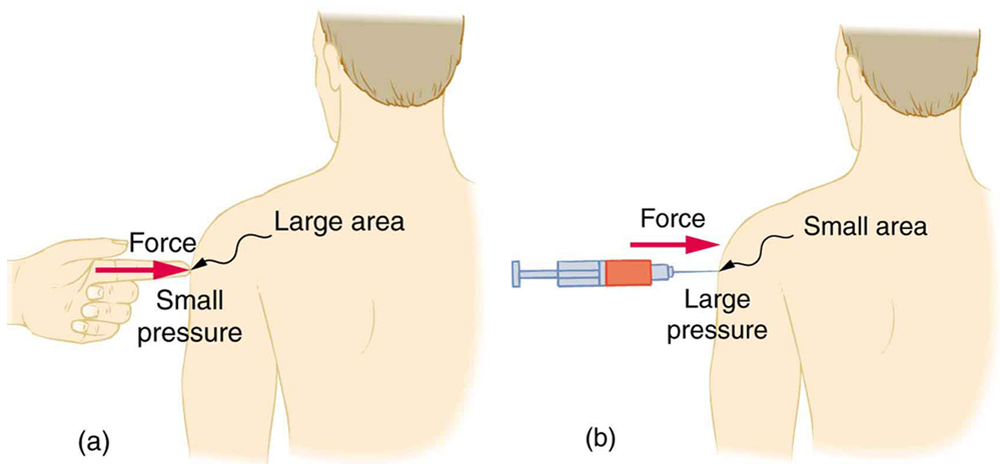
In figure a, the person is poked with a finger exerting a small pressure due to the large area of contact and, in b, he is poked with a syringe exerting a large pressure due to the small area of contact.
Figure 7.4.1. (a) While the person being poked with the finger might be irritated, the force has little lasting effect. (b) In contrast, the same force applied to an area the size of the sharp end of a needle is great enough to break the skin.
Example 7.4.1

Calculating Force Exerted by the Air: What Force Does a Pressure Exert?

An astronaut is working outside the International Space Station where the atmospheric pressure is essentially zero. The pressure gauge on her air tank reads 6.90×10⁶Pa. What force does the air inside the tank exert on the flat end of the cylindrical tank, a disk 0.150 m in diameter?
Strategy
We can find the force exerted from the definition of pressure given in P=FA, provided we can find the area A acted upon.
Solution
By rearranging the definition of pressure to solve for force, we see that
F=PA.
Here, the pressure P is given, as is the area of the end of the cylinder A, given by A=πr2. Thus,
F=(6.90×10⁶N/m2)(3.14)(0.0750m)2=1.22×105N.
Discussion
Wow! No wonder the tank must be strong. Since we found F=PA, we see that the force exerted by a pressure is directly proportional to the area acted upon as well as the pressure itself.
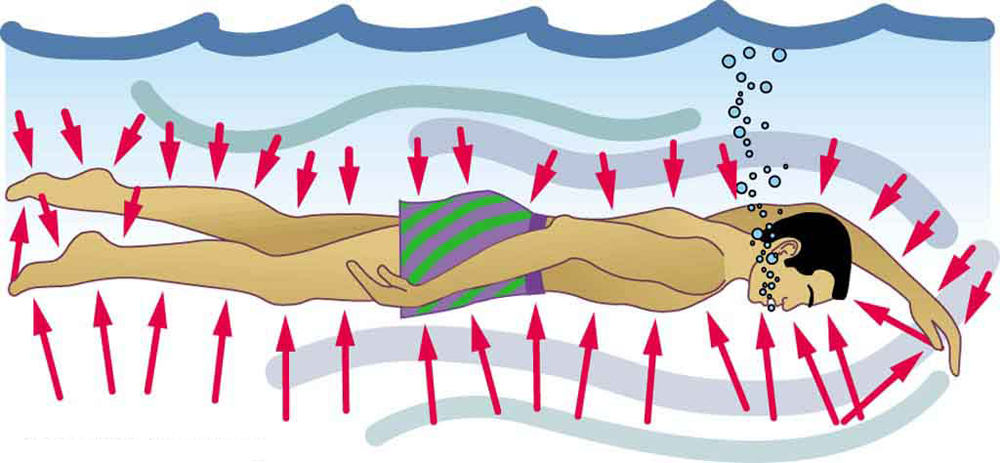
The force exerted on the end of the tank is perpendicular to its inside surface. This direction is because the force is exerted by a static or stationary fluid. We have already seen that fluids cannot withstand shearing (sideways) forces; they cannot exert shearing forces, either. Fluid pressure has no direction, being a scalar quantity. The forces due to pressure have well-defined directions: they are always exerted perpendicular to any surface. (See the tire in Figure 7.4.2, for example.) Finally, note that pressure is exerted on all surfaces. Swimmers, as well as the tire, feel pressure on all sides. (See Figure 7.4.3.)
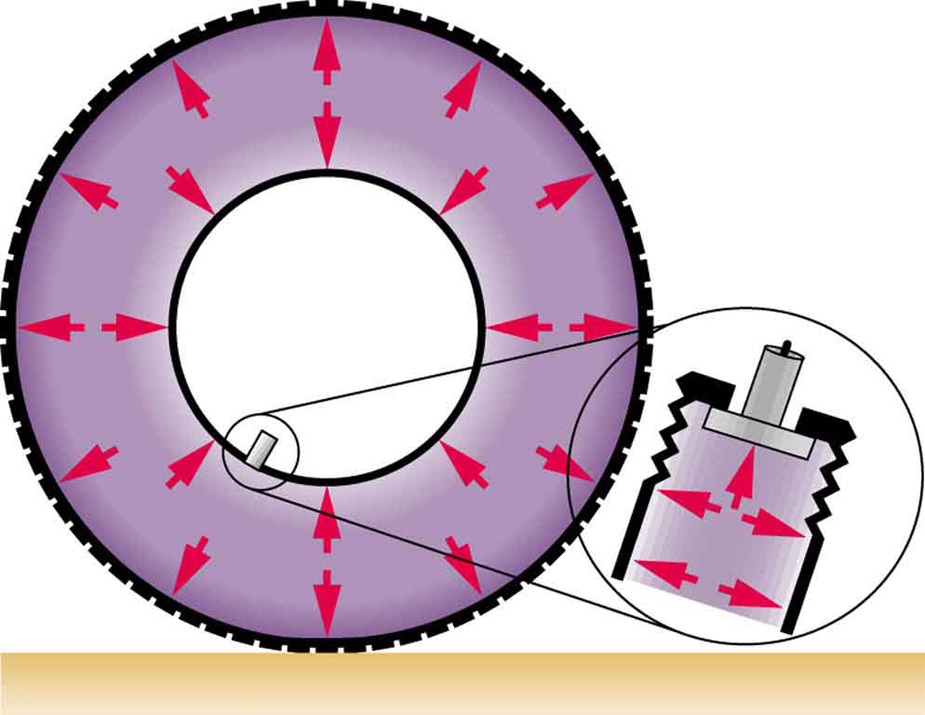
The forces inside a tire are shown by arrow lines. An inset shows an enlarged view of the valve in the tire. Air pressure in the tire keeps the valve closed.
Figure 7.4.2. Pressure inside this tire exerts forces perpendicular to all surfaces it contacts. The arrows give representative directions and magnitudes of the forces exerted at various points. Note that static fluids do not exert shearing forces.
A man swimming underwater has many arrows pointing toward him to represent the directions and magnitudes of the forces exerted on him at various points.
Figure 7.4.3. Pressure is exerted on all sides of this swimmer, since the water would flow into the space he occupies if he were not there. The arrows represent the directions and magnitudes of the forces exerted at various points on the swimmer. Note that the forces are larger underneath, due to greater depth, giving a net upward or buoyant force that is balanced by the weight of the swimmer.
Continue to this item in the chapter review.Continue to this item in the chapter review.Continue to this item in the chapter review.Continue to this item in the chapter review.Continue to this item in the chapter review.Continue to this item in the chapter review.Continue to this item in the chapter review.Continue to this item in the chapter review.Continue to this item in the chapter review.Continue to this item in the chapter review.Continue to this item in the chapter review.Continue to this item in the chapter review.Continue to this item in the chapter review.Continue to this item in the chapter review.Continue to this item in the chapter review.Continue to this item in the chapter review.Continue to this item in the chapter review.Continue to this item in the chapter review.Continue to this item in the chapter review.Continue to this item in the chapter review.Continue to this item in the chapter review.Continue to this item in the chapter review.Continue to this item in the chapter review.Continue to this item in the chapter review.Continue to this item in the chapter review.Continue to this item in the chapter review.Continue to this item in the chapter review.
Continue to this item in the chapter review.Continue to this item in the chapter review.