7.E: Fluids (Exercise)
Conceptual Questions
7.2: What Is a Fluid?
Conceptual Questions
Exercise 1
What physical characteristic distinguishes a fluid from a solid?
Exercise 2
Which of the following substances are fluids at room temperature: air, mercury, water, glass?
Exercise 3
Why are gases easier to compress than liquids and solids?
Exercise 4
How do gases differ from liquids?
7.3: Density
Conceptual Questions
Exercise 5
Approximately how does the density of air vary with altitude?
Exercise 6
Give an example in which density is used to identify the substance composing an object. Would information in addition to average density be needed to identify the substances in an object composed of more than one material?
Exercise 7
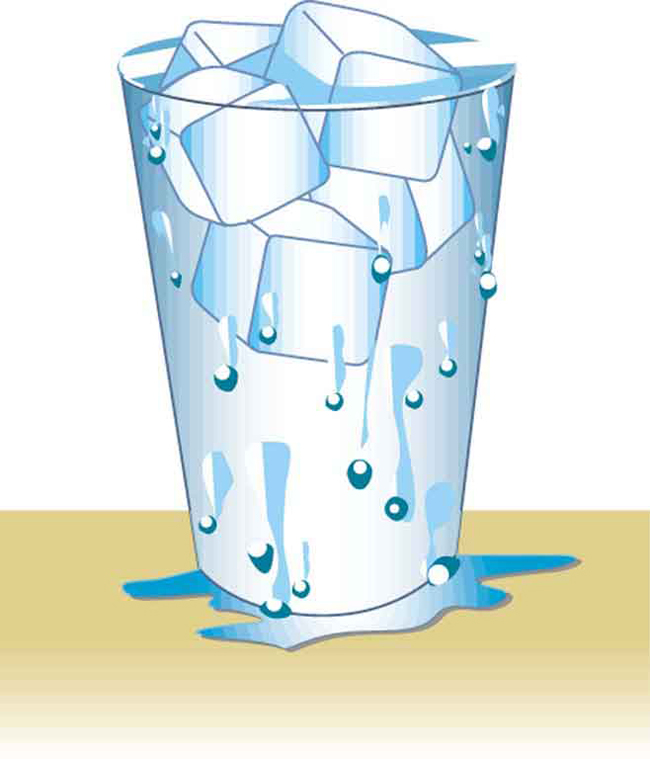
Figure 7.E.1 shows a glass of ice water filled to the brim. Will the water overflow when the ice melts? Explain your answer.
7.4: Pressure
Conceptual Questions
Exercise 8
How is pressure related to the sharpness of a knife and its ability to cut?
Exercise 9
Why does a dull hypodermic needle hurt more than a sharp one?
Exercise 10
The outward force on one end of an air tank was calculated in Example 7.4.1. How is this force balanced? (The tank does not accelerate, so the force must be balanced.)
Exercise 11
Why is force exerted by static fluids always perpendicular to a surface?
Exercise 12
In a remote location near the North Pole, an iceberg floats in a lake. Next to the lake (assume it is not frozen) sits a comparably sized glacier sitting on land. If both chunks of ice should melt due to rising global temperatures (and the melted ice all goes into the lake), which ice chunk would give the greatest increase in the level of the lake water, if any?
Exercise 13
How do jogging on soft ground and wearing padded shoes reduce the pressures to which the feet and legs are subjected?
Exercise 14
Toe dancing (as in ballet) is much harder on toes than normal dancing or walking. Explain in terms of pressure.
Exercise 15
How do you convert pressure units like millimeters of mercury, centimeters of water, and inches of mercury into units like newtons per meter squared without resorting to a table of pressure conversion factors?
7.5: Pressure Due to the Weight of Fluid
Conceptual Questions
Exercise 16
Atmospheric pressure exerts a large force (equal to the weight of the atmosphere above your body—about 10 tons) on the top of your body when you are lying on the beach sunbathing. Why are you able to get up?
Exercise 17
What are two reasons why mercury rather than water is used in barometers?
Exercise 18
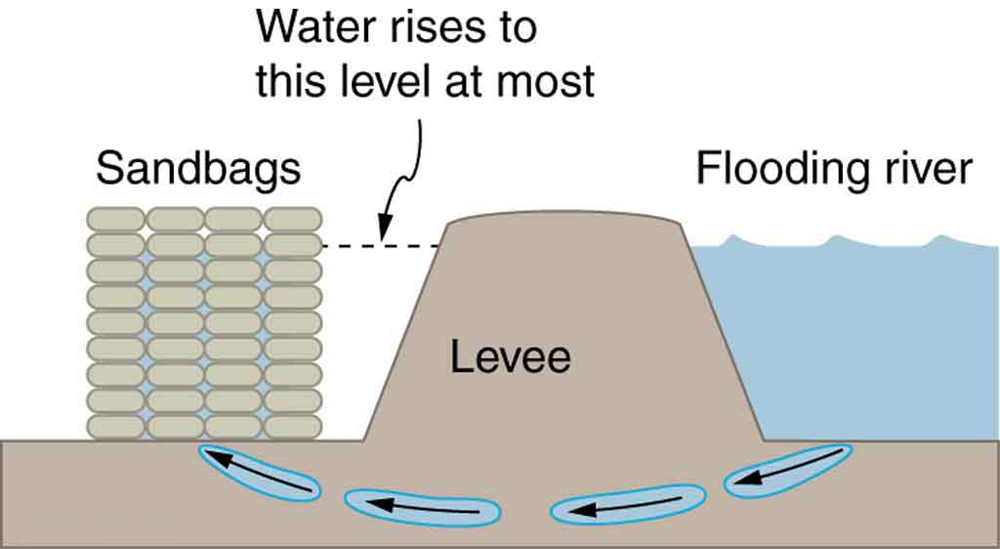
Figure 7.E.2 shows how sandbags placed around a leak outside a river levee can effectively stop the flow of water under the levee. Explain how the small amount of water inside the column formed by the sandbags is able to balance the much larger body of water behind the levee.
Exercise 19
Is there a net force on a dam due to atmospheric pressure? Explain your answer.
Exercise 20
Does atmospheric pressure add to the gas pressure in a rigid tank? In a toy balloon? When, in general, does atmospheric pressure not affect the total pressure in a fluid?
Exercise 21
You can break a strong wine bottle by pounding a cork into it with your fist, but the cork must press directly against the liquid filling the bottle—there can be no air between the cork and liquid. Explain why the bottle breaks, and why it will not if there is air between the cork and liquid.
7.6: Archimedes’ Principle
Conceptual Questions
Exercise 22
More force is required to pull the plug in a full bathtub than when it is empty. Does this contradict Archimedes’ principle? Explain your answer.
Exercise 23
Do fluids exert buoyant forces in a “weightless” environment, such as in the space shuttle? Explain your answer.
Exercise 24
Will the same ship float higher in salt water than in freshwater? Explain your answer.
Exercise 25
Marbles dropped into a partially filled bathtub sink to the bottom. Part of their weight is supported by buoyant force, yet the downward force on the bottom of the tub increases by exactly the weight of the marbles. Explain why.
7.7: Flow Rate and Its Relation to Velocity
Conceptual Questions
Exercise 26
What is the difference between flow rate and fluid velocity? How are they related?
Exercise 27
Many figures in the text show streamlines. Explain why fluid velocity is greatest where streamlines are closest together. (Hint: Consider the relationship between fluid velocity and the cross-sectional area through which it flows.)
Exercise 28
Identify some substances that are incompressible and some that are not.
7.8: Bernoulli’s Equation
Conceptual Questions
Exercise 29
You can squirt water a considerably greater distance by placing your thumb over the end of a garden hose and then releasing, than by leaving it completely uncovered. Explain how this works.
Exercise 30
Water is shot nearly vertically upward in a decorative fountain and the stream is observed to broaden as it rises. Conversely, a stream of water falling straight down from a faucet narrows. Explain why, and discuss whether surface tension enhances or reduces the effect in each case.
Exercise 31
Look back to Figure 7.8.1. Answer the following two questions. Why is less than atmospheric? Why is greater than ?
Exercise 32
Give an example of entrainment not mentioned in the text.
Exercise 33
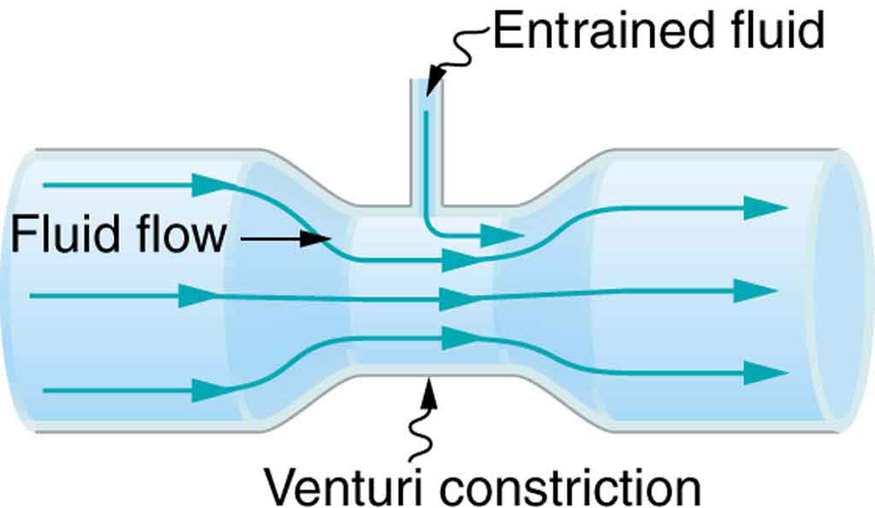
Many entrainment devices have a constriction, called a Venturi, such as shown in Figure 7.E.3. How does this bolster entrainment?
Exercise 34
Some chimney pipes have a T-shape, with a crosspiece on top that helps draw up gases whenever there is even a slight breeze. Explain how this works in terms of Bernoulli’s principle.
Exercise 35
Is there a limit to the height to which an entrainment device can raise a fluid? Explain your answer.
Exercise 36
Why is it preferable for airplanes to take off into the wind rather than with the wind?
Exercise 37
Roofs are sometimes pushed off vertically during a tropical cyclone, and buildings sometimes explode outward when hit by a tornado. Use Bernoulli’s principle to explain these phenomena.
Exercise 38
Why does a sailboat need a keel?
Exercise 39
It is dangerous to stand close to railroad tracks when a rapidly moving commuter train passes. Explain why atmospheric pressure would push you toward the moving train.
Exercise 40
Water pressure inside a hose nozzle can be less than atmospheric pressure due to the Bernoulli effect. Explain in terms of energy how the water can emerge from the nozzle against the opposing atmospheric pressure.
Exercise 41
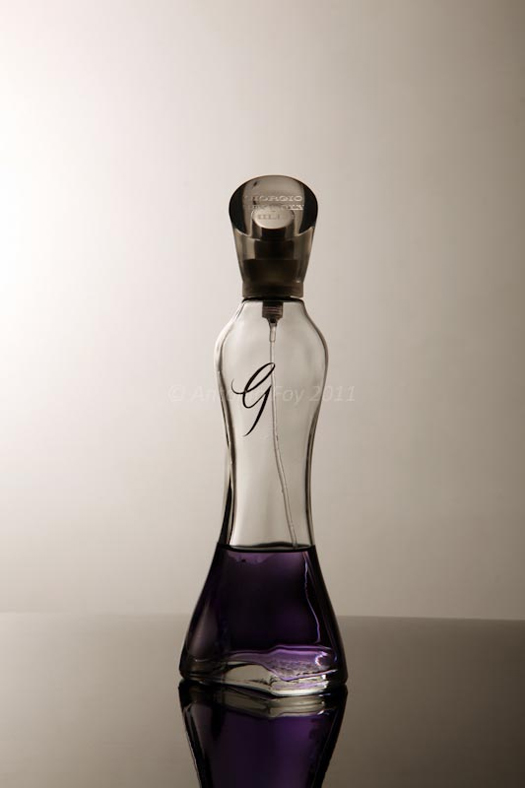
A perfume bottle or atomizer sprays a fluid that is in the bottle. (Figure 7.E.4.) How does the fluid rise up in the vertical tube in the bottle?
Exercise 42
If you lower the window on a car while moving, an empty plastic bag can sometimes fly out the window. Why does this happen?