13.3
Simultaneity And Time Dilation
Chapter contents: Chapter 13: Special Relativity

Do time intervals depend on who observes them? Intuitively, we expect the time for a process, such as the elapsed time for a foot race, to be the same for all observers. Our experience has been that disagreements over elapsed time have to do with the accuracy of measuring time. When we carefully consider just how time is measured, however, we will find that elapsed time depends on the relative motion of an observer with respect to the process being measured.
Simultaneity
Consider how we measure elapsed time. If we use a stopwatch, for example, how do we know when to start and stop the watch? One method is to use the arrival of light from the event, such as observing a light turning green to start a drag race. The timing will be more accurate if some sort of electronic detection is used, avoiding human reaction times and other complications.
Now suppose we use this method to measure the time interval between two flashes of light produced by flash lamps. (See Figure 13.3.2.) Two flash lamps with observer A midway between them are on a rail car that moves to the right relative to observer B. Observer B arranges for the light flashes to be emitted just as A passes B, so that in B’s frame, both A and B are equidistant from the lamps when the light is emitted. Observer B measures the time interval between the arrival of the light flashes. According to postulate 2, the speed of light is not affected by the motion of the lamps relative to B. Therefore, light travels equal distances to him at equal speeds. Thus, observer B measures the flashes to be simultaneous. Since in B’s frame, A is moving to the right, B will measure the light from the right bulb arrive at observer A before the light from the left bulb arrives at observer A.
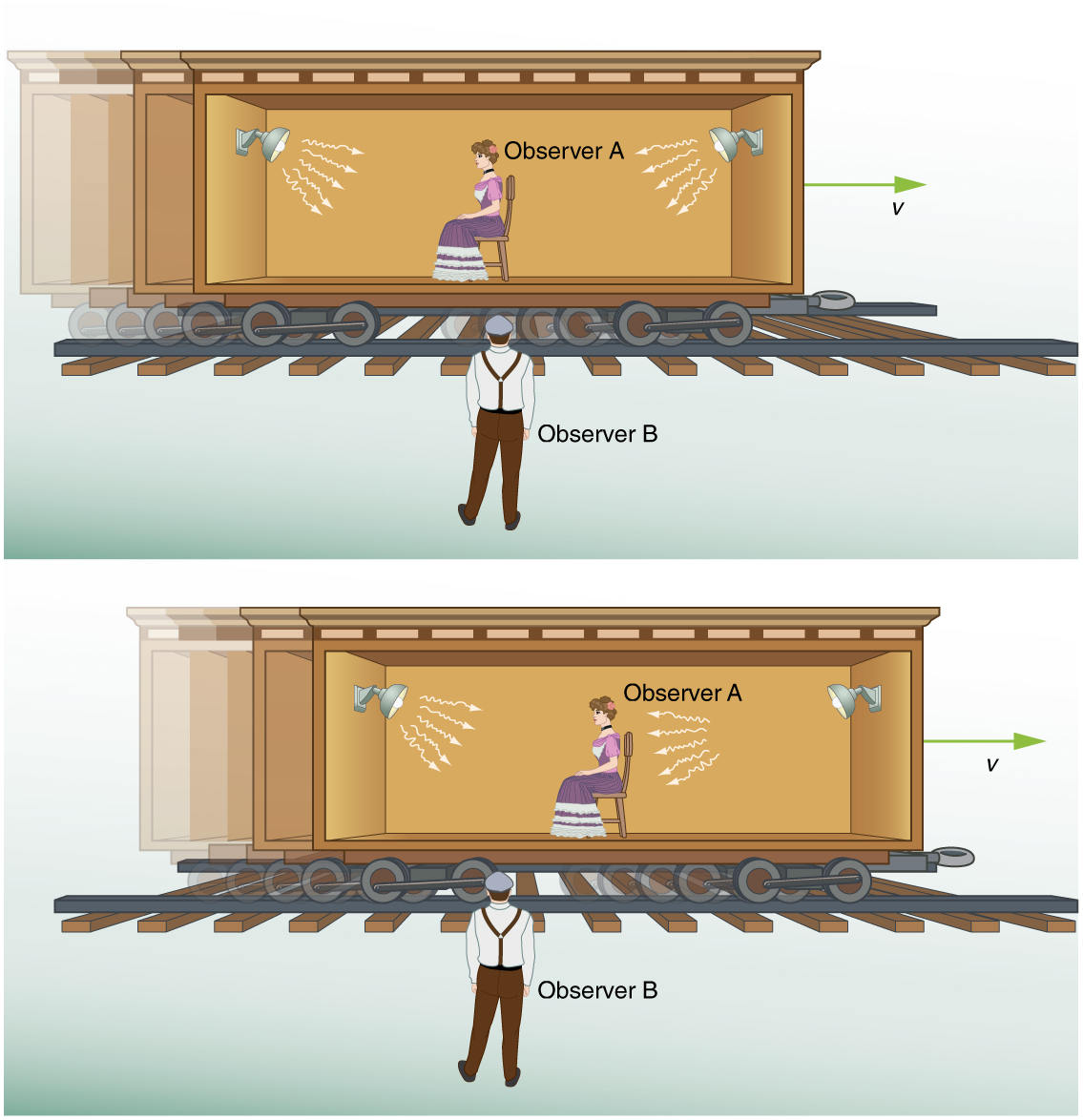
Now consider what observer A sees happening. As observer B also notes, she receives the flash from the right-hand bulb before the flash from the left-hand bulb. Since the lamps are equally distant from her and light travels at the same speed in both directions in her frame (postulate 2), she concludes that the right-hand bulb emitted its flash first. Here, a relative velocity between observers affects whether two events are observed to be simultaneous. Simultaneity is not absolute.
This thought experiment shows how the postulates of special relativity lead to a counterintuitive conclusion. We might expect two flashes emitted simultaneously for one observer to be emitted simultaneously for everyone. But the second postulate requires both observers to measure the same speed of light, despite their relative motion. Even after accounting for light-travel times, they disagree about whether the flashes were emitted simultaneously. Neither inertial reference frame is privileged (postulate 1), so we must give up the idea of absolute simultaneity.
Reading a Space-Time Diagram
We can represent the train-and-flashes experiment on a space-time diagram, a graph of events according to their positions and times in a chosen reference frame. In Figure 13.3.3, position increases to the right and time increases upward. The vertical axis is labeled : multiplying time by the speed of light gives a distance, so both axes can use the same scale. Each point represents an event, and all coordinates in this diagram belong to the station frame. The flashes are emitted when the train observer A passes the station observer B at the origin.
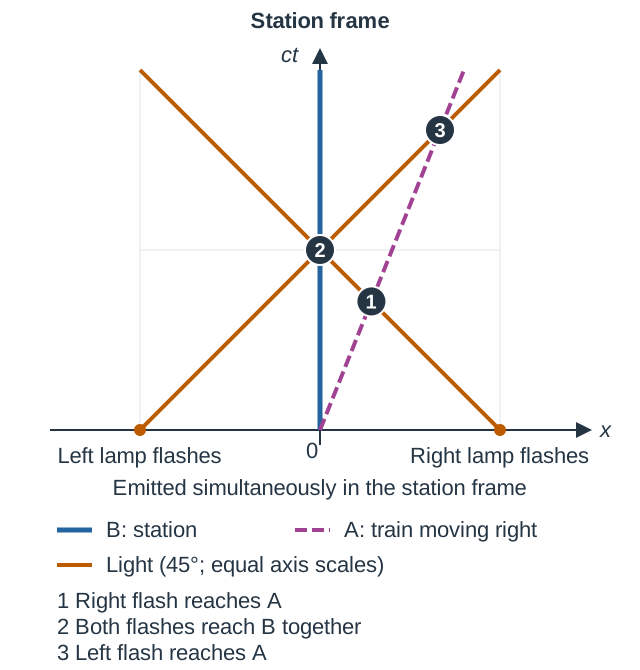
An object’s path on this graph is called its worldline. B stays at one position, so his worldline is vertical. A moves steadily to the right, so her worldline slopes to the right as time passes. Light travels at speed , so its worldlines make 45° angles with the horizontal when the axis scales are equal. Intersections mark events at which light reaches an observer. Reading upward, we see the right flash reach A, both flashes reach B together, and finally the left flash reach A. A horizontal line joins events that are simultaneous in the station frame.
The diagram shows the different arrival times using station-frame coordinates. To understand the emission times assigned by A, return to her description of the experiment: she and the lamps are at rest relative to one another, and she is midway between the lamps. Light travels equal distances to her at the same speed in both directions, so the two travel times in her frame are equal. Because the right flash arrives first, she concludes that the right lamp emitted its flash first. Unequal arrival times alone would not establish unequal emission times; the equal distances and equal light speeds in A’s frame are essential to her conclusion.
Time Dilation
The consideration of the measurement of elapsed time and simultaneity leads to an important relativistic effect.
Time dilation
Time dilation means that, in an inertial frame, a moving clock records less time between its ticks than the elapsed time measured in that frame. Each clock measures time normally in its own rest frame.
Suppose, for example, an astronaut measures the time it takes for light to cross her ship, bounce off a mirror, and return. (See Figure 13.3.4.) How does the elapsed time the astronaut measures compare with the elapsed time measured for the same event by a person on the Earth? Asking this question (another thought experiment) produces a profound result. We find that the elapsed time for a process depends on who is measuring it. In this case, the time measured by the astronaut is smaller than the time measured by the Earth-bound observer. The passage of time is different for the observers because the distance the light travels in the astronaut’s frame is smaller than in the Earth-bound frame. Light travels at the same speed in each frame, and so it will take longer to travel the greater distance in the Earth-bound frame.
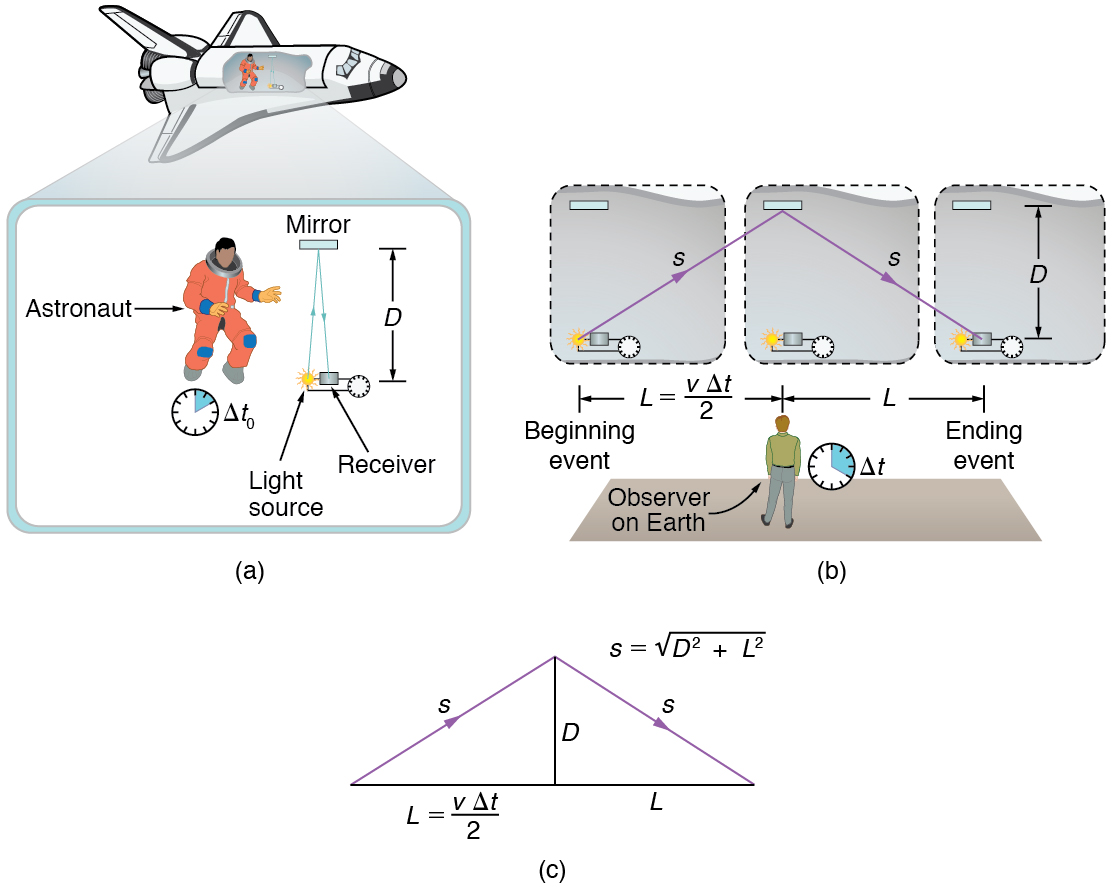
To quantitatively verify that time depends on the observer, consider the paths followed by light as seen by each observer. (See Figure 13.3.4(c).) The astronaut sees the light travel straight across and back for a total distance of , twice the width of her ship. The Earth-bound observer sees the light travel a total distance . Since the ship is moving at speed to the right relative to the Earth, light moving to the right hits the mirror in this frame. Light travels at a speed in both frames (postulate 2), and because time is the distance divided by speed, the time measured by the astronaut is
.
This time has a separate name to distinguish it from the time measured by the Earth-bound observer.
Proper Time
Proper time is the time interval measured by a clock present at both events. For the inertial clock considered here, the events occur at the same position in its rest frame.
The astronaut observing the reflected light measures proper time. The time measured by the Earth-bound observer is
.
To find the relationship between and , consider the triangles formed by and . (See Figure 13.3.4(c).) The third side of these triangles is , the distance the astronaut moves as the light goes across her ship. In the frame of the Earth-bound observer,
.
Using the Pythagorean Theorem, the distance is found to be
.
Substituting into the expression for the time interval gives
.
We square this equation, which yields
.
Note that if we square the first expression we had for , we get . This term appears in the preceding equation, giving us a means to relate the two time intervals. Thus,
.
Gathering terms, we solve for :
.
Thus,
.
Taking the square root yields an important relationship between elapsed times:
,
(13.3.1)where
.
(13.3.2)This equation for is truly remarkable. First, as contended, elapsed time is not the same for different observers moving relative to one another, even though both are in inertial frames. Proper time measured by an observer, like the astronaut moving with the apparatus, is smaller than time measured by other observers. Since those other observers measure a longer time , the effect is called time dilation. The Earth-bound observer sees time dilate (get longer) for a system moving relative to the Earth. Alternatively, according to the Earth-bound observer, time slows in the moving frame, since less time passes there. All clocks moving relative to an observer, including biological clocks such as aging, are observed to run slow compared with a clock stationary relative to the observer.
Note that if the relative velocity is much less than the speed of light (), then is extremely small, and the elapsed times and are nearly equal. At low velocities, modern relativity approaches classical physics—our everyday experiences have very small relativistic effects.
The equation also implies that relative velocity cannot exceed the speed of light. As
approaches ,
approaches infinity. This would imply that time in the astronaut’s frame stops at the speed of light. If exceeded , then we would be taking the square root of a negative number, producing an imaginary value for .
There is considerable experimental evidence that the equation is correct. One example is found in cosmic ray particles that continuously rain down on the Earth from deep space. Some collisions of these particles with nuclei in the upper atmosphere result in short-lived particles called muons. The half-life (amount of time for half of a material to decay) of a muon is
when it is at rest relative to the observer who measures the half-life. This is the proper time
. Muons produced by cosmic ray particles have a range of velocities, with some moving near the speed of light. It has been found that the muon’s half-life as measured by an Earth-bound observer () varies with velocity exactly as predicted by the equation . The faster the muon moves, the longer it lives. We on the Earth see the muon’s half-life time dilated—as viewed from our frame, the muon decays more slowly than it does when at rest relative to us.
Example 13.3.1
Calculating for a Relativistic Event: How Long Does a Speedy Muon Live?
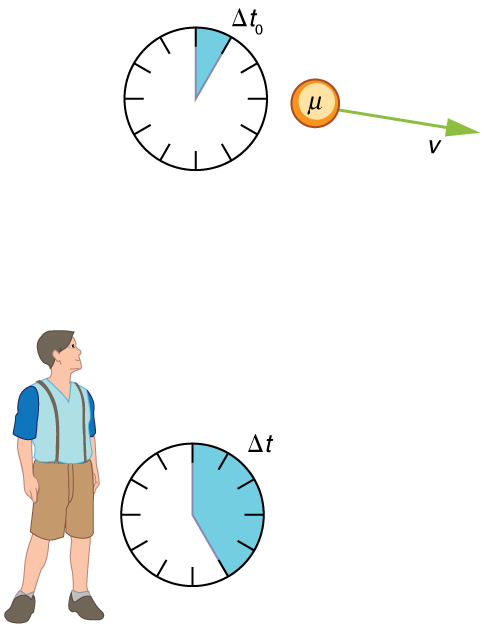
Suppose a cosmic ray colliding with a nucleus in the Earth’s upper atmosphere produces a muon that has a velocity . The muon then travels at constant velocity and lives as measured in the muon’s frame of reference. (You can imagine this as the muon’s internal clock.) How long does the muon live as measured by an Earth-bound observer? (See Figure 13.3.5.)
Strategy
A clock moving with the system being measured observes the proper time, so the time we are given is . The Earth-bound observer measures
as given by the equation
. Since we know the velocity, the calculation is straightforward.
Solution
1) Identify the knowns. ,
2) Identify the unknown.
3) Choose the appropriate equation.
Use,
,
where
.
4) Plug the knowns into the equation.
First find .
.
Use the calculated value of to determine .
Discussion
One implication of this example is that since at of the speed of light (), the relativistic effects are significant. The two time intervals differ by this factor of 3.20, where classically they would be the same. Something moving at is said to be highly relativistic.
Another implication of the preceding example is that everything an astronaut does when moving at of the speed of light relative to the Earth takes 3.20 times longer when observed from the Earth. Does the astronaut sense this? Only if she looks outside her spaceship. All methods of measuring time in her frame will be affected by the same factor of 3.20. This includes her wristwatch, heart rate, cell metabolism rate, nerve impulse rate, and so on. She will have no way of telling, since all of her clocks will agree with one another because their relative velocities are zero. Motion is relative, not absolute. But what if she does look out the window?
Real-World Connections
It may seem that special relativity has little effect on your life, but it is probably more important than you realize. One of the most common effects is through the Global Positioning System (GPS). Emergency vehicles, package delivery services, electronic maps, and communications devices are just a few of the common uses of GPS, and the GPS system could not work without taking into account relativistic effects. GPS satellites rely on precise time measurements to communicate. The signals travel at relativistic speeds. Without corrections for time dilation, the satellites could not communicate, and the GPS system would fail within minutes.
The Twin Paradox
An intriguing consequence of time dilation is that a space traveler moving at a high velocity relative to the Earth would age less than her Earth-bound twin. Imagine the astronaut moving at such a velocity that , as in Figure 13.3.6. A trip that takes 2.00 years in her frame would take 60.0 years in her Earth-bound twin’s frame. Suppose the astronaut traveled 1.00 year to another star system. She briefly explored the area, and then traveled 1.00 year back. If the astronaut was 40 years old when she left, she would be 42 upon her return. Everything on the Earth, however, would have aged 60.0 years. Her twin, if still alive, would be 100 years old.
The situation would seem different to the astronaut. Because motion is relative, the spaceship would seem to be stationary and the Earth would appear to move. (This is the sensation you have when flying in a jet.) If the astronaut looks out the window of the spaceship, she will see time slow down on the Earth by a factor of . To her, the Earth-bound sister will have aged only 2/30 (1/15) of a year, while she aged 2.00 years. The two sisters cannot both be correct.

During each constant-velocity leg of the journey, each twin measures the other’s clock as running slower. This symmetry does not extend to the whole round trip. The astronaut turns around and changes inertial frames, while the Earth-bound twin remains in approximately the same inertial frame. Changing frames also changes which event on Earth the astronaut assigns as simultaneous with her own: the outward and return frames assign different ages to the distant Earth-bound twin at the turnaround. Accounting for this change, special relativity predicts that the astronaut ages less when the twins reunite. The key is that the twins follow different paths through spacetime, so they need not experience the same elapsed time.
In 1971, American physicists Joseph Hafele and Richard Keating verified time dilation at low relative velocities by flying extremely accurate atomic clocks around the Earth on commercial aircraft. They measured elapsed time to an accuracy of a few nanoseconds and compared it with the time measured by clocks left behind. Hafele and Keating’s results were within experimental uncertainties of the predictions of relativity. The predictions included both the effects of motion from special relativity and gravitational time dilation from general relativity: clocks at the aircraft’s higher altitude run faster than clocks on the ground because of the difference in gravitational potential.
Exercise
Check Your Understanding
1. What is if ?
Solution
2. A particle travels at and lives when at rest relative to an observer. How long does the particle live as viewed in the laboratory?
Solution