Chapter 9: Electricity — Review and Exercises
Chapter contents: Chapter 9: Electricity
Glossary
ampere
(amp) the SI unit for current; 1 A = 1 C/s
capacitor
an arrangement of conductors designed to store charge using voltage difference
conductor
an object with properties that allow charges to move about freely within it
Coulomb force
another term for the electrostatic force
Coulomb’s law
the mathematical equation calculating the electrostatic force vector between two charged particles
electric charge
a property of matter that determines its electric interactions; charge can be positive or negative
electric current
the rate of flow of electric charge through a surface or past a point
electric field
a vector field equal to the electric force per unit positive test charge at each point
electric field lines
imaginary curves whose tangents show the direction of the electric field. Closer spacing represents a stronger field
electric field strength
the magnitude of the electric field, equal to the electric force per unit positive test charge
electric polarization
separation or displacement of positive and negative charge within a material, without necessarily changing its net charge
electric potential
potential energy per unit charge
electric power
the rate at which electrical energy is supplied by a source or dissipated by a device; it is the product of current times voltage
electromagnetic force
one of the four fundamental forces of nature; the electromagnetic force consists of static electricity, moving electricity and magnetism
electron
an elementary particle with negative electric charge; electrons are constituents of atoms and can also exist freely
electron volt
the energy given to a fundamental charge accelerated through a potential difference of one volt
electrostatic equilibrium
a steady distribution of charge with no net macroscopic flow of charge
electrostatic force
the amount and direction of attraction or repulsion between two charged bodies
electrostatic precipitators
filters that apply charges to particles in the air, then attract those charges to a filter, removing them from the airstream
electrostatics
the study of electricity in electrostatic equilibrium
Faraday cage
a conducting enclosure that shields its interior from external electrostatic fields
field
a physical quantity assigned to each point in space, and possibly time; a vector field also assigns a direction
free charge
an electrical charge (either positive or negative) which can move about separately from its base molecule
grounded
connected to the ground with a conductor, so that charge flows freely to and from the Earth to the grounded object
Joule’s law
the rate of conversion of electrical energy into thermal energy in a resistor: power equals the square of the current times the resistance
law of conservation of charge
the total electric charge of an isolated system remains constant
microshock sensitive
a condition in which a person’s skin resistance is bypassed, possibly by a medical procedure, rendering the person vulnerable to electrical shock at currents about 1/1000 the normally required level
ohm
the unit of resistance, given by 1 Ω = 1 V/A
ohmic
a type of a material for which Ohm’s law is valid
Ohm’s law
an empirical relation stating that the current I is proportional to the potential difference V. It is often written as I = V/R, where R is the resistance
parallel
the wiring of resistors or other components in an electrical circuit such that each component receives an equal voltage from the power source; often pictured in a ladder-shaped diagram, with each component on a rung of the ladder
parallel-plate capacitor
an example of capacitor using arrangement of two parallel conducting plates placed near each other
photoconductor
a substance that is an insulator until it is exposed to light, when it becomes a conductor
point charge
an idealized electric charge concentrated at a point; a useful model when the charged object’s size is negligible for the problem
potential difference (or voltage)
the change in electric potential energy per unit charge between two points; measured in volts (joules per coulomb)
proton
a positively charged particle found in atomic nuclei; its charge is equal in magnitude to the electron’s charge
resistance
the electric property that impedes current; for ohmic materials, it is the ratio of voltage to current, R = V/I
resistor
a component that provides resistance to the current flowing through an electrical circuit
series
a sequence of resistors or other components wired into a circuit one after the other
shock hazard
when electric current passes through a person
short circuit
also known as a “short”, a low-resistance path between terminals of a voltage source
static electricity
a buildup of electric charge on the surface of an object
test charge
a small charge used to probe an electric field, small enough that its effect on the source charges can be neglected
thermal hazard
a hazard in which electric current causes undesired thermal effects
Van de Graaff generator
a machine that produces a large amount of excess charge, used for experiments with high voltage
voltage drop
a decrease in electric potential across a circuit component, corresponding to a decrease in electric potential energy per unit positive charge
xerography
a dry copying process based on electrostatics
Section Summary
9.2: Static Electricity and Charge: Conservation of Charge
- There are only two types of charge, which we call positive and negative.
- Like charges repel, unlike charges attract, and the force between charges decreases with the square of the distance.
- The vast majority of positive charge in nature is carried by protons, while the vast majority of negative charge is carried by electrons.
- The electric charge of one electron is equal in magnitude and opposite in sign to the charge of one proton.
- An ion is an atom or molecule that has nonzero total charge due to having unequal numbers of electrons and protons.
- The SI unit for charge is the coulomb (C), with protons and electrons having charges of opposite sign but equal magnitude; the magnitude of this basic charge is
.(9.2.1)
- Whenever charge is created or destroyed, equal amounts of positive and negative are involved.
- Most often, existing charges are separated from neutral objects to obtain some net charge.
- Both positive and negative charges exist in neutral objects and can be separated by rubbing one object with another. For macroscopic objects, negatively charged means an excess of electrons and positively charged means a depletion of electrons.
- The law of conservation of charge ensures that whenever a charge is created, an equal charge of the opposite sign is created at the same time.
9.3: Coulomb’s Law
- Frenchman Charles Coulomb was the first to publish the mathematical equation that describes the electrostatic force between two objects.
- Coulomb’s law gives the magnitude of the force between point charges. It is
,(9.3.1)where and are two point charges separated by a distance , and
- This Coulomb force is extremely basic, since most charges are due to point-like particles. It is responsible for all electrostatic effects and underlies most macroscopic forces.
- The Coulomb force is extraordinarily strong compared with the gravitational force, another basic force—but unlike gravitational force it can cancel, since it can be either attractive or repulsive.
- The electrostatic force between two subatomic particles is far greater than the gravitational force between the same two particles.
9.4: Electric Field: Concept of a Field Revisited
- The electrostatic force field surrounding a charged object extends out into space in all directions.
- The electrostatic force exerted by a point charge on a test charge at a distance depends on the charge of both charges, as well as the distance between the two.
- The electric field is defined to be
,(9.4.1)where is the Coulomb or electrostatic force exerted on a small positive test charge . has units of N/C.
- The magnitude of the electric field created by a point charge is
.(9.4.2)where is the distance from . The electric field is a vector and fields due to multiple charges add like vectors.
9.5: Electric Field Lines
- Drawings of electric field lines are useful visual tools. The properties of electric field lines for any charge distribution are that:
- Field lines must begin on positive charges and terminate on negative charges, or at infinity in the hypothetical case of isolated charges.
- The number of field lines leaving a positive charge or entering a negative charge is proportional to the magnitude of the charge.
- The strength of the field is proportional to the closeness of the field lines—more precisely, it is proportional to the number of lines per unit area perpendicular to the lines.
- The direction of the electric field is tangent to the field line at any point in space.
- Field lines can never cross.
9.6: Electric Potential and Potential Energy
- Electric potential is potential energy per unit charge.
- The potential difference between points A and B, , defined to be the change in potential energy of a charge moved from A to B, is equal to the change in potential energy divided by the charge, Potential difference is commonly called voltage, represented by the symbol
.and .(9.6.4)
- An electron volt is the energy given to a fundamental charge accelerated through a potential difference of 1 V. In equation form,
.(9.6.5)
- Mechanical energy is the sum of the kinetic energy and potential energy of a system, that is, . This sum is constant when only conservative forces do work.
9.7: Conductors and Applications of Electrostatics
- The electrical forces around a conductor will cause free charges to move around inside the conductor until static equilibrium is reached.
- Any excess charge will collect along the surface of a conductor.
- Conductors with sharp corners or points will collect more charge at those points.
- Strong electric fields near pointed conductors can ionize nearby air and allow charge leakage through corona discharge. A lightning rod can exhibit this leakage, but its principal protective role is to provide a conducting path to ground if lightning strikes.
- In electrostatic equilibrium, a closed conducting Faraday cage shields an empty cavity from external electric fields.
- In addition to research using equipment such as a Van de Graaff generator, many practical applications of electrostatics exist, including photocopiers, laser printers, ink-jet printers and electrostatic air filters.
9.8: Current
- Electric current is the rate at which charge flows, given by
where is the amount of charge passing through an area in time .,(9.8.1)
- The direction of conventional current is taken as the direction in which positive charge moves.
- The SI unit for current is the ampere (A), where .
- Current is the flow of free charges, such as electrons and ions.
9.9: Ohm’s Law: Resistance and Simple Circuits
- A simple circuit is one in which there is a single voltage source and a single resistance.
- One statement of Ohm’s law gives the relationship between current , voltage , and resistance in a simple circuit to be .
- Resistance has units of ohms (), related to volts and amperes by .
- There is a voltage or IR drop across a resistor, caused by the current flowing through it, given by .
9.10: Electric Power and Energy
- Electric power is the rate (in watts) that energy is supplied by a source or dissipated by a device.
- Three expressions for electrical power are
,(9.10.1),(9.10.2)and.(9.10.3)
- The energy used by a device with a power over a time is .
9.11: Resistors in Series and Parallel
- The total resistance of an electrical circuit with resistors wired in a series is the sum of the individual resistances: .
- Each resistor in a series circuit has the same amount of current flowing through it.
- Series resistors carry the same current. Their voltage drops add to the source voltage, and their power dissipations add to the power supplied by the source. Equal resistors have equal voltage drops and equal power dissipations.
- The total resistance of an electrical circuit with resistors wired in parallel is less than the lowest resistance of any of the components and can be determined using the formula:
.(9.11.4)
- Each resistor in a parallel circuit has the same full voltage of the source applied to it.
- The current through each parallel resistor depends on its resistance; equal resistors carry equal currents.
- If a more complex connection of resistors is a combination of series and parallel, it can be reduced to a single equivalent resistance by identifying its various parts as series or parallel, reducing each to its equivalent, and continuing until a single resistance is eventually reached.
9.12: Electric Hazards and the Human Body
- The two types of electric hazards are thermal (excessive power) and shock (current through a person).
- Shock severity is determined by current, path, duration, and AC frequency.
- Table 9.12.1 lists shock hazards as a function of current.
- Figure 9.12.5 graphs the threshold current for two hazards as a function of frequency.
Questions and Exercises
9.2: Static Electricity and Charge: Conservation of Charge
Exercise 1
There are very large numbers of charged particles in most objects. Why, then, don’t most objects exhibit static electricity?
Exercise 2
Two initially neutral objects are rubbed together in an isolated system. Electrons transfer from object A to object B. Which object becomes positive, which becomes negative, and how do their net charges compare? Does rubbing create net electric charge?
Exercise 3
An initially neutral object gains electrons. Using , find its net charge. Would removing the same number of electrons instead give the same magnitude and sign?
Exercise 4
Two small objects are known to carry nonzero net charges. Which statements are correct? Explain each choice. (a) Like signs repel. (b) Opposite signs attract. (c) They must touch before exerting electric forces on one another. (d) Doubling their separation makes the electric force exactly zero.
9.3: Coulomb’s Law
Exercise 5
A neutral polar molecule has separated positive and negative regions. It is free to turn near a charged object whose field is nonuniform. Explain why it can be attracted whether the object is positive or negative.
Exercise 6
Two small spheres are 8.00 cm apart and each carries −30.0 nC. Treat them as point charges. Find the magnitude of the force on each sphere and state whether it is attractive or repulsive. Use .
Exercise 7
Two fixed point charges exert forces of magnitude 5.0 N on each other. Starting from this arrangement each time, find the force magnitude if (a) their separation triples, (b) one charge doubles, and (c) both charges double while their separation doubles. Explain using proportional reasoning.
Exercise 8
Two fixed point charges lie on a line: at and at , where and are positive. A nonzero test charge is placed elsewhere on that line. In which region can its net electric force be zero: , , or ? Explain without solving for the exact position. Would changing the sign of the test charge change the answer?
9.4: Electric Field: Concept of a Field Revisited
Exercise 9
Why should a test charge used to probe an electric field be small enough not to appreciably disturb the source charges?
Exercise 10
At one point, an electric field points east. Compare the electric forces on test charges , , and placed there one at a time, without disturbing the sources. Does the electric field itself change when the test charge changes?
Exercise 11
A −2.0 μC test charge experiences an electric force of upward. What are the magnitude and direction of the electric field?
Exercise 12
A uniform electric field of 250 N/C points east. Find the electric force on (a) +4.0 μC and (b) −4.0 μC.
9.5: Electric Field Lines
Exercise 13
Using the same field-line scale in both sketches, draw the electric field lines around (a) and (b) . Show the directions and explain how the numbers of drawn lines compare.
Exercise 14
Which statements about an electrostatic field-line diagram are correct? Explain. (a) Arrows give the force direction for a positive test charge. (b) Closer line spacing indicates a stronger field when the same drawing convention is used. (c) Two field lines can cross at a point where the field is nonzero. (d) A moving charged particle must follow a field line.
Exercise 15
Sketch a field-line diagram for two fixed charges, and . Indicate which lines connect the charges and whether any must extend to or from far away. What sign of net charge would the pair resemble at distances much larger than their separation?
9.6: Electric Potential and Potential Energy
Exercise 16
What does a potential difference of 12 V mean in joules per coulomb? If a positive charge of 2.0 μC moves to a point 12 V higher in potential, what is the change in its electric potential energy?
Exercise 17
Why is a voltage measured between two points? If the same constant is added to the electric potential assigned to every point, do potential differences or electric forces change?
Exercise 18
Two points are at the same electric potential. What is the net work done by the electrostatic force as a charge moves between them? Does this imply that the electric force must vanish at every point along its path? Explain.
Exercise 19
Explain the difference between a volt and an electron volt. Why is the electron volt convenient for energies of atoms and charged subatomic particles? Is an electron volt restricted to the energy of an electron?
Exercise 20
An electron moves from rest from a point at 0 V to a point at +100 V under the electric force alone. (a) Does its electric potential energy increase or decrease? (b) Find its kinetic-energy gain in eV and joules. Use .
9.7: Conductors and Applications of Electrostatics
Exercise 21
A diagram shows a nonzero electric-field component tangent to the surface of a solid metal object. Can that object be in electrostatic equilibrium? Explain what its mobile charges would do.
Exercise 22
In Figure 9.7.4, what features of the field lines indicate that the electric field between the plates is approximately uniform in both strength and direction? Where does this approximation break down?
Exercise 23
Can the belt of a Van de Graaff accelerator be a conductor? Explain.
Exercise 24
A closed conducting shell is in electrostatic equilibrium in an external electric field. There are no charges in its cavity. Explain why an object in the cavity can be shielded from the external static electric field. What role does charge redistribution play?
Exercise 25
In a demonstration, a person is insulated from the ground and acquires charge from a Van de Graaff generator. Individual strands of hair acquire charges of the same sign and spread apart. Explain the spreading. Would the explanation change if all the charges had the opposite sign?
9.8: Current
Exercise 26
A wire carries a steady current of 2.0 A. Which statement gives its meaning? Explain why the others do not. (a) 2.0 C passes a cross section each second. (b) Each charge carrier moves at 2.0 m/s. (c) The wire uses up 2.0 C each second.
Exercise 27
Can a wire carry a current and still be neutral—that is, have a net charge of zero? Explain.
Exercise 28
In a metal wire, electrons drift west. Which direction is the conventional current? Explain why the directions differ.
Exercise 29
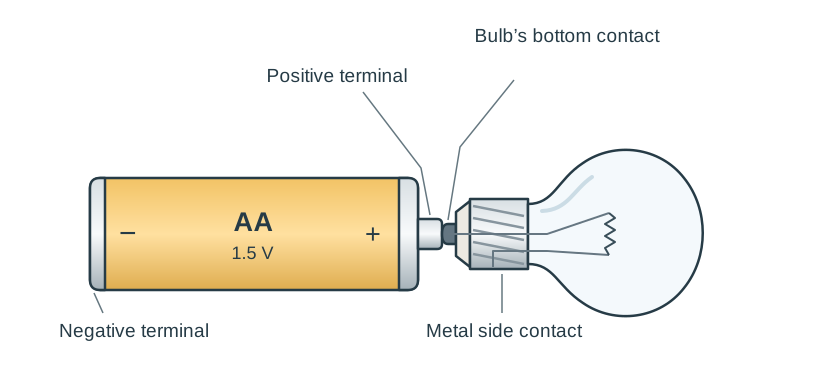
A small bulb’s bottom contact touches the positive terminal of an AA battery, as shown. The bulb’s metal side contact and the battery’s negative terminal are unconnected. Why does this not sustain a steady current? What is needed to complete the circuit?
Exercise 30
A total of 600 C passes through a flashlight in 0.500 h. What is the average current in amperes? Show the conversion from hours to seconds.
Exercise 31
A charge of 0.250 μC moves during a 1.00 μs static discharge. (a) Find the average current during the pulse. (b) Explain why this current alone does not tell you how much energy was transferred.
9.9: Ohm’s Law: Resistance and Simple Circuits
Exercise 32
In a steady circuit with one resistor, compare the current entering and leaving the resistor. What changes as charge passes through the resistor: the amount of charge flowing each second, its electric potential energy, or both?
Exercise 33
In the analogy between a resistor and a pipe carrying steady fluid flow, what corresponds to electric current and what corresponds to potential difference? Why does a pressure drop along the pipe not mean that fluid is being consumed there?
Exercise 34
At constant temperature, a device carries 0.10 A at 2.0 V, 0.20 A at 4.0 V, and 0.30 A at 6.0 V. (a) Is this consistent with ohmic behavior? (b) Find its resistance. (c) Predict the current at 8.0 V if that behavior continues.
Exercise 35
A flashlight bulb operates at 3.00 V with a hot resistance of 3.60 Ω. What current flows? Why is the word “hot” relevant when applying this model to an incandescent bulb?
Exercise 36
Two cords have total resistances 0.060 Ω and 0.300 Ω. If each carries 5.0 A in a separate circuit, find the voltage drop across each cord. For the same supply voltage, which leaves less voltage across the attached appliance?
9.10: Electric Power and Energy
Exercise 37
For a resistor, and . Why does one expression suggest decreasing power with increasing resistance and the other increasing power? State what must be held fixed in each comparison.
Exercise 38
A starter motor draws 250 A from a 24.0 V source. What electrical power is delivered to it? If it runs for 2.0 s at these values, how much electrical energy is delivered?
Exercise 39
Consider the two cords from Exercise 36. Their resistances are 0.060 Ω and 0.300 Ω, and each carries 5.0 A. Find the power dissipated in each. If the current in either cord doubles while its resistance stays fixed, by what factor does its heating power change?
Exercise 40
Use to show that . Is a kilowatt-hour a unit of energy or power? Explain why the time unit matters.
Exercise 41
A 1200-W toaster runs for 1.0 minute. Find the electrical energy used in joules and kilowatt-hours. At an assumed price of $0.30 per kilowatt-hour, what is the cost of this use?
Exercise 42
A battery is rated at 2400 mA·h. (a) Express this charge capacity in coulombs. (b) Can its energy capacity be found from this rating alone? (c) Estimate the delivered energy if its voltage is approximately 1.5 V throughout discharge.
9.11: Resistors in Series and Parallel
Exercise 43
An ideal battery, a resistor, and a switch are connected in one series loop. Compare an open switch with an ideal closed switch: (a) What is the current? (b) What is the voltage across the switch? (c) Why is the switch’s power dissipation zero in each ideal case?
Exercise 44
Four identical bulbs are connected in series across an ideal 12 V source. Treat their resistances as equal and constant. (a) What voltage is across each bulb? (b) If one bulb becomes an open circuit, what happens to the others? (c) If one bulb is instead shorted by an ideal wire connecting its two terminals, what voltage is across each remaining bulb?
Exercise 45
Suppose you are doing a physics lab that asks you to put a resistor into a circuit, but all the resistors supplied have a larger resistance than the requested value. How would you connect the available resistances to attempt to get the smaller value asked for?
Exercise 46
A 6.0-Ω resistor and a 3.0-Ω resistor are connected to an ideal 12 V source, first in series and then in parallel. For each connection, find the equivalent resistance and the current in each resistor. In which connection is the total source current larger?
Exercise 47
One resistor is connected across an ideal fixed-voltage source. An identical second resistor is added in parallel. Predict how (a) equivalent resistance, (b) total source current, and (c) current in the original resistor change. Explain why the source current is not fixed.
Exercise 48
For a simplified calculation, treat a 1200-W heater and a 600-W appliance as resistive loads connected in parallel to a 120-V supply on the same 15-A branch circuit. (a) Find each current and their sum. (b) Does adding a 120-W lamp put the total above 15 A? (Several outlets may share the same circuit, so moving an appliance to a different outlet does not necessarily reduce the current through that circuit’s breaker.)
Exercise 49
Without calculating an unknown resistor, assess these claims for ordinary positive resistances: (a) a 145-Ω resistor and another resistor in parallel have equivalent resistance 150 Ω; (b) a 900-kΩ resistor and another resistor in series have equivalent resistance 500 kΩ. Explain each answer.
9.12: Electric Hazards and the Human Body
Exercise 50
What are the two major hazards of electricity?
Exercise 51
A damaged cord creates a low-resistance path between supply conductors. Explain why this can cause intense heating. Does the existence of that short circuit prove that nobody can receive an electric shock from the damaged equipment? Explain.
Exercise 52
Why can the severity of an electric shock not be predicted from voltage alone? Identify at least three other relevant factors.
Exercise 53
Measurements made with suitable equipment show that a person’s measured resistance can change substantially with skin moisture and contact area, even when the internal path is similar. Explain why. Why should a single body-resistance value not be treated as a reliable protection measure?
Exercise 54
In an idealized model, a bird touches only one conducting power line with both feet, which are close together. Why may the current through its body be small despite the line’s high potential relative to ground? What changes if it also contacts a conductor at a substantially different potential?
Exercise 55
Explain how an ordinary overcurrent circuit breaker reduces the risk of overheating wiring. Why does its presence not guarantee protection from electric shock? Why would bypassing it defeat its protective purpose?
Source sections: Introduction to Electricity, Static Electricity and Charge: Conservation of Charge, Coulomb’s Law, Electric Field: Concept of a Field Revisited, Electric Field Lines, Electric Potential and Potential Energy, Conductors and Applications of Electrostatics, Current, Ohm’s Law: Resistance and Simple Circuits, Electric Power and Energy, Resistors in Series and Parallel, Electric Hazards and the Human Body. Credits and licenses appear with each source section.