Chapter 8: Thermal Physics — Review and Exercises
Chapter contents: Chapter 8: Thermal Physics
Glossary
absolute zero
0 K, the lower limit of the Kelvin temperature scale
adiabatic process
a process in which no heat transfer takes place
Boltzmann constant
, a physical constant that relates energy to temperature;
Carnot cycle
an ideal cycle consisting of two reversible isothermal processes and two reversible adiabatic processes
Carnot efficiency
the maximum theoretical efficiency for a heat engine operating between two specified heat reservoirs
Carnot engine
a heat engine that uses a Carnot cycle
Celsius scale
temperature scale in which the freezing point of water is and the boiling point of water is
change in entropy
for reversible heat transfer at constant temperature, the ratio of heat transfer to absolute temperature
closed system
a system that can exchange energy, but not matter, with its surroundings
coefficient of performance
for a heat pump, it is the ratio of heat transfer at the output (the hot reservoir) to the work supplied; for a refrigerator or air conditioner, it is the ratio of heat transfer from the cold reservoir to the work supplied
conduction
heat transfer through stationary matter by physical contact
convection
heat transfer by the macroscopic movement of fluid
cyclical process
a process in which the path returns to its original state at the end of every cycle
degree Celsius
unit on the Celsius temperature scale
degree Fahrenheit
unit on the Fahrenheit temperature scale
entropy
a thermodynamic state quantity whose change for reversible heat transfer at constant temperature equals the heat transferred into the system divided by the absolute temperature; microscopically, it is related to the number of compatible microscopic arrangements
Fahrenheit scale
temperature scale in which the freezing point of water is and the boiling point of water is
first law of thermodynamics
states that the change in internal energy of a system equals the net heat transfer into the system minus the net work done by the system
heat
the spontaneous transfer of energy due to a temperature difference
heat engine
a machine that uses heat transfer to do work
heat of sublimation
the energy per unit mass required to change a substance directly from solid to vapor at specified conditions
heat pump
a machine that uses work input to transfer heat from a colder region to a warmer region
human metabolism
the chemical processes in the human body that transform matter and energy to sustain life
ideal gas law
the physical law that relates the pressure and volume of a gas to the number of gas molecules or number of moles of gas and the temperature of the gas
internal energy
the total microscopic kinetic and potential energy of a system’s constituents
irreversible process
a process that cannot be reversed so as to restore both the system and its surroundings to their initial states
isobaric process
a thermodynamic process that occurs at constant pressure
isochoric process
a constant-volume process
isolated system
a system that exchanges neither energy nor matter with its surroundings
isothermal process
a constant-temperature process
Kelvin scale
temperature scale in which 0 K is the lowest possible temperature, representing absolute zero
kilocalorie
latent heat coefficient
the energy transferred per unit mass during a specified phase transition at given temperature and pressure
macrostate
a description of a system in terms of its macroscopic properties
mechanical equivalent of heat
the work needed to produce the same effects as heat transfer
microstate
a detailed microscopic description of a system compatible with a given macrostate
Otto cycle
an ideal heat-engine cycle consisting of two reversible adiabatic processes and two constant-volume processes, used to model a spark-ignition engine
radiation
heat transfer which occurs when microwaves, infrared radiation, visible light, or other electromagnetic radiation is emitted or absorbed
reversible process
an ideal process that can be reversed so that both the system and its surroundings return to their original states
second law of thermodynamics
heat does not spontaneously flow from a cooler to a hotter object, and no cyclic engine can convert heat from a single reservoir entirely into work as its sole result
second law of thermodynamics stated in terms of entropy
the total entropy of an isolated system either increases or remains constant; it never decreases
specific heat
the heat transferred per unit mass per unit temperature change, without a phase change and under specified conditions such as constant pressure or constant volume
sublimation
the transition from the solid phase to the vapor phase
temperature
a quantity describing thermal state; equal temperatures characterize thermal equilibrium, and temperature differences determine the direction of spontaneous heat transfer
thermal equilibrium
the condition in which heat no longer flows between two objects that are in contact; the two objects have the same temperature
zeroth law of thermodynamics
law that states that if two objects are in thermal equilibrium, and a third object is in thermal equilibrium with one of those objects, it is also in thermal equilibrium with the other object
Section Summary
8.2: Temperature
- Temperature describes a system’s thermal state and is measured by a thermometer in thermal equilibrium with it.
- Temperature is related to the average kinetic energy of atoms and molecules in a system.
- Absolute zero, 0 K, is the lower limit of the Kelvin temperature scale.
- There are three main temperature scales: Celsius, Fahrenheit, and Kelvin.
- The Kelvin and Celsius scales have equally sized temperature intervals, but their zero points differ by 273.15 degrees. A temperature in degrees Celsius converts to kelvins as .
- Systems are in thermal equilibrium when they have the same temperature.
- Bodies in thermal equilibrium have no net heat transfer between them.
- The zeroth law of thermodynamics states that when two systems, A and B, are in thermal equilibrium with each other, and B is in thermal equilibrium with a third system, C, then A is also in thermal equilibrium with C.
8.3: The Ideal Gas Law
- The ideal gas law relates the pressure and volume of a gas to the number of gas molecules and the temperature of the gas.
- The ideal gas law can be written in terms of the number of molecules of gas:
where is pressure, is volume, is temperature, is number of molecules, and is the Boltzmann constant,(8.3.1).(8.3.2)
- The ideal gas law is generally valid at temperatures well above the boiling temperature.
8.4: Heat
- Heat and work are the two distinct methods of energy transfer.
- Heat is energy transferred solely due to a temperature difference.
- Any energy unit can be used for heat transfer, and the most common are kilocalorie (kcal) and joule (J).
- A thermochemical calorie is defined as exactly 4.184 J; a kilocalorie is 1000 calories, or exactly 4184 J.
- The conversion between kilocalories and joules is .
8.5: Heat Transfer Methods
- Heat is transferred by three different methods: conduction, convection, and radiation.
8.6: Temperature Change and Heat Capacity
- The transfer of heat that leads to a change in the temperature of a body with mass is , where is the specific heat of the material. This relationship can also be considered as the definition of specific heat.
8.7: Phase Change and Latent Heat
- Most substances can exist either in solid, liquid, and gas forms, which are referred to as “phases”.
- Phase changes occur at fixed temperatures for a given substance at a given pressure, and these temperatures are called boiling and freezing (or melting) points.
- During phase changes, heat absorbed or released is given by , where is the latent heat coefficient.
8.8: The First Law of Thermodynamics
- The first law of thermodynamics is given as , where is the change in internal energy of a system, is the net heat transferred into the system, and is the net work done by the system.
- Both and are energy in transit; only represents the change in the system’s stored internal energy.
- The internal energy of a system depends only on the state of the system and not how it reached that state.
8.9: The First Law of Thermodynamics and Heat Engine Processes
- One of the important implications of the first law of thermodynamics is that machines can be harnessed to do work that humans previously did by hand or by external energy supplies such as running water or the heat of the Sun. A machine that uses heat transfer to do work is known as a heat engine.
- There are several simple processes, used by heat engines, that flow from the first law of thermodynamics. Among them are the isobaric, isochoric, isothermal and adiabatic processes.
- These processes differ from one another based on how they affect pressure, volume, temperature, and heat transfer.
- If the work done is performed on the outside environment, work () will be a positive value. If the work done is done to the heat engine system, work () will be a negative value.
- Some thermodynamic processes, including isothermal and adiabatic processes, are reversible in theory; that is, both the thermodynamic system and the environment can be returned to their initial states. Dissipative processes such as friction make real macroscopic processes irreversible; total energy is still conserved.
8.10: Introduction to the Second Law of Thermodynamics: Heat Engines and Their Efficiency
- The two expressions of the second law of thermodynamics are: (i) Heat transfer occurs spontaneously from higher- to lower-temperature bodies but never spontaneously in the reverse direction; and (ii) It is impossible for a system operating in a cycle to have as its sole result the absorption of heat from a single reservoir and the conversion of all that heat into work. These expressions describe the direction of irreversible processes that occur in nature.
- Cyclical processes are processes that return to their original state at the end of every cycle.
- In a cyclical process, such as a heat engine, the net work done by the system equals the net heat transfer into the system, or , where is the heat transfer from the hot object (hot reservoir), and is the heat transfer into the cold object (cold reservoir).
- Efficiency can be expressed as , the ratio of work output divided by the amount of energy input.
- The four-stroke gasoline engine is often explained in terms of the Otto cycle, which is a repeating sequence of processes that convert heat into work.
8.11: Carnot’s Perfect Heat Engine: The Second Law of Thermodynamics Restated
- The Carnot cycle is a theoretical cycle that is the most efficient cyclical process possible. Any engine using the Carnot cycle, which uses only reversible processes (adiabatic and isothermal), is known as a Carnot engine.
- Any engine that uses the Carnot cycle enjoys the maximum theoretical efficiency.
- While Carnot engines are ideal engines, in reality, no engine achieves Carnot’s theoretical maximum efficiency, since dissipative processes, such as friction, play a role. Carnot efficiency approaches 100% as the cold-reservoir temperature approaches absolute zero, but absolute zero cannot be attained.
8.12: Applications of Thermodynamics: Heat Pumps and Refrigerators
- A heat pump uses work to transfer heat from a colder region to a warmer one. In the system described here, a refrigerant absorbs heat outdoors, is compressed to a higher temperature, and releases heat indoors.
- To calculate the heat pump’s coefficient of performance, use the equation .
- A refrigerator uses the same principle to remove heat from its cold interior and release heat to the warmer surroundings.
8.13: Entropy and the Second Law of Thermodynamics: Disorder and the Unavailability of Energy
- Entropy helps determine the energy available to do work.
- Another form of the second law of thermodynamics states that the total entropy of an isolated system either increases or remains constant; it never decreases.
- The total entropy change of the system and its surroundings is zero in a reversible process; it increases in an irreversible process.
- Entropy is also associated with the tendency toward disorder in an isolated system.
8.14: Statistical Interpretation of Entropy and the Second Law of Thermodynamics: The Underlying Explanation
- For equally likely microstates, a macrostate compatible with more microstates is more probable and has greater entropy.
- The entropy of a system in a given state (a macrostate) can be written as where is Boltzmann’s constant, and is the natural logarithm of the number of microstates corresponding to the given macrostate.,(8.14.1)
Questions and Exercises
8.2: Temperature
Exercise 1
What does it mean to say that two systems are in thermal equilibrium?
Exercise 2
Give an example of a physical property that varies with temperature and describe how it is used to measure temperature.
Exercise 3
A cup of hot water is left in a room whose temperature remains constant. After enough time for thermal equilibrium, how will the temperatures of the water, cup, and room compare? Explain.
Exercise 4
A person has a temperature of 39.0 °C. What is this temperature in kelvins? Would changing the temperature scale change whether the person has a fever? Explain.
Exercise 5
A sample warms from 20 °C to 30 °C. What is its temperature change in degrees Celsius and in kelvins? Why do its temperature readings differ between the two scales even though the temperature changes have the same numerical value?
8.3: The Ideal Gas Law
Exercise 6
Under what circumstances would you expect a gas to behave significantly differently than predicted by the ideal gas law?
Exercise 7
A constant-volume gas thermometer contains a fixed amount of gas. What property of the gas is measured to indicate its temperature?
Exercise 8
For a fixed amount of ideal gas, predict what happens to its temperature when (a) its pressure increases at constant volume, (b) its volume decreases at constant pressure, and (c) its pressure doubles while its volume is halved. Explain each prediction.
Exercise 9
A fixed amount of ideal gas expands. Is that information alone enough to determine whether its temperature increases, decreases, or stays the same? Explain what additional information would allow you to decide.
Exercise 10
A sealed flexible bag contains 100 mL of air at an absolute pressure of 100 kPa. The surrounding pressure falls to 75 kPa. Assume the air stays at the same temperature, no air escapes, and the bag expands until its internal pressure equals the surrounding pressure. What is its final volume? Explain why the direction of the change makes sense.
8.4: Heat
Exercise 11
How is heat transfer related to temperature?
Exercise 12
When heat transfers into a system, is the energy stored as heat? Explain briefly.
Exercise 13
Water can become warmer either by contact with a hotter object or by stirring it in an insulated container. How does energy enter the water in each case? What can happen to the water’s internal energy?
8.5: Heat Transfer Methods
Exercise 14
Identify the main heat-transfer mechanism in each case: (a) energy passes along a stationary metal spoon from its hot end, (b) warm water circulates through a cooler region of a pot, and (c) sunlight warms your skin. Which mechanism can transfer energy across a vacuum?
Exercise 15
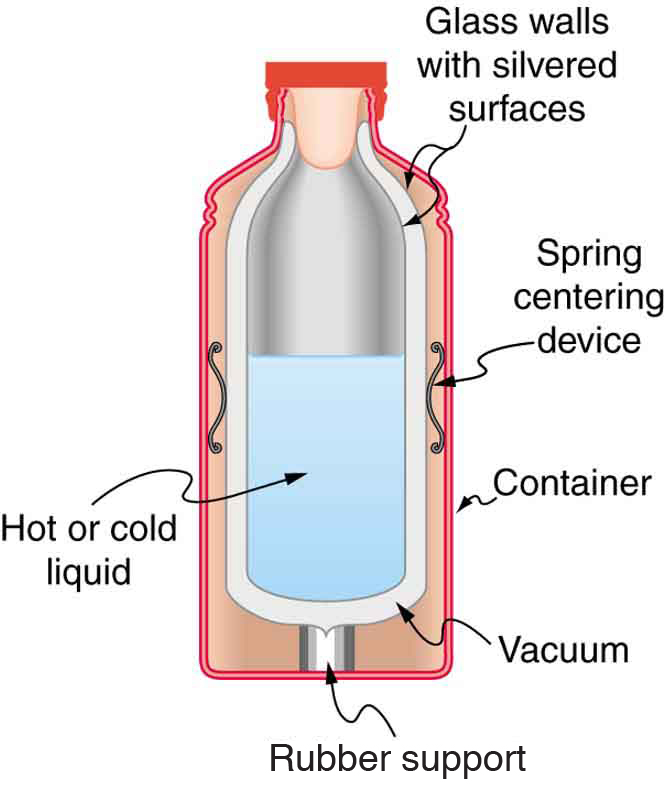
A thermos bottle has two walls separated by a vacuum, silvered surfaces that reflect infrared radiation, and a tightly fitting stopper made from a material that conducts heat poorly.
(a) How does the vacuum reduce heat transfer by conduction and convection?
(b) Why can radiation still transfer energy across the vacuum, and how do the silvered surfaces reduce this transfer?
(c) How does the stopper help reduce heat transfer?
(d) Explain why the same thermos can keep a hot drink hot and a cold drink cold.
8.6: Temperature Change and Heat Capacity
Exercise 16
What three factors affect the heat transfer that is necessary to change an object’s temperature?
Exercise 17
Equal 1.0-kg samples of water and steel each absorb 4.2 kJ, with no phase change or work done. Use specific heats of 4200 J/(kg·°C) for water and 450 J/(kg·°C) for steel. (a) Predict which sample has the larger temperature rise. (b) Calculate each rise. Explain how your results reflect specific heat.
Exercise 18
Equal masses of water at 20 °C and 60 °C are mixed in an insulated container of negligible heat capacity. (a) What is the final temperature? (b) If the mass of the cooler water were greater, would the final temperature be above or below your answer to (a)? Explain. Assume no phase change and constant specific heat.
Exercise 19
The brakes in a car increase in temperature by when bringing the car to rest from a speed . How much greater would be if the car initially had twice the speed? You may assume the car to stop sufficiently fast so that no heat transfers out of the brakes.
Exercise 20
Oakland, California, lies beside San Francisco Bay and is exposed to cool marine air. Orinda is a short distance inland, east of Oakland, with hills between it and the bay that reduce this marine influence. On a hot summer day, Orinda can be considerably warmer than Oakland. How does the large specific heat of water help explain why the nearby water moderates Oakland’s temperature? Explain why water warms more slowly than land during the day and cools more slowly as temperatures fall.
8.7: Phase Change and Latent Heat
Exercise 21
For each process, state whether the substance absorbs or releases energy as heat: (a) melting, (b) freezing, (c) vaporization, and (d) condensation. Explain briefly in terms of changes in molecular interactions.
Exercise 22
Heat is transferred into a mixture of ice and liquid water at its melting temperature. Why can the ice melt without the temperature rising? Explain where the added energy goes.
Exercise 23
Ice and liquid water are in thermal equilibrium at 0°C in an insulated container, also at 0°C, at ordinary atmospheric pressure. Will the total amount of ice increase, decrease, or remain the same? Explain. Does this mean that no molecules move between the ice and liquid water?
Exercise 24
What effect does condensation on a glass of ice water have on the rate at which the ice melts? Will the condensation speed up the melting process or slow it down?
Exercise 25
Use the heating curve in Figure 8.7.3 for the same fixed mass of water at atmospheric pressure. Rank the energy inputs required to (a) warm ice from −20 °C to 0 °C, (b) melt all the ice at 0 °C, (c) warm the liquid from 0 °C to 100 °C, and (d) vaporize all the liquid at 100 °C. Explain how the horizontal lengths of the graph support your ranking.
Exercise 26
Sweat on exposed skin can evaporate, while sweat on skin submerged in warm water cannot evaporate directly into the air. Explain why evaporation can cool the body and why this cooling mechanism is unavailable to submerged skin.
8.8: The First Law of Thermodynamics
Exercise 27
The first law of thermodynamics and the conservation of energy are clearly related. How do they differ in the types of energy considered?
Exercise 28
Heat transfer and work done are always energy in transit, whereas internal energy is energy stored in a system. Give an example of each type of energy, and state specifically how it is either in transit or resides in a system.
Exercise 29
A closed system absorbs 500 J as heat and does 200 J of work on its surroundings. (a) How does its internal energy change? (b) Starting from the same initial state, suppose instead that 200 J of work is done on it while it absorbs the same heat. How does its internal energy change now? Explain the difference.
8.9: The First Law of Thermodynamics and Heat Engine Processes
Exercise 30
A fixed amount of gas is heated in a rigid sealed container. Assume there is no work other than possible expansion or compression work. Does the gas do work? What happens to its internal energy? Explain using the first law.
Exercise 31
A fixed amount of ideal gas expands isothermally and does work on a piston. Does its internal energy change? Must energy enter or leave as heat? Explain using the first law.
Exercise 32
A fixed amount of ideal gas expands against a piston and does work while no heat is transferred. What happens to its internal energy and temperature? Explain using the first law.
Exercise 33
A real process may be nearly adiabatic if it occurs over a very short time. How does the short time span help the process to be adiabatic?
8.10: Introduction to the Second Law of Thermodynamics: Heat Engines and Their Efficiency
Exercise 34
Is a temperature difference necessary to operate a heat engine? State why or why not.
Exercise 35
During each complete cycle, a heat engine absorbs 600 J from a hot reservoir and releases 400 J to a cold reservoir. (a) How much net work does it do? (b) What is its efficiency? (c) Does the energy released to the cold reservoir disappear? Explain.
8.11: Carnot’s Perfect Heat Engine: The Second Law of Thermodynamics Restated
Exercise 36
Think about the drinking bird shown in Figure 8.11.1. If left to its own devices over time, the bird will cease “drinking”. Why does its dipping motion eventually stop?
Exercise 37
Can improved engineering and materials be employed in heat engines to reduce heat transfer into the environment? Can they eliminate heat transfer into the environment entirely?
Exercise 38
Does the second law of thermodynamics alter the conservation of energy principle?
Exercise 39
A proposed cyclic heat engine operates between reservoirs at 600 K and 300 K and absorbs 100 J from the hot reservoir each cycle. (a) What is its maximum possible efficiency? (b) Could it deliver 60 J of work per cycle? (c) Would a claim of 40 J per cycle prove that the engine actually works? Explain what the theoretical limit does and does not tell you.
8.12: Applications of Thermodynamics: Heat Pumps and Refrigerators
Exercise 40
For an ideal heat pump maintaining the same indoor temperature, why does a colder outdoor temperature require more work to deliver the same amount of energy indoors? Relate your answer to the coefficient of performance.
Exercise 41
Can you cool a kitchen by leaving the refrigerator door open?
Exercise 42
A heat pump uses 1.0 kJ of electrical work to deliver 3.0 kJ to a room. (a) How much energy does it take from outdoors? (b) What is its coefficient of performance in heating mode? (c) Explain why delivering more energy than the electrical input does not violate conservation of energy.
8.13: Entropy and the Second Law of Thermodynamics: Disorder and the Unavailability of Energy
Exercise 43
Explain how water’s entropy can decrease when it freezes without violating the second law of thermodynamics. Specifically, explain what happens to the entropy of its surroundings.
Exercise 44
Two bodies at different temperatures exchange heat inside an isolated enclosure until they reach the same temperature. What happens to their combined entropy? Why does reaching a common temperature reduce the opportunity to obtain work from them using a heat engine?
Exercise 45
A gas initially occupies one half of an insulated container; the other half is a vacuum. A partition is removed, and the gas expands freely into the empty half.
(a) Why is this process irreversible?
(b) No heat is transferred during the expansion. Does this mean that the gas’s entropy remains unchanged? Explain why substituting into , the relation for reversible heat transfer at constant temperature, would not correctly determine the entropy change in this free expansion.
8.14: Statistical Interpretation of Entropy and the Second Law of Thermodynamics: The Underlying Explanation
Exercise 46
Three distinguishable fair coins are tossed independently. (a) List the eight possible sequences of heads and tails. (b) How many sequences give exactly two heads? How many give three heads? (c) Which macrostate is more likely, and why? Explain how counting possible microscopic arrangements helps motivate the statistical interpretation of entropy.
Exercise 47
Why does a gas have greater entropy when it occupies a larger volume at the same temperature? Explain in terms of the microscopic arrangements available to its molecules.
Source sections: Temperature, The Ideal Gas Law, Heat, Heat Transfer Methods, Temperature Change and Heat Capacity, Phase Change and Latent Heat, The First Law of Thermodynamics, The First Law of Thermodynamics and Heat Engine Processes, Introduction to the Second Law of Thermodynamics: Heat Engines and Their Efficiency, Carnot’s Perfect Heat Engine: The Second Law of Thermodynamics Restated, Applications of Thermodynamics: Heat Pumps and Refrigerators, Entropy and the Second Law of Thermodynamics: Disorder and the Unavailability of Energy, Statistical Interpretation of Entropy and the Second Law of Thermodynamics: The Underlying Explanation. Credits and licenses appear with each source section.