Chapter 10: Magnetism — Review and Exercises
Chapter contents: Chapter 10: Magnetism
Glossary
AC current
an electric current that periodically reverses direction; a sinusoidal current is a common example
AC voltage
a voltage that periodically reverses polarity; a sinusoidal voltage is a common example
alternating current
(AC) the flow of electric charge that periodically reverses direction
Ampere’s law
for steady currents, a relationship between the magnetic field accumulated along a closed path and the net current passing through a surface bounded by the path
B-field
another term for magnetic field
Biot-Savart law
a law giving the magnetic-field contribution of a small segment of steady current
Curie temperature
the temperature above which a ferromagnetic material loses its spontaneous magnetization; it can still respond to an applied magnetic field
direct current
(DC) the flow of electric charge in only one direction
direction of magnetic field lines
the direction that the north end of a compass needle points
domains
regions within a material that behave like small bar magnets
electromagnet
a magnet whose magnetic field is produced by an electric current
electromagnetic induction
the process of inducing a voltage with a change in magnetic flux
Faraday’s law of induction
the means of calculating the voltage in a coil due to changing magnetic flux, given by
ferromagnetic
materials, such as iron, cobalt, nickel, and gadolinium, that exhibit strong magnetic effects
gauss
G, the unit of the magnetic field strength;
induced current
the current created by a changing magnetic field through voltage induced over a conducting path
Lenz’s law
an induced current flows in a direction whose magnetic field opposes the change in magnetic flux that induces it
magnetic field
a vector field that describes magnetic effects on moving charges, electric currents, and magnetic dipoles
magnetic field lines
imaginary curves whose tangents show the direction of the magnetic field. Closer spacing represents a stronger field
magnetic field strength
the magnitude B of the magnetic field, measured in teslas
magnetic flux
the amount of magnetic field going through a particular area, calculated with , where is the magnetic field strength perpendicular to the area
magnetic force
the force on a charge produced by its motion through a magnetic field
magnetic monopoles
an isolated magnetic pole; a south pole without a north pole, or vice versa (no magnetic monopole has ever been observed)
magnetized
having a net magnetization, with microscopic magnetic moments sufficiently aligned to produce an overall magnetic effect
motor
loop of wire in a magnetic field; when current is passed through the loops, the magnetic field exerts torque on the loops, which rotates a shaft; electrical energy is converted to mechanical work in the process
moving-coil meter
an instrument in which magnetic torque on a current-carrying coil moves a pointer, with its deflection indicating the current
north magnetic pole
the end or the side of a magnet that is attracted toward Earth’s geographic north pole
permeability of free space
the magnetic constant relating currents and magnetic fields in vacuum; approximately 4π × 10−7 T·m/A
right hand rule 1 (RHR-1)
the rule to determine the direction of the magnetic force on a positive moving charge: when the thumb of the right hand points in the direction of the charge’s velocity and the fingers point in the direction of the magnetic field , then the force on the charge is perpendicular and away from the palm; the force on a negative charge is perpendicular and into the palm
right hand rule 2 (RHR-2)
a rule to determine the direction of the magnetic field induced by a current-carrying wire: Point the thumb of the right hand in the direction of current, and the fingers curl in the direction of the magnetic field loops
rms
a type of average taken for a time-varying quantity by squaring it, taking the mean of the square, and then taking the square-root of the mean.
solenoid
a thin wire wound into a coil that produces a magnetic field when an electric current is passed through it
south magnetic pole
the end or the side of a magnet that is attracted toward Earth’s geographic south pole
step-down transformer
a transformer that decreases voltage
step-up transformer
a transformer that increases voltage
tesla
T, the SI unit of the magnetic field strength;
transformer
a device that transforms voltages from one value to another using induction
transformer equation
the equation showing that the ratio of the secondary to primary voltages in a transformer equals the ratio of the number of loops in their coils;
Section Summary
10.2: Magnets
- Magnetism is a subject that includes the properties of magnets, the effect of the magnetic force on moving charges and currents, and the creation of magnetic fields by currents.
- There are two types of magnetic poles, called the north magnetic pole and south magnetic pole.
- North magnetic poles are those that are attracted toward the Earth’s geographic north pole.
- Like poles repel and unlike poles attract.
- Magnetic poles always occur in pairs of north and south—it is not possible to isolate north and south poles.
10.3: Ferromagnets and Electromagnets
- Magnetic poles always occur in pairs of north and south—it is not possible to isolate north and south poles.
- Ferromagnetic materials, such as iron, are those that exhibit strong magnetic effects.
- The atoms in ferromagnetic materials act like small magnets (due to currents within the atoms) and can be aligned, usually in millimeter-sized regions called domains.
- Domains can grow and align on a larger scale, producing permanent magnets. Such a material is magnetized, or induced to be magnetic.
- Above a material’s Curie temperature, thermal agitation destroys the alignment of atoms, and ferromagnetism disappears.
- Electromagnets employ electric currents to make magnetic fields, often aided by induced fields in ferromagnetic materials.
- Electric currents produce magnetic fields. Within atoms, electron orbital motion and spin contribute to magnetic moments; their alignment helps explain ferromagnetism.
10.4: Magnetic Fields and Magnetic Field Lines
- Magnetic fields can be pictorially represented by magnetic field lines, the properties of which are as follows:
- The field is tangent to the magnetic field line.
- Field strength is proportional to the line density.
- Field lines cannot cross.
- Field lines are continuous loops.
10.5: Magnetic Field Strength: Force on a Moving Charge in a Magnetic Field
- The maximum force a magnetic field can exert on a moving charge is .
- The SI unit for magnetic field strength is the tesla (T), which is related to other units by
.(10.5.2)
- The direction of the force on a positive moving charge is given by right hand rule 1 (RHR-1): Point the thumb of the right hand in the direction of , the fingers in the direction of , and a perpendicular to the palm points in the direction of . For a negative charge, reverse this direction.
- The force is perpendicular to the plane formed by and . Since the force is zero if is parallel to , charged particles often follow magnetic field lines rather than cross them.
10.6: Magnetic Force on a Current-Carrying Conductor
- The magnetic force on current-carrying conductors (when current direction and magnetic field direction are perpendicular) is given by
where is the current, is the length of a straight conductor in a uniform magnetic field , and . The force follows RHR-1 with the thumb in the direction of .,(10.6.1)
10.8: Magnetic Fields Produced by Currents: Ampere’s Law
- The strength of the magnetic field created by current in a long straight wire is given by
where is the current, is the shortest distance to the wire, and the constant is the permeability of free space.(long straight wire),(10.8.1)
- The direction of the magnetic field created by a long straight wire is given by right hand rule 2 (RHR-2): Point the thumb of the right hand in the direction of current, and the fingers curl in the direction of the magnetic field loops created by it.
- The Biot-Savart law gives the magnetic-field contribution from each segment of a steady current; adding these contributions gives the total field. Ampere’s law relates the accumulated component of the magnetic field along a closed path to the net current passing through a surface bounded by that path.
- The magnetic field strength at the center of a circular loop is given by
where is the radius of the loop. This equation becomes for a flat coil of loops. RHR-2 gives the direction of the field about the loop. A long coil is called a solenoid.(at center of loop),(10.8.2)
- The magnetic field strength inside a solenoid is
where is the number of loops per unit length of the solenoid. The field inside is very uniform in magnitude and direction.(inside a solenoid),(10.8.3)
10.9: Induced Voltage and Magnetic Flux
- The crucial quantity in induction is magnetic flux , defined to be , where is the magnetic field strength perpendicular to the area .
- Units of magnetic flux are .
- Any change in magnetic flux induces a voltage—the process is defined to be electromagnetic induction.
10.10: Faraday’s Law of Induction: Lenz’s Law
- Faraday’s law of induction states that the voltage induced by a change in magnetic flux is
(10.10.1)when flux changes by in a time .
- If voltage is induced in a coil, is its number of turns.
- The minus sign means that the induced voltage creates a current and magnetic field that oppose the change in flux —this opposition is known as Lenz’s law.
10.11: Transformers
- Transformers use induction to transform voltages from one value to another.
- For a transformer, the voltages across the primary and secondary coils are related by
where and are the voltages across primary and secondary coils having and turns.,(10.11.1)
- The currents and in the primary and secondary coils are related by .
- A step-up transformer increases voltage and decreases current, whereas a step-down transformer decreases voltage and increases current.
10.12: Alternating Current versus Direct Current
- Ohm’s law for AC is .
- Expressions for the average power of an AC circuit are , , and , analogous to the expressions for DC circuits.
Questions and Exercises
10.2: Magnets
Exercise 1
Give one example of a natural phenomenon and one example of a technology involving magnetism. What role does magnetism play in each?
Exercise 2
The north-seeking end of a compass points roughly toward geographic north. Does the region near Earth’s geographic North Pole behave like the north or the south pole of a bar magnet? Explain.
Exercise 3
A bar magnet is cut into two shorter pieces. What magnetic poles would you expect each piece to have? How does this differ from separating positive and negative electric charges?
10.3: Ferromagnets and Electromagnets
Exercise 4
An unmagnetized iron nail contains magnetic domains. Why does it not necessarily act as a strong magnet? Explain what changes when the nail becomes magnetized and what can happen if it is heated above its Curie temperature.
Exercise 5
Volcanic and other such activity at the mid-Atlantic ridge extrudes material to fill the gap between separating tectonic plates associated with continental drift. The magnetization of rocks is found to reverse in a coordinated manner with distance from the ridge. What does this imply about the Earth’s magnetic field and how could the knowledge of the spreading rate be used to give its historical record?
10.4: Magnetic Fields and Magnetic Field Lines
Exercise 6
Explain why two magnetic field lines cannot cross. What would a crossing imply about the direction of the magnetic field at that point?
Exercise 7
Compare and contrast electric field lines and magnetic field lines. Describe at least two similarities and two differences. At least one similarity and one difference should concern how the fields interact with matter.
Exercise 8
Noting that the magnetic field lines of a bar magnet resemble the electric field lines of a pair of equal and opposite charges, do you expect the magnetic field to rapidly decrease in strength with distance from the magnet? Is this consistent with your experience with magnets?
Exercise 9
Is Earth’s magnetic field parallel to the ground everywhere? Where is its strength generally greatest? Explain why a compass needle constrained to rotate horizontally becomes unreliable near a magnetic pole, even though the magnetic field there is strong.
10.5: Magnetic Field Strength: Force on a Moving Charge in a Magnetic Field
Exercise 10
If a charged particle moves in a straight line through some region of space, can you say that the magnetic field in that region is necessarily zero?
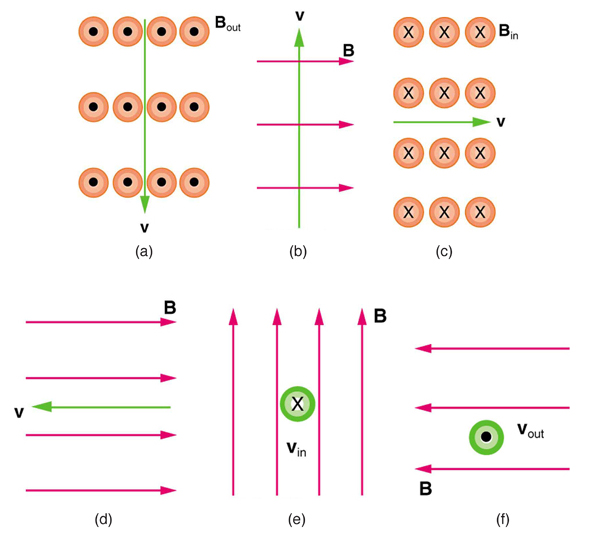
Exercise 11
What is the direction of the magnetic force on a positive charge that moves as shown in each of the six cases shown in Figure 10.E.1? Note that indicates “coming out of the page” and means “going into the page”. How would your answers change if the charge were negative?
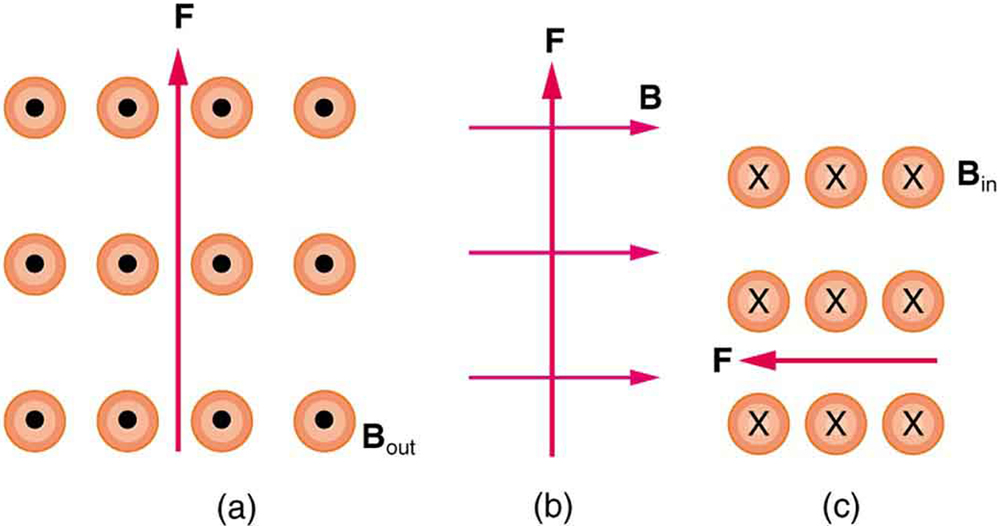
Exercise 12
What is the direction of the velocity of a negative charge that experiences the magnetic force shown in each of the three cases in Figure 10.E.2, assuming it moves perpendicular to ? Note that indicates “coming out of the page” and means “going into the page”.
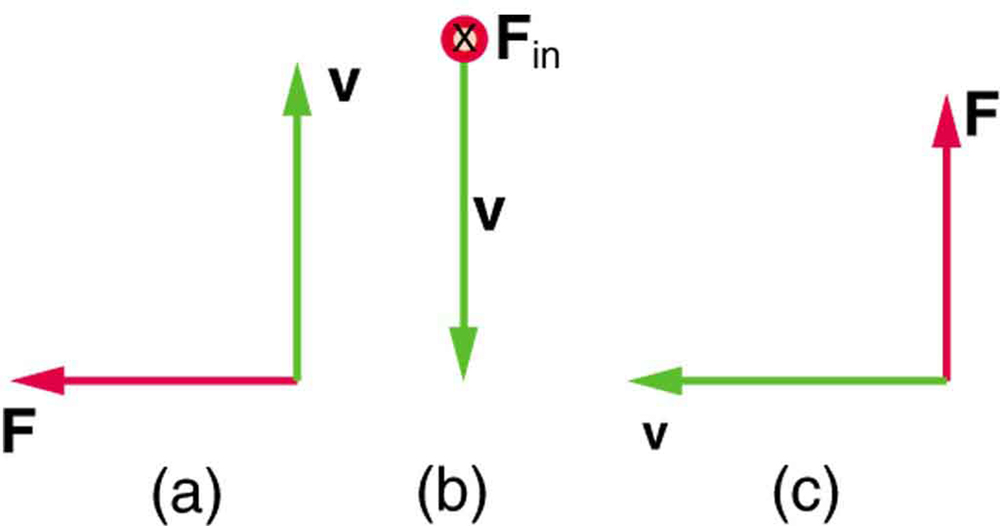
Exercise 13
What is the direction of the magnetic field that produces the magnetic force on a positive charge as shown in each of the three cases in the figure below, assuming is perpendicular to ? Note that means “going into the page”.
Exercise 14
An electron in a laboratory cathode-ray tube travels at through a magnetic field of strength . (a) What is the maximum magnetic force on the electron? (b) What is the corresponding maximum acceleration? (c) When the electron’s velocity is perpendicular to the magnetic field, it follows a circular path. What is the radius of that path? Use an electron charge magnitude of and an electron mass of .
Exercise 15
(a) Aircraft sometimes acquire small static charges. Suppose a supersonic jet has a charge and flies due west at a speed of 660 m/s over the Earth’s magnetic south pole (near Earth’s geographic north pole), where the magnetic field points straight down. What are the direction and the magnitude of the magnetic force on the plane? (b) Discuss whether the value obtained in part (a) implies this is a significant or negligible effect.
10.6: Magnetic Force on a Current-Carrying Conductor
Exercise 16
Draw a sketch of the situation in Figure 10.6.1 showing the direction of electrons carrying the current, and use RHR-1 to verify the direction of the force on the wire.
Exercise 17
Verify that the direction of the force in an MHD drive, such as that in Figure 10.6.3, does not depend on the sign of the charges carrying the current across the fluid.
Exercise 18
Why would a magnetohydrodynamic drive work better in ocean water than in fresh water? Also, why would superconducting magnets be desirable?
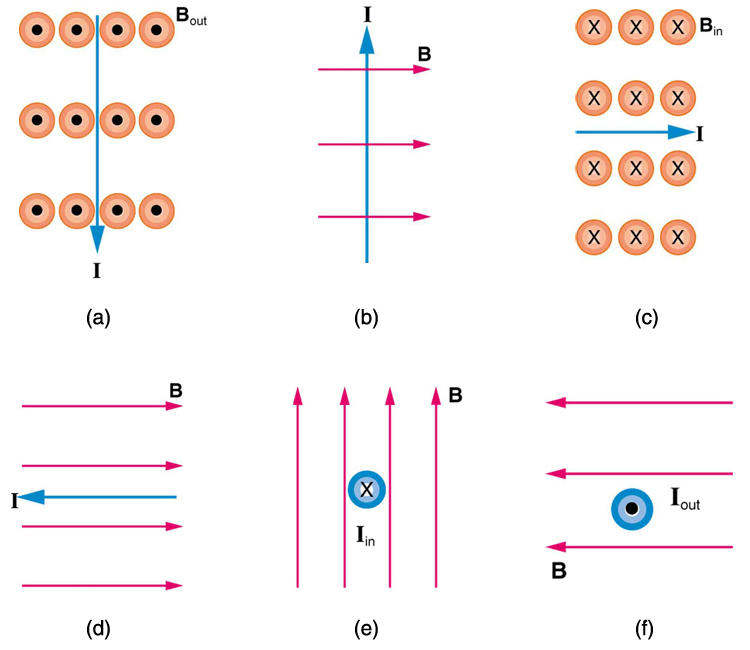
Exercise 19
What is the direction of the magnetic force on the current in each of the six cases in Figure 10.E.4? Note that indicates “coming out of the page” and means “going into the page”.
Exercise 20
(a) A DC power line for a light-rail system carries 1000 A.
If Earth’s magnetic field at this location is T, what is the maximum possible magnetic force on a 100-m section of this line? (b) Discuss practical concerns this presents, if any.
Exercise 21
The knocking sounds heard during an MRI scan come largely from vibrations of current-carrying gradient coils in the scanner’s main magnetic field. At one instant, a straight 5.0-cm segment of wire in a gradient coil carries a current of 100 A perpendicular to a 1.5-T magnetic field. What is the magnitude of the magnetic force on this segment at that instant?
Exercise 22
A wire carrying a 30.0-A current passes between the poles of a strong magnet that is perpendicular to its field and experiences a 2.16-N force on the 4.00 cm of wire in the field. What is the average field strength?
10.7: Motors and Meters
Exercise 23
How can magnetic forces on opposite sides of a current-carrying loop make the loop rotate? Why must the current reverse every half-turn in the simple motor described in this section?
10.8: Magnetic Fields Produced by Currents: Ampere’s Law
Exercise 24
A straight wire carries a current toward you, out of the page. Sketch the magnetic field lines around the wire and indicate their direction. What changes if the current reverses?
Exercise 25
(a) Describe the magnetic field pattern around a long, straight current-carrying wire.
(b) Describe the magnetic field pattern around a single circular current loop. How does it resemble the field of a bar magnet?
(c) Describe the magnetic field inside a long solenoid, away from its ends.
10.9: Induced Voltage and Magnetic Flux
Exercise 26
In Faraday’s two-coil apparatus, why does the galvanometer briefly register a current when the switch is closed, but return to zero while the switch remains closed? What happens when the switch is opened again?
Exercise 27
When a magnet is thrust into a coil as in Figure 10.9.2(a), what is the direction of the force exerted by the coil on the magnet? Draw a diagram showing the direction of the current induced in the coil and the magnetic field it produces, to justify your response. How does the magnitude of the force depend on the resistance of the galvanometer?
Exercise 28
Explain how magnetic flux can be zero when the magnetic field is not zero.
Exercise 29
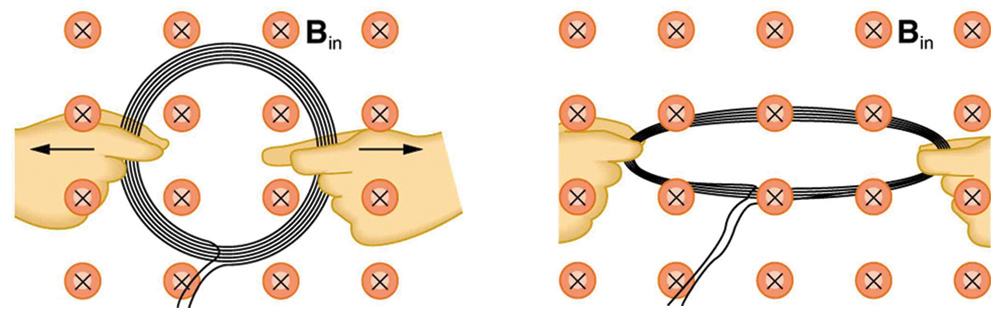
Is a voltage induced in the coil in Figure 10.E.5 when it is stretched? If so, state why and give the direction of the induced current.
10.10: Faraday’s Law of Induction: Lenz’s Law
Exercise 30
A coil rotates in a steady magnetic field and supplies a current to a connected resistor. Explain why a voltage can be induced even though the magnetic field is steady. Where does the energy dissipated in the resistor come from?
Exercise 31
A closed conducting loop is held fixed while the magnetic field through it increases in strength without changing direction. What is the direction of the magnetic field produced by the induced current relative to the applied field? How does your answer change when the applied field decreases instead?
Exercise 32
A strong magnet falls through a vertical copper tube much more slowly than it falls through an otherwise similar plastic tube. Copper is not ferromagnetic, but it conducts electricity. Currents induced in the body of a conductor are called eddy currents.
(a) Explain why the falling magnet induces currents in the copper tube.
(b) Use Lenz’s law to explain why these currents slow the magnet’s fall.
(c) As the magnet falls, some of its gravitational potential energy becomes kinetic energy. Where does the rest go?
10.11: Transformers
Exercise 33
A real transformer delivers less electrical power than it receives. Explain how electrical resistance in the coils and eddy currents induced in the iron core contribute to this inefficiency. Why does constructing the core from thin iron sheets separated by insulating layers reduce energy loss?
Exercise 34
A transformer increases the voltage used to transmit a given amount of electrical power. How does this affect the current in the transmission lines? Explain why this reduces energy loss in lines whose resistance stays the same.
Exercise 35
An ideal plug-in transformer supplies 9.00 V to a video game system. (a) How many turns are in its secondary coil if its input voltage is 120 V and the primary coil has 400 turns? (b) What is its input current when its output current is 1.30 A?
Exercise 36
A traveler carries a transformer to convert a 240-V AC supply to 120 V for an appliance. Treat the transformer as ideal. (a) What is the ratio of turns in its primary and secondary coils? (b) What is the ratio of input to output current? (c) How could the same transformer be used to obtain 240 V from a 120-V AC supply?
10.12: Alternating Current versus Direct Current
Exercise 37
Why is alternating current widely used in electric power grids? Explain the role of transformers in transmitting power at high voltage and supplying it to users at lower voltage.
Exercise 38
Why do voltage, current, and power go through zero 120 times per second for 60-Hz AC electricity?
Exercise 39
Under some indoor lights, a hand or meter stick moved rapidly back and forth appears in a series of separated positions rather than as a continuous blur, even though the light seems steady when you look at a stationary object. Explain this effect.
Exercise 40
Military aircraft use 400-Hz AC power, because it is possible to design lighter-weight equipment at this higher frequency. What is the time for one complete cycle of this power?
Exercise 41
A North American tourist takes his 25.0-W, 120-V AC razor to Europe, finds a special adapter, and plugs it into 240 V AC. Assuming constant resistance, what power does the razor consume as it is ruined?
Exercise 42
In this problem, you will verify statements made at the end of the power losses for Example 10.12.1. (a) What current is needed to transmit 100 MW of power at a voltage of 25.0 kV? (b) Find the power loss in a transmission line. (c) What percent loss does this represent?
Exercise 43
An office-building air conditioner operates on a 208 V rms AC supply and consumes an average electrical power of 50.0 kW. (a) Treating the air conditioner as a resistor, estimate its rms current. (b) What is the cost of running the air conditioner for 8.0 hours per workday over 22 workdays in a hot summer month? Assume an electricity price of 35.0 cents per kilowatt-hour.
Exercise 44
What is the average power consumption of a 120-V AC microwave oven that draws 10.0 A?
Exercise 45
A 500-W room heater operates on a 120 V rms AC supply. (a) What is the rms current through the heater? (b) If its heating element is made of nichrome wire, what resistance must the wire have to produce this power?
Exercise 46
Two different electrical devices have the same power consumption, but one is meant to be operated on 120-V AC and the other on 240-V AC. (a) What is the ratio of their resistances? (b) What is the ratio of their currents? (c) Assuming its resistance is unaffected, by what factor will the power increase if a 120-V AC device is connected to 240-V AC?
Source sections: Magnets, Ferromagnets and Electromagnets, Magnetic Fields and Magnetic Field Lines, Magnetic Field Strength: Force on a Moving Charge in a Magnetic Field, Magnetic Force on a Current-Carrying Conductor, Motors and Meters, Magnetic Fields Produced by Currents: Ampere’s Law, Induced Voltage and Magnetic Flux, Faraday’s Law of Induction: Lenz’s Law, Transformers, Alternating Current versus Direct Current. Credits and licenses appear with each source section.